Start with 15–20 minutes a day. That’s the whole secret. Mix five minutes of pronunciation drills, ten minutes of vocabulary with spaced repetition, and five minutes of active listening, and you’ll build a real foundation faster than any weekend binge session. TV5MONDE offers free graded video exercises you can use from day one. RFI FrançaisFacile pairs short news clips with transcripts and exercises. And Singwithcanary adds song-based karaoke drills that make pronunciation practice feel less like homework. For benchmarks, DELF/DALF are the internationally recognized proficiency exams that give your progress a concrete target.
Your daily micro-plan to copy right now:
- 5 min: Repeat 5–10 French sounds aloud (nasal vowels, the French “r,” silent endings)
- 10 min: Review 20–30 core words using spaced repetition (Anki or a similar SRS tool)
- 5 min: Listen to one short audio clip and answer one comprehension question.
That’s it. Doing that regularly over a few months will help you cover the A1 foundations effectively.
Key Takeaways
A 15–20 minute daily routine mixing pronunciation, spaced repetition vocabulary, and active listening is the most reliable path to A1 French in 12 weeks.
| Point | Details |
|---|---|
| Start with a placement test | Use AUF or Institut français to find your real level before choosing materials. |
| Follow the 12-week block plan | Weeks 1–4 build foundations; weeks 5–8 consolidate; weeks 9–12 focus on speaking output. |
| Use a 3:1 active-to-passive ratio | Three active drills (recall, speaking, pronunciation) for every one passive listening session. |
| Record yourself weekly | A 30–60 second recording each week is the fastest way to hear and fix pronunciation gaps. |
| Singwithcanary for music practice | One song-based session per week adds ear training and pronunciation repetition that news clips don’t provide. |
Table of Contents
- How to build your French study plan from week 1 to week 12
- Which resources are actually worth your time?
- How to train your ear and get your pronunciation right
- Ready-to-use phrases, verbs, and quick drills
- How to stay consistent when you’re studying alone
- Why songs and news are the combination most learners overlook
- Singwithcanary makes music-based French practice actually stick
- Sources
How to build your French study plan from week 1 to week 12
A 12-week roadmap keeps you from spinning your wheels. The structure below is built around three four-week blocks, each with a clear focus and measurable output.
Weeks 1–4: Foundations
Focus entirely on phonetics, the 100 highest-frequency words, and the two most important verbs in French: être (to be) and avoir (to have). Add greetings, numbers 1–10, basic pronouns, and the indefinite/definite articles (un/une, le/la/les). A free A1 course structured across 36 lessons shows that 15 minutes of daily practice is enough to build a solid A1 foundation at this stage.
Weekly targets:
- 100 core words in SRS by end of week 4
- 30 useful phrases (greetings, introductions, simple questions)
- 5 recorded self-speaking attempts (even 30 seconds each counts)
Weeks 5–8: Consolidation
Add present-tense regular verbs (-er, -ir, -re), basic question structures (Où est…? Qu’est-ce que…?), colors, common nouns, and simple adjective agreement. Start replacing one vocabulary session per week with a listening drill from TV5MONDE’s graded exercises or an RFI news clip. Begin building short sentences from the words you already know.
Weekly targets:
- 200 total words in active recall
- 3 short paragraphs written about yourself (present tense only)
- One 5-minute listening session with comprehension check
Weeks 9–12: Production and interaction
This block is about output. Speak more than you read. Record yourself answering simple questions, then compare your pronunciation against a native audio source. Add the passé composé (past tense with avoir/être) and the near future (aller + infinitive). Take a free placement test from the Institut français or the AUF level-check tool to confirm your level before moving to A2 materials.
Weekly targets:
- 5 recorded speaking attempts, each 1–2 minutes long
- One full RFI news item listened to twice (once for gist, once for detail)
- A DELF A1 mock test to benchmark progress
Which resources are actually worth your time?
The internet has thousands of French learning tools. Most of them overlap. Here’s a short, honest list of what covers the ground you actually need, and how to use each one without wasting time.
Free institutional resources:
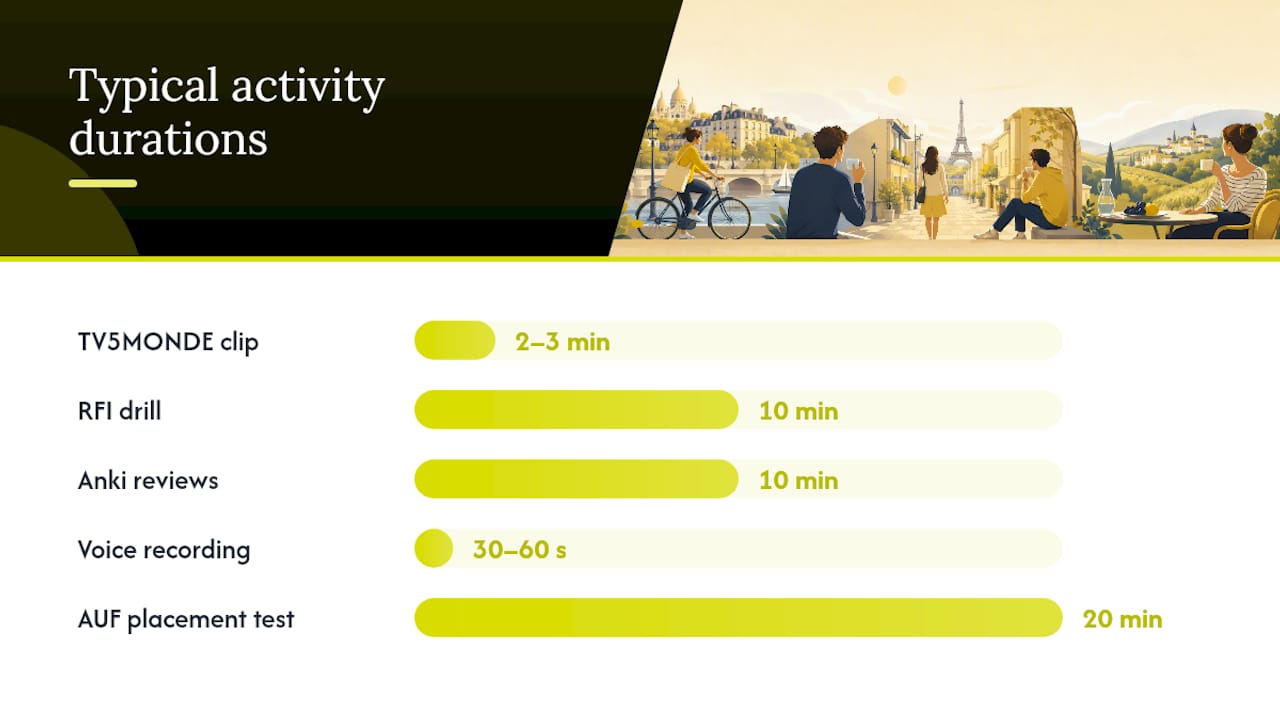
- TV5MONDE: Over 2,000 graded video exercises from A1 to C1. Use it for daily micro-listening. Pick a 2–3 minute clip at your level, watch once without subtitles, then again with them. Answer the built-in questions.
- Institut français: Offers placement tests, certified DELF/DALF exams, and structured courses. Use their placement test at the start of week 1 and again after week 12.
- AUF placement test: Free, quick, and accurate. Takes about 20 minutes and tells you exactly where to start.
- LeccionFrancesFacil: A Spanish-language portal with progressive grammar and vocabulary lessons. Particularly useful for Spanish speakers because explanations are in Spanish, which cuts early confusion.
Study tools:
- Anki (SRS): Build a deck of 20–30 new words per week. Set reviews to 10 minutes daily. Never skip review days, even when you skip new cards.
- Voice memos / recording app: Record yourself speaking for 30–60 seconds, then listen back. This is uncomfortable at first and exactly why it works.
- Lara Translate: Useful for quick French-to-Spanish checks when you encounter an unfamiliar word in a reading or listening exercise. Don’t use it as a crutch, but it’s faster than a dictionary for context-checking during study.
Music-based practice:
- Singwithcanary: Song lyrics, karaoke-style pronunciation drills, vocabulary cards, and quizzes built around real French songs. One song session per week replaces a standard listening drill and adds ear training that graded news clips can’t replicate. More on this below.
The trade-off between structured courses and self-study playlists is real. Courses give you a sequence; playlists give you flexibility. For most beginners, a structured A1 course for the first eight weeks, combined with daily SRS and one listening session, beats either extreme alone.
How to train your ear and get your pronunciation right
Pronunciation is where Spanish speakers most often stall. French has sounds that simply don’t exist in Spanish, and ignoring them early means building habits that are hard to undo later.
The three biggest problem areas for Spanish speakers:
- Nasal vowels (an, en, in, on, un): French nasalizes vowels before “n” or “m” in ways Spanish never does. Practice by holding your nose lightly and feeling the resonance shift.
- The French “r”: It’s produced at the back of the throat (uvular), not the front like the Spanish rolled “r.” Start by gargling water, then try to make the same sound dry.
- Silent endings: Most French word endings are silent. Ils parlent sounds like il parle. Train yourself to read the spelling and hear the spoken form as two separate things.
Practical drills that work:
- Shadowing: Play a 30-second audio clip, pause it, and repeat the exact phrase immediately. Focus on rhythm and intonation, not just individual sounds. Use this step-by-step pronunciation guide to target specific sounds systematically.
- Minimal pairs: Practice word pairs that differ by one sound (vin/vent, peu/peur) until you can hear and produce the difference reliably.
- Slowed audio then normal speed: Many podcast apps let you play at 0.75x speed. Listen slow, then replay at normal speed. The contrast sharpens your ear fast.
- Record and compare: Record yourself saying a phrase, then play the native version. The gap between them is your practice target.
For listening comprehension, follow this progression: daily 1–3 minute clips (TV5MONDE beginner videos) → graded news podcasts (RFI) → French songs with lyrics. The song layer is where ear training for French gets genuinely interesting, because melody forces you to hear syllable stress and liaison in ways that spoken dialogue doesn’t.
Pro Tip: Pick one French song you like and use it as a weekly pronunciation session. Read the lyrics first, identify three words you can’t pronounce, drill those words in isolation, then sing along. Singwithcanary’s karaoke feature makes this structured and trackable rather than a casual singalong.

Ready-to-use phrases, verbs, and quick drills
Here’s the core material for your first four weeks. No searching required.
Greetings and polite phrases:
- Bonjour (Hello) / Bonsoir (Good evening) / Salut (Hi, informal)
- Comment vous appelez-vous? (What’s your name?) / Je m’appelle… (My name is…)
- S’il vous plaît (Please) / Merci (Thank you) / De rien (You’re welcome)
- Excusez-moi (Excuse me) / Je ne comprends pas (I don’t understand)
Numbers 1–10: un, deux, trois, quatre, cinq, six, sept, huit, neuf, dix
Basic colors: rouge (red), bleu (blue), vert (green), jaune (yellow), blanc (white), noir (black), gris (gray)
10 high-frequency nouns: la maison (house), le temps (time/weather), l’eau (water), le travail (work), la personne (person), l’ami/l’amie (friend), le jour (day), la ville (city), le livre (book), la chose (thing)
Present-tense conjugation: être and avoir
| Pronoun | être (to be) | avoir (to have) |
|---|---|---|
| Je | suis | ai |
| Tu | es | as |
| Il/Elle | est | a |
| Nous | sommes | avons |
| Vous | êtes | avez |
| Ils/Elles | sont | ont |
Sample sentences: Je suis étudiant. (I am a student.) / Tu as un livre. (You have a book.) / Nous sommes à Paris. (We are in Paris.)
For French verb groups and conjugation patterns beyond être and avoir, a dedicated grammar reference will save you time once you hit week 5.
Quick drills you can do alone:
- Write-and-say: Write a sentence from the table above, say it aloud three times, then cover it and write it from memory.
- Replace-the-word: Take Je suis étudiant and swap the noun: Je suis professeur, Je suis américain. Do this with five different nouns.
- Record-and-compare: Say the sample sentences into your phone, then check your pronunciation against a native audio source (Forvo or a TV5MONDE clip).
To convert these lists into SRS flashcards: put the French word or phrase on the front, the Spanish equivalent on the back, and add a sample sentence. Review daily. After two weeks, flip the cards and practice producing French from Spanish prompts.
How to stay consistent when you’re studying alone
The biggest threat to solo French learning isn’t difficulty. It’s the week where “I’ll catch up on the weekend” becomes “I’ll start fresh next month.” Consistency at a low volume beats intensity in bursts every time.
Minimum viable routine:
- 10 minutes on a bad day still moves you forward. SRS review alone counts.
- 20 minutes on a normal day: 10 min SRS + 5 min listening + 5 min speaking aloud.
- 30–40 minutes on a good day: Add a grammar drill or a full RFI news item.
Practical habits that hold:
- Attach French practice to something you already do daily (morning coffee, commute, lunch break).
- Use a 3:1 ratio: three active drills (vocab recall, pronunciation, short speaking) for every one passive activity (watching, reading). Passive exposure alone doesn’t build production skills.
- Set micro-goals, not vague ones. “Learn 20 new words this week” is trackable. “Get better at French” is not.
- Do a monthly self-check: retake the AUF placement test or complete a DELF A1 mock test. Seeing your score move is the most reliable motivation tool there is.
Common mistakes and quick fixes:
- Trying to learn everything at once: Fix it by following the 12-week block structure above. One focus per block.
- Skipping pronunciation: Fix it by recording yourself once a week, no exceptions. You can’t improve what you don’t hear.
- Only consuming, never producing: Fix it by ending every study session with at least one spoken sentence, even if it’s just Je m’appelle [name] et j’ai [age] ans.
For more habit-building ideas, this activity list covers creative ways to keep practice from feeling like a chore.
Why songs and news are the combination most learners overlook
Most learners treat listening as a passive activity. They put on a French podcast while cooking and call it study time. That’s not wrong, but it’s not enough. The research-backed approach pairs short, focused listening with active production immediately after, and that’s where the combination of news and music earns its keep.
My own routine runs like this: three mornings a week, I spend five minutes with an RFI news clip, reading the transcript once, then listening twice without it. On two other days, I use a French song on Singwithcanary, working through the lyrics line by line, drilling the three hardest phrases, and then singing the full verse. The difference between those two session types is real. News builds comprehension and vocabulary in context. Songs build rhythm, intonation, and the kind of muscle memory that makes pronunciation feel natural rather than calculated.
The habit that made the biggest difference: a weekly recorded speaking check. Every Sunday, I record myself answering the same three questions in French (Comment tu vas? Qu’est-ce que tu as fait cette semaine? Qu’est-ce que tu aimes faire?). Listening back to recordings from four weeks ago against the current one is more motivating than any streak counter. Learning French with music naturally is the framework that made this workflow click for me, and Singwithcanary is the platform that keeps it structured enough to repeat without thinking.
Singwithcanary makes music-based French practice actually stick
Most French learners eventually hit the same wall: grammar drills feel mechanical, and passive listening doesn’t produce speaking confidence. Singwithcanary is built for exactly that gap. Instead of another vocabulary list, you get real French songs with karaoke-style pronunciation drills, vocabulary cards tied to lyrics, quizzes, and ear training exercises that make the words stick because they’re attached to melody and rhythm.
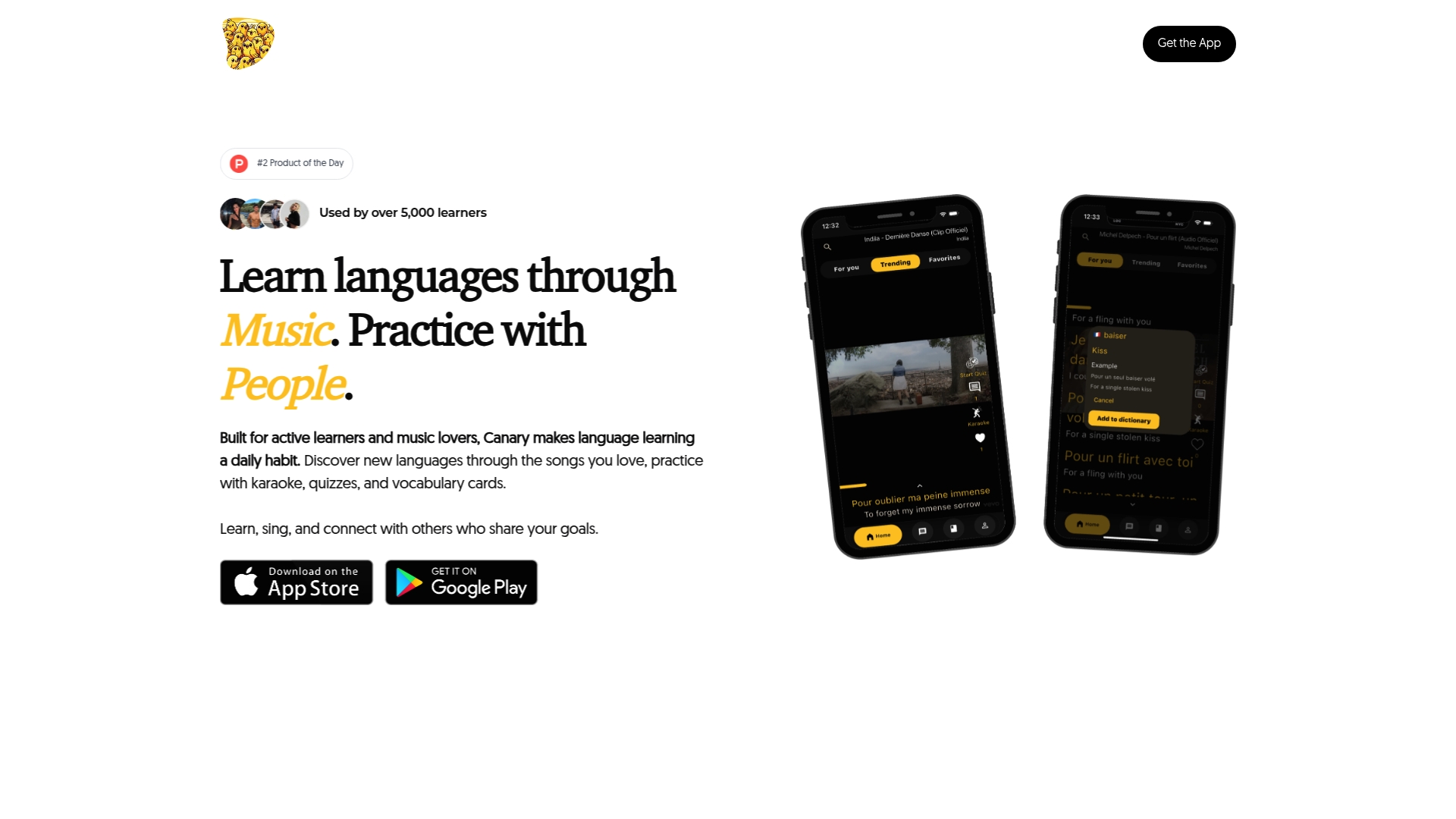
For a beginner following the 12-week plan above, one Singwithcanary song session per week replaces a standard listening drill and adds something no news clip can: the repetition of a chorus. You’ll hear the same phrase eight times in three minutes, in natural spoken rhythm, with immediate feedback on your pronunciation. The platform is freemium, so you can start with a free account and see whether song-based practice fits your routine before committing to anything. If you want a structured first session, the Song of the Week gives you a ready-made drill with no setup required.
Sources
These are the highest-value official resources for French learners. Each one is free and reliable.
- Aprender Francés | Institut Français
- Aprende francés como lengua extranjera gratis. Cursos de francés con TV5MONDE
- Curso de francés A1 inmersivo gratis (36 lecciones) - Francés 100% GRATIS online
- Apprendre