TL;DR:
- Using music for pronunciation practice leverages rhythm, stress, and connected speech to accelerate mastery more effectively than passive listening. Shadowing and recording enhance self-awareness and engagement, transforming pronunciation into an enjoyable, rhythmic activity. Regular, song-based exercises significantly improve speech naturalness and can be complemented with targeted feedback and progress tracking.
You’ve drilled flashcards, replayed audio exercises, and practiced vowel sounds in front of a mirror. Yet the moment you speak, something feels off. Your words don’t flow the way a native speaker’s do. Learning how to improve pronunciation with music changes that equation entirely. Songs give you rhythm, stress patterns, and natural connected speech all at once, packaged in something your brain actually wants to engage with. This article walks you through exactly how to make it work, from the right mindset going in to the specific techniques that deliver real results.
Table of Contents
- Key takeaways
- How to improve pronunciation with music: what to know first
- Step-by-step guide to using songs for pronunciation
- Common mistakes that slow your progress
- Tracking progress and making it last
- My honest take on music and pronunciation
- Take your pronunciation further with Singwithcanary
- FAQ
Key takeaways
| Point | Details |
|---|---|
| Music lowers learning anxiety | Framing pronunciation as a musical challenge reduces stress and helps you produce more natural speech. |
| Shadowing beats passive listening | Actively mimicking what you hear in songs drives far greater pronunciation gains than simply playing music in the background. |
| Connected speech is the real goal | Focus on how words link and blur together in songs, not how to say each word in isolation. |
| Short sessions compound fast | Two to three brief practice sessions per week produce measurable gains in vocal skills over time. |
| Recording yourself is non-negotiable | Playback reveals specific pronunciation gaps that your ear misses in real time. |
How to improve pronunciation with music: what to know first
Before you press play on your first practice song, a few fundamentals will determine whether this works or stalls.
Mindset matters more than you think. Music lowers the affective filter, which is the psychological barrier that makes learners freeze up when speaking. When you treat pronunciation as a musical challenge rather than a test, your brain relaxes enough to actually absorb new patterns. That shift alone changes outcomes.
Get your tools ready before you start:
- Access to streaming music with accurate lyrics (verified lyric sites beat auto-generated ones)
- A recording device, your phone works perfectly
- A notebook or app for logging sounds you want to target
- Headphones that let you hear vocal detail clearly
Understand what music actually teaches your mouth. Songs are not just vocabulary in melody form. They demonstrate rhythm (which syllables land on the beat), word stress (which syllable in a word carries weight), and intonation (how your pitch rises and falls across a phrase). All three are features that written grammar rules simply cannot teach you. Native speakers absorb these patterns from childhood through constant musical exposure. You can replicate that process deliberately.
One technique worth knowing early is shadowing, where you speak along with audio in real time, matching the speaker’s speed, rhythm, and stress. Research shows shadowing improves pronunciation scores significantly across multiple studies, with mean gains reaching as high as 86% after several sessions. Songs are one of the best shadowing sources available because the melody slows and stretches sounds in ways that make them easier to isolate and copy.
You should also be aware of Melodic Intonation Therapy, or MIT. Originally developed for patients recovering from aphasia, MIT uses melody, rhythm, and rhythmic hand tapping to activate right-hemisphere brain regions and improve speech production. The principles apply directly to language learners: singing phrases engages motor regions that pure repetition does not reach.
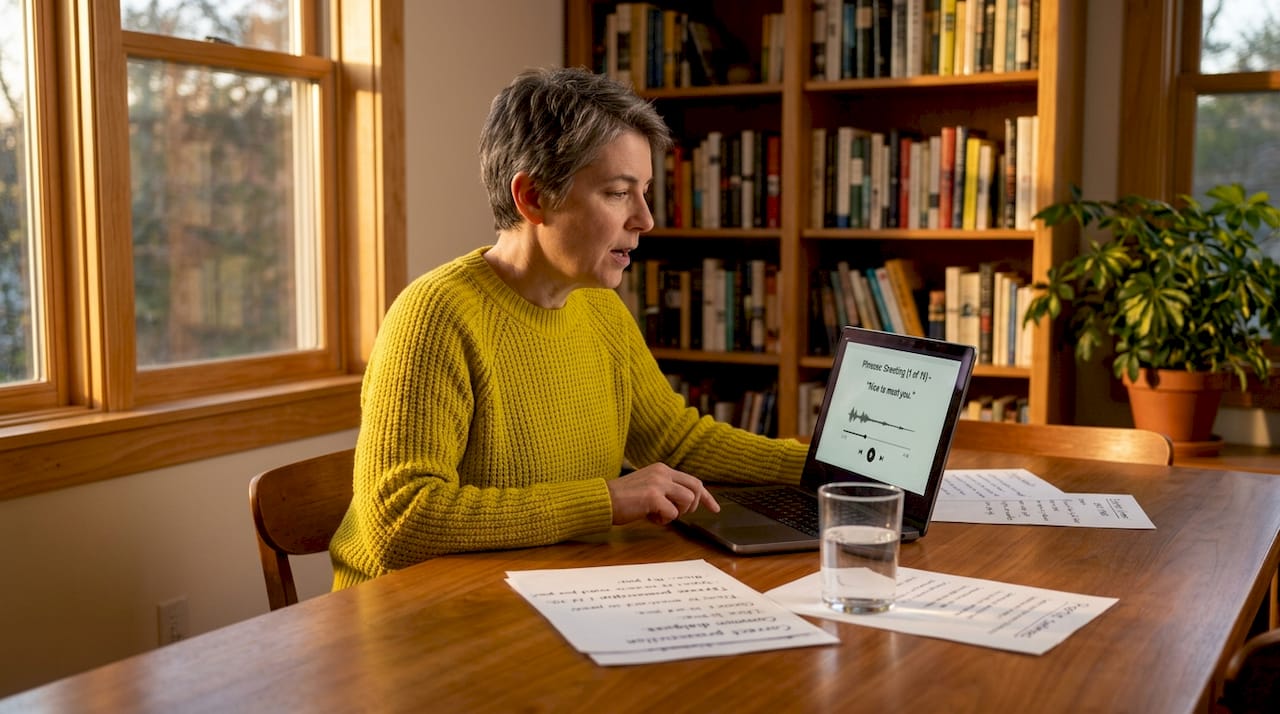
Pro Tip: Before starting any song-based session, tap a steady beat with your left hand while saying a target phrase. This activates motor cortex areas near your speech control centers and primes your brain for better output.
Step-by-step guide to using songs for pronunciation
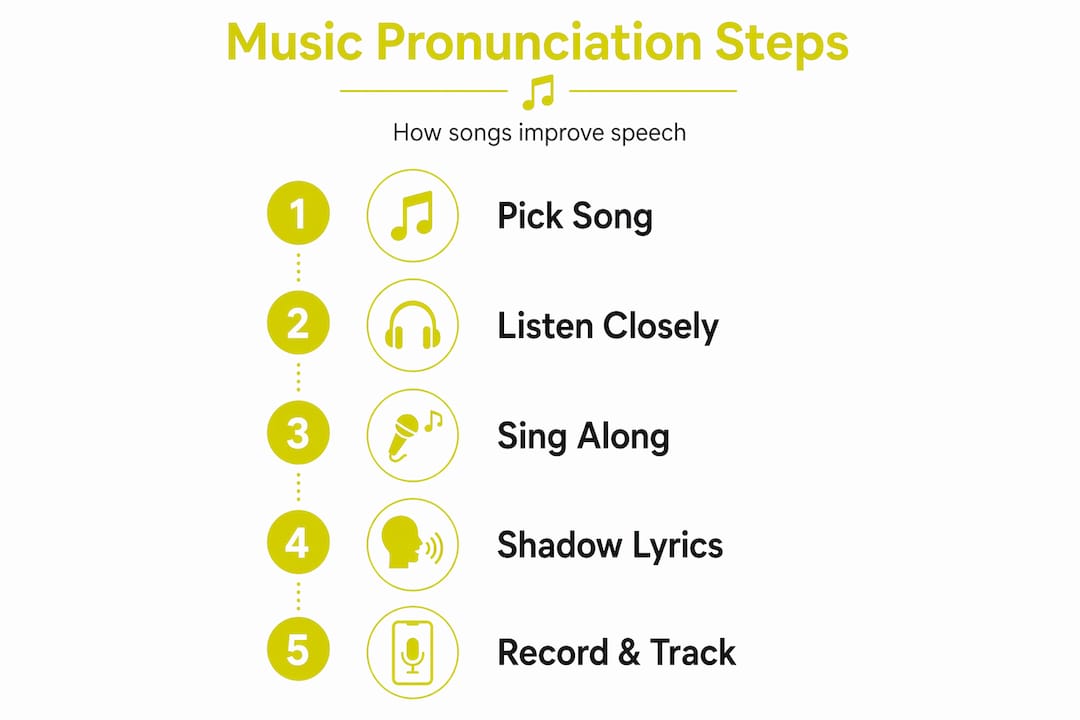
This is where the actual work happens. Follow these steps in order and you will move faster than any drill-based approach.
-
Choose a song at the right level. Start with slower songs that have clear vocals and minimal background noise. Pop ballads and acoustic tracks work well for beginners. Faster rap or heavily produced tracks come later. Pick a song you genuinely enjoy. Motivation is part of the method.
-
Listen once without the lyrics. Just absorb the overall feel, the tempo, the mood. Notice where the singer’s voice rises and falls, and which words feel emphasized. This passive first listen trains your ear before your mouth gets involved.
-
Read the lyrics and mark stress patterns. Print or pull up the lyrics and underline the syllables that land on a strong beat. Notice where two words blend together, like “going to” becoming “gonna” or “want to” becoming “wanna.” These reductions are not lazy speech. They are exactly how native speakers talk, and active singing helps you internalize them.
-
Listen again and shadow the vocal line. Play the song and speak along with the singer in real time. Do not worry about singing beautifully. Match the rhythm, the emphasis, and the way syllables connect. If a section is too fast, find a slower version or use an app that reduces playback speed.
-
Isolate one line and repeat it ten times. Pick a line that contains a sound you struggle with. Loop just that section. Sing it along with the track, then try it without the track. Record both versions.
-
Use the fade-out method. Play the full song but gradually lower the volume over multiple repetitions until you are speaking entirely from memory. This mirrors the progression MIT uses, moving from full support to independent production.
-
Record and compare. Play back your recording next to the original. Listen for specific differences, not overall quality. Note which vowel sounds drift, which consonants disappear, and where your rhythm breaks from the singer’s. Recording combined with self-assessment builds the kind of self-awareness that accelerates improvement faster than any teacher correction alone.
Pro Tip: Try song-based pronunciation practice with songs from your target language’s charts, not just English-language hits. The rhythm and stress patterns differ significantly between languages, and working with native-language songs exposes you to the exact prosody patterns you need.
Common mistakes that slow your progress
Even motivated learners hit walls. Most of those walls come from the same handful of errors.
-
Hyperarticulating every word. Many learners focus so hard on “correct” pronunciation that they say each word in careful isolation. Native speakers do not do this. Words link, blend, and reduce constantly. When you mimic a singer, you are actually practicing connected speech patterns without realizing it. That is the goal.
-
Only passive listening. Playing music while you cook or commute has real benefits for ear training. But it will not move your pronunciation forward on its own. The gains come from active engagement: singing along, marking lyrics, recording yourself.
-
Getting discouraged by your singing voice. This is not a singing lesson. You are not auditioning for anything. If your pitch is imperfect, that is completely irrelevant to the pronunciation work you are doing. Keep your focus on rhythm, stress, and how your mouth forms sounds. Pitch can drift. Articulation matters.
-
Repeating the same song until you are bored. Repetition is necessary, but you need variety across songs to encounter a wide range of sounds and patterns. Once you feel comfortable with a track, move to something new while still reviewing previous material weekly.
-
Skipping daily integration. Pronunciation practice only sticks when it happens regularly. Brief but consistent sessions of ten minutes, two or three times a week, outperform a single two-hour weekend session every time. Tie your practice to something already in your routine: your morning coffee, your commute, or the last ten minutes before bed.
Tracking progress and making it last
Progress in pronunciation is real, but it is gradual enough that it feels invisible without a tracking system. Here is how to measure what is actually changing.
| Milestone | How to measure it | When to move on |
|---|---|---|
| Mastering specific sounds | Record target phrases weekly and compare | When 3 recordings in a row sound consistent |
| Nailing a full song’s rhythm | Shadow the track without pausing | When you stay in sync at full speed |
| Natural connected speech | Compare your recording to the original | When a listener cannot identify the point of difference |
| Advancing song complexity | Attempt a faster-tempo track | When current song feels effortless |
Setting goals at this level of specificity prevents the vague sense of “am I even improving?” that kills motivation. Instead of telling yourself you want to “get better at pronunciation,” you target one sound, one phrase, one song. That specificity is what makes music-based language learning measurable.
Complementary tools that amplify your results include working with a language exchange partner who can give you honest feedback on recordings. You can also bring your recorded comparisons to a teacher and ask for targeted correction on the specific gaps you have identified.
Celebrate the small wins, too. The first time a sound you have been working on clicks into place, that moment is worth acknowledging. Confidence built on real, earned progress carries into real conversations in ways that forced positive thinking never does.
My honest take on music and pronunciation
I have worked with language learners at every level, and the ones who make the fastest pronunciation gains share one thing: they stopped treating practice as a chore and started treating it as something closer to play.
Music does that. I have seen learners who were paralyzed by the fear of sounding wrong completely unlock when they picked up a song they loved. The music engages different brain pathways than ordinary speech, and there is something about the rhythm that seems to bypass the internal critic that makes speaking a second language so stressful.
What I find most interesting is the physical side of it. When I started tapping rhythms while practicing phrases, my speech became noticeably more fluid. I was not expecting that. But it aligns with what MIT research shows about motor cortex activation through tapping contributing to speech output. Your hands and your mouth are more connected than most learners realize.
My one pushback on how most people use music for pronunciation: they treat it as supplemental, something to do after the “real” practice. I think it should be the anchor of your practice. Build everything else around it.
— Ben
Take your pronunciation further with Singwithcanary
If this approach resonates with you, Singwithcanary is built around exactly this method. The platform combines song-based language learning with interactive features like karaoke-style practice, vocabulary cards tied directly to lyrics, and pronunciation quizzes that give you immediate feedback. You are not just listening passively. You are engaging with real songs and real language in the way this article describes.
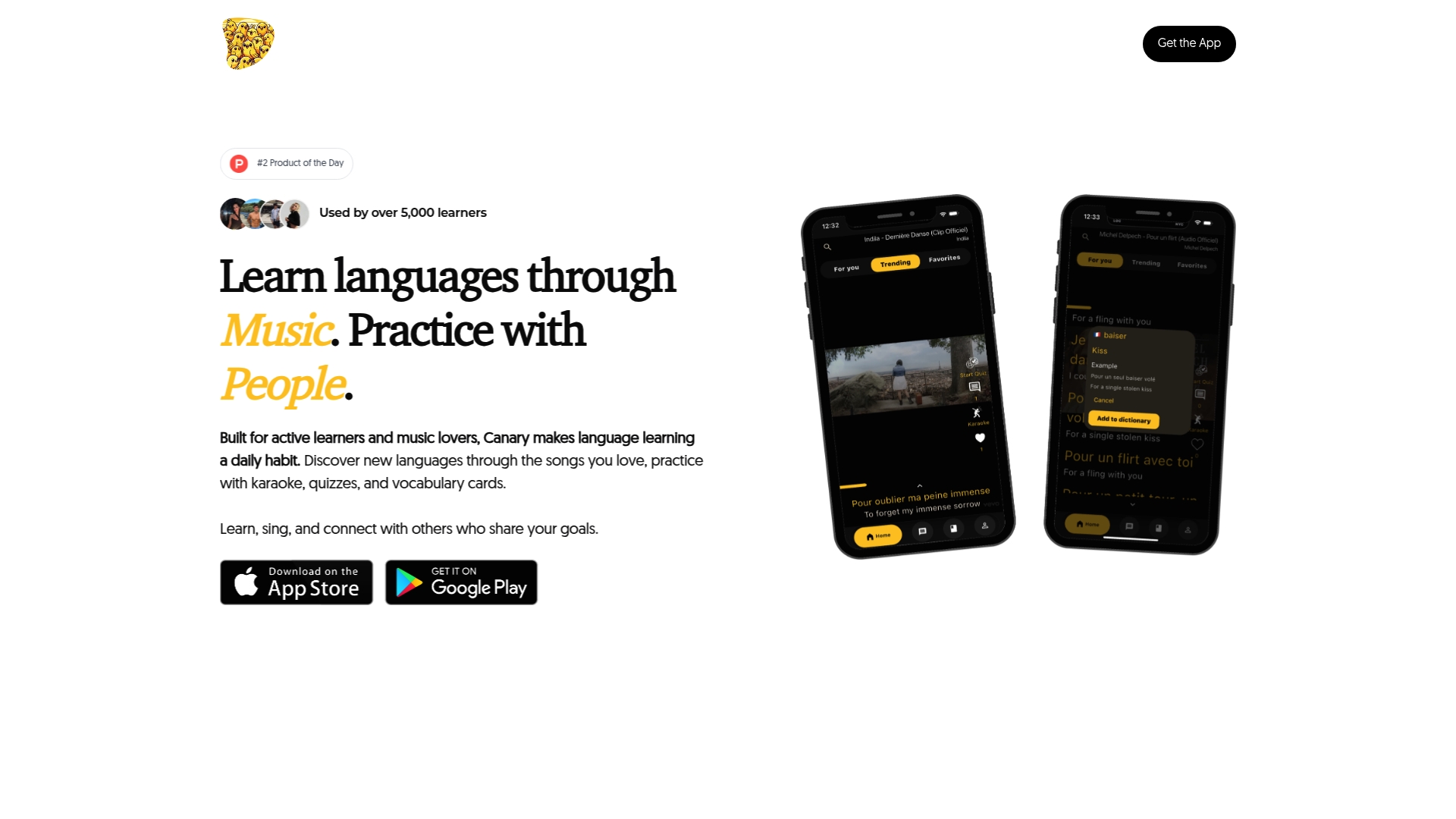
Singwithcanary also connects you with learners around the world, so you can practice pronunciation with native speakers and get feedback that goes beyond what any app algorithm can give you. Every week brings new curated songs through the song of the week feature, so your practice material stays fresh. If you are ready to make music the center of your pronunciation practice, start learning with Singwithcanary today and experience the difference firsthand.
FAQ
Can music really improve my pronunciation?
Yes. Active singing improves pronunciation by training stress patterns, intonation, and difficult sounds in context, which passive study cannot replicate. The key is engaging actively with lyrics rather than just listening.
How long does it take to see results?
Short, consistent sessions of ten minutes two to three times per week show measurable gains. Most learners notice meaningful differences in specific sounds or rhythm patterns within four to six weeks of regular practice.
Do I need to be a good singer to use this method?
No. Pronunciation work through music focuses on rhythm, stress, and articulation, not vocal quality or pitch accuracy. You are training your mouth, not auditioning for a performance.
What kinds of songs work best for pronunciation practice?
Slower songs with clear vocals and minimal heavy production are ideal for beginners. As your ear and control develop, you can progress to faster or more complex tracks. Songs in your target language are always more effective than translated covers.
What is shadowing and how does it help?
Shadowing means speaking along with a recording in real time, matching the speaker’s rhythm and stress. Studies show shadowing improves pronunciation scores by up to 86% after consistent sessions, making it one of the most efficient techniques available.