TL;DR:
- Singing in your target language improves pronunciation, rhythm, and intonation naturally.
- Lyrics repetition and emotional context boost vocabulary retention effectively.
- Song-based learning reduces anxiety and increases motivation, enhancing active language use.
Traditional language apps can feel like a chore. You memorize a word, forget it by morning, and repeat the cycle until motivation fades. Song-based learning breaks that pattern entirely. Research now confirms what music lovers have suspected for years: singing in your target language sharpens pronunciation, locks vocabulary into long-term memory, and makes daily practice something you actually look forward to. This article covers five research-backed benefits of learning a language through songs, plus honest limitations and practical tips to help you get real results faster.
Table of Contents
- Enhances pronunciation through rhythm and melody
- Boosts vocabulary retention through lyric repetition
- Reduces foreign language anxiety and increases motivation
- Outperforms traditional methods in spoken language skills
- Limitations and best practices for song-based learning
- Our take: The overlooked power and nuances of learning with songs
- Discover smarter language study with music
- Frequently asked questions
Key Takeaways
| Point | Details |
|---|---|
| Improves pronunciation | Songs help you master natural speech patterns, stress, and intonation more easily. |
| Boosts vocabulary retention | Lyric repetition locks in new words faster than rote memorization. |
| Reduces anxiety | Music makes practice enjoyable and lowers stress so you use the language more confidently. |
| Outperforms traditional study | Speaking skills and fluency grow faster with songs than with textbook drills alone. |
| Best with tailored use | Combining songs with other methods and thoughtful strategies drives the best results. |
Enhances pronunciation through rhythm and melody
Pronunciation is one of the hardest parts of learning a new language, and traditional drills rarely fix it. Songs work differently. When you sing along to a track, the melody forces you to match the natural rhythm and stress patterns of the language. You are not just repeating sounds; you are physically syncing with how native speakers breathe, pause, and emphasize words.
This process has a name: rhythmic-prosodic entrainment. It means your brain and body align with the musical pulse, which helps you internalize stress timing and intonation far more naturally than reading from a textbook. Song-based learning enhances pronunciation through exactly this mechanism, making it one of the most effective tools for accent reduction.
The research backs this up. A meta-analysis found that musical ability correlates positively with second-language phonological learning, meaning the more you engage with music, the better your ear and mouth adapt to new sounds. Even learners without formal musical training benefit.
Here is what song-based practice targets for pronunciation:
- Stress patterns: Songs highlight which syllables get emphasis, making it easier to copy native rhythm.
- Intonation curves: Melody teaches you when a sentence rises or falls naturally.
- Connected speech: Lyrics show how words blend together in real conversation.
- Sound discrimination: Repeated listening sharpens your ability to hear subtle phonetic differences.
Pro Tip: Pick a song with clear diction and a moderate tempo. Rap and spoken-word tracks are surprisingly effective because they mirror natural speech rhythm closely. Explore pronunciation with music methods to find the approach that fits your style, or read music learning success stories from real learners who improved their accents this way.
Boosts vocabulary retention through lyric repetition
Beyond pronunciation, song-based learning delivers major advantages for vocabulary development. The secret is repetition, but not the boring kind. When a word appears inside a catchy hook you hear twenty times, it sticks in a way that flashcard drilling rarely achieves.
Lyrics create emotional and musical context around new words. That context acts as a memory anchor. You do not just remember the word; you remember the melody, the feeling, and the moment. Data from five intervention studies shows that lyric-based repetition yields significant vocabulary gains in EFL (English as a Foreign Language) learners, with consistent improvements across different age groups and proficiency levels.
Here is how songs support vocabulary learning at each stage:
- Exposure: You hear new words naturally embedded in real sentences.
- Repetition: Choruses and refrains give you spaced practice without extra effort.
- Context: Words appear alongside emotions, images, and story, making meaning clear.
- Production: Singing the lyrics out loud forces active recall, not just passive recognition.
For a deeper look at strategies, check out this guide on expanding vocabulary with songs.
| Strategy | How it works | Best for |
|---|---|---|
| Chorus repetition | Hear target words multiple times per song | High-frequency vocabulary |
| Lyric gap-fill | Predict missing words while listening | Active recall practice |
| Playlist cycling | Rotate songs over days and weeks | Spaced repetition effect |
| Vocabulary card pairing | Match lyrics to flashcard sets | Connecting sound to meaning |
Pro Tip: Use a lyric app alongside a curated playlist. When you encounter an unfamiliar word, pause, look it up, then replay the section. That three-step loop is a powerful form of spaced repetition built right into your listening session.
Reduces foreign language anxiety and increases motivation
While cognitive gains are crucial, the right mindset can make or break language progress. Foreign language anxiety is real. Many learners freeze when asked to speak, terrified of sounding foolish. Songs lower that barrier significantly.

Singing along to a favorite track feels playful, not performative. There is no teacher grading your accent. There is no classmate watching you stumble. That low-stakes environment is exactly what anxious learners need to start producing sounds and words with confidence. Research confirms that songs foster a low-anxiety environment that actively encourages participation.
Here is how the emotional benefits stack up:
- Reduced fear of mistakes: Singing feels like play, so errors feel less threatening.
- Increased enjoyment: Pleasure in the activity drives consistent daily practice.
- Higher participation: Learners who enjoy practice engage more often and more deeply.
- Greater confidence: Small wins in singing transfer to confidence in speaking.
“Music gives you a reason to open your mouth in a new language before you feel ready. That’s exactly when the real learning starts.”
Choosing songs you genuinely love amplifies all of these effects. When you care about the music, you replay it naturally, which means more exposure without any extra effort. Try the weekly music practice resources to build this habit into your routine. For a broader look at why this works, explore the music education benefits that go beyond vocabulary and pronunciation.
Pro Tip: Start with songs in your target language that you already know in your native language. The familiar melody removes one layer of cognitive load, letting you focus purely on the new words.
Outperforms traditional methods in spoken language skills
Now, how does song-based practice actually measure up against standard methods? Direct comparison studies give a clear answer: songs win in several key areas of spoken language performance.
Research published in the Arab World English Journal found that English songs measurably improve EFL learners’ speaking accuracy, fluency, and lexical density compared to conventional instruction. Lexical density refers to how many content-rich words a speaker uses per sentence. Higher lexical density signals more sophisticated, natural language use. Song learners showed statistically significant gains over peers using rote memorization and grammar drills.
Why does this happen? Songs expose you to real language in context. You hear how words connect, how sentences flow, and how meaning is carried by rhythm as much as by grammar. That exposure builds speaking intuition that drills simply cannot replicate.
| Skill area | Song-based learning | Traditional methods |
|---|---|---|
| Pronunciation accuracy | High improvement | Moderate improvement |
| Speaking fluency | Significant gains | Slower progress |
| Lexical density | Notably higher | Minimal change |
| Learner motivation | Consistently high | Often declines over time |
| Real-world language use | Encouraged naturally | Requires separate practice |
For more evidence, read about language gains with songs or compare approaches directly in this breakdown of music versus traditional study.
Limitations and best practices for song-based learning
Despite impressive benefits, song-based learning has limitations and works best with informed use. Knowing where it falls short helps you use it more strategically.
First, the evidence is not uniform. Some studies show null or conflicting effects, and expert-designed activities produce the best results rather than casual listening alone. Randomly playing songs in the background is not the same as structured lyric study.
Second, effectiveness varies by learner profile. A meta-analysis found that benefits are stronger early in learning and that teacher training significantly increases impact. Advanced learners may find songs less challenging and need to pair them with more complex input.
Here are the key limitations to keep in mind:
- Age and level: Very young children and advanced learners may see smaller gains without adapted materials.
- Song selection: Poorly chosen tracks with unclear diction or complex slang can confuse rather than teach.
- Passive listening: Simply hearing songs without active engagement produces minimal results.
- Publication bias: Many positive studies may overrepresent ideal conditions; real classrooms vary widely.
Pro Tip: Treat songs as one layer of a broader study plan. Pair them with grammar review, conversation practice, and reading. The teaching strategies for music learning on Canary’s blog show how to integrate songs without losing structure. Understanding the role of music in learning helps you place it correctly in your overall routine.
Our take: The overlooked power and nuances of learning with songs
Having explored the research, here is a direct perspective on what actually works in practice. Most learners overcomplicate this. They search for the perfect song, the ideal study method, or the most scientifically optimized playlist. Meanwhile, the learner who picks one song they love, sings it daily for two weeks, and looks up every word they do not know is making faster progress.
Simplicity and repetition with music you genuinely enjoy have an outsized impact. The research confirms this, but so does common sense. Motivation is the engine. Songs fuel it.
That said, gains do plateau. If you only ever listen to songs, you will develop a good ear and decent pronunciation, but your grammar and writing may lag. Music works best as a powerful supplement, not a complete replacement for structured study. The learners who see the biggest results combine song-based practice with conversation, reading, and intentional review.
Our honest advice: experiment freely. Try different genres, tempos, and artists. Explore music’s broader role in language acquisition and let joy guide your choices. The best method is the one you will actually stick with.
Discover smarter language study with music
Ready to put research into action? Canary makes it simple to turn your favorite songs into effective language lessons. The platform combines interactive karaoke, vocabulary cards, and quizzes built directly around song lyrics, so every session builds real skills.
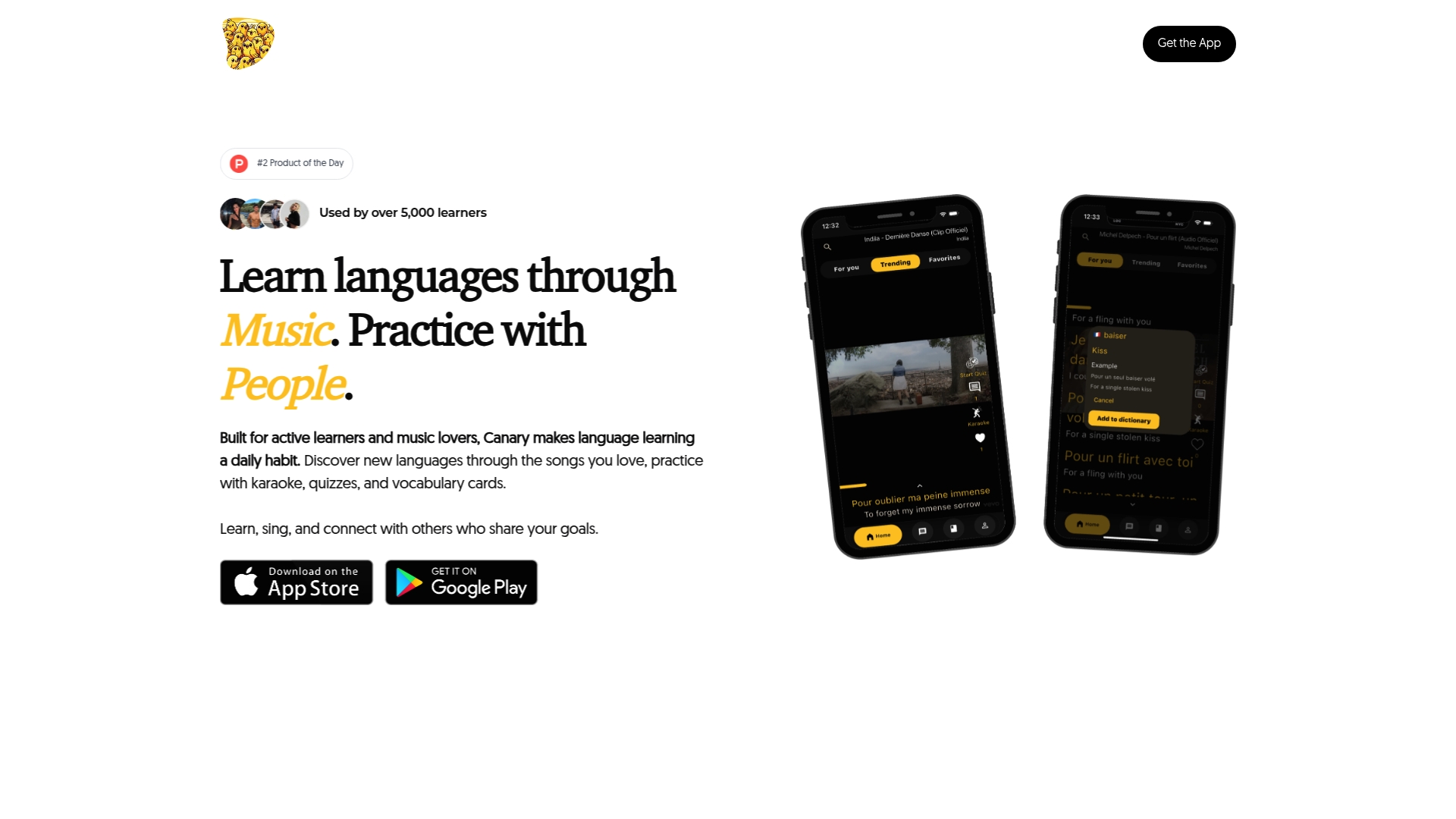
Whether you are just starting out or looking to sharpen your accent, Canary’s curated approach gives you structure without losing the fun. Visit singwithcanary.com to create a free account and start learning today. Explore musical tips for vocabulary to boost retention, or dive into the song of the week resources for fresh, guided practice every week. Your next language breakthrough might be just one great song away.
Frequently asked questions
How does song-based learning improve pronunciation?
Rhythm and melody reinforce natural speech patterns, helping learners absorb stress, intonation, and connected speech through rhythmic-prosodic entrainment rather than mechanical drilling.
Is learning with songs effective for vocabulary?
Yes. Lyric repetition and spaced exposure consistently produce significant vocabulary gains across multiple intervention studies with EFL learners.
Does musical ability matter for language learning success?
It helps but is not required. A meta-analysis confirms a positive correlation between musical ability and language learning, though even non-musicians benefit from song-based practice.
Can song-based learning replace traditional methods?
Not entirely. Song-based interventions outperform traditional methods in some areas but deliver the best outcomes when combined with structured grammar and conversation practice.
Are there limitations to using songs to learn a language?
Yes. Effect sizes are stronger early in learning, and results improve significantly when activities are designed by trained teachers rather than used casually.