Traditional language learning methods often leave learners frustrated and unmotivated, struggling to maintain consistent practice. Music offers a powerful alternative, transforming daily study into an engaging experience that naturally builds retention and fluency. This guide reveals how to leverage songs to create effective language learning habits that stick, combining proven techniques with interactive tools designed for music enthusiasts and active learners seeking genuine progress in their target language.
Table of Contents
- Preparing Your Language Learning Journey With Music
- Step-By-Step Guide To Forming Effective Music-Based Language Learning Habits
- Troubleshooting Common Challenges In Music-Based Language Learning Habits
- Measuring Progress And Maximizing Results With Music-Driven Language Habits
- Boost Your Language Learning With Canary
- How Can I Start Building Language Learning Habits With Songs?
- What If I Struggle To Understand Song Lyrics In My Target Language?
- How Do Music-Based Language Learning Habits Improve Fluency?
- How Long Does It Take To See Results From Music-Based Language Learning?
- Can I Learn A Language Using Only Music, Or Do I Need Other Methods Too?
Key takeaways
| Point | Details |
|---|---|
| Daily consistency matters | Regular practice with music builds neural pathways faster than sporadic intensive sessions |
| Context drives retention | Learning vocabulary through song lyrics creates emotional connections that enhance memory |
| Interactive engagement works | Active participation through singing and annotation beats passive listening for fluency gains |
| Community accelerates progress | Practicing with others provides accountability and real-world application opportunities |
| Strategic tools optimize results | Purpose-built platforms combine music with structured learning for maximum efficiency |
Preparing your language learning journey with music
Successful habit formation starts with proper groundwork. Before diving into songs, assess your current language proficiency honestly. Beginners should focus on children’s songs or simplified pop tracks, while intermediate learners can tackle mainstream music with moderate vocabulary complexity. Advanced students benefit from rap, poetry-heavy lyrics, or regional dialect songs that challenge comprehension.
Your musical preferences matter significantly. Choose genres you genuinely enjoy, whether pop, rock, hip-hop, or folk. Forcing yourself through music you dislike sabotages motivation, the cornerstone of habit formation. Create playlists organized by difficulty level, starting with three to five songs that match your current abilities.
Gather essential resources before beginning. You need lyrics in your target language, accurate translations, and audio files you can replay easily. Many streaming platforms offer lyric displays, but dedicated language learning tools provide synchronized text that highlights words as they’re sung. Download songs for offline access to eliminate excuses about connectivity.
Set specific, measurable goals tied to your musical journey. Instead of vague aims like “get better at Spanish,” target concrete outcomes: “understand 80% of this song’s lyrics without translation within two weeks” or “correctly pronounce all words in the chorus by Friday.” Structured preparation improves habit formation in language learning, creating clear benchmarks for progress.
Establish your learning environment carefully. Designate a specific time and place for music-based practice, whether it’s morning coffee with French ballads or evening commutes with German pop. Consistency in timing triggers automatic behavior, making practice feel natural rather than forced.
Understand the habit loop: cue, routine, reward. Your cue might be putting on headphones, the routine is active listening with lyric study, and the reward could be singing along confidently or checking off completed songs. This psychological framework transforms sporadic learning into automatic daily practice.
Pro Tip: Start with songs you already know in your native language but translated into your target language. Familiar melodies reduce cognitive load, letting you focus entirely on new vocabulary and pronunciation patterns.
| Preparation Element | Beginner Approach | Intermediate Approach | Advanced Approach | | — | — | — | | Song Selection | Children’s songs, simple pop | Mainstream hits, moderate vocabulary | Complex lyrics, regional dialects | | Daily Time Commitment | 10-15 minutes | 20-30 minutes | 30-45 minutes | | Resource Needs | Lyrics, basic translation | Lyrics, context notes, slang guides | Native materials, cultural references | | Goal Specificity | Learn 5 new words per song | Understand full verses without help | Master pronunciation nuances |
Step-by-step guide to forming effective music-based language learning habits
Start each session by listening to your chosen song once without any text. This primes your ear for natural speech patterns and rhythm. Notice which words you recognize and where comprehension breaks down. Don’t stress about understanding everything; this initial listen establishes a baseline.
Second, play the song again with lyrics displayed. Follow along word by word, pausing frequently to annotate unfamiliar terms. Circle verbs, underline new nouns, and highlight interesting phrases. This active engagement transforms passive listening into deliberate study. Daily language practice with songs boosts fluency through consistent exposure to authentic language use.

Third, break down complex sections into manageable chunks. Focus on one verse or the chorus during a single session rather than tackling the entire song. Repeat these segments until you can sing along smoothly, matching the artist’s pronunciation and pace. Record yourself to identify specific sounds or words needing extra attention.
Fourth, incorporate translation strategically. Look up meanings after attempting to understand from context. This approach builds inference skills crucial for real conversations. Create vocabulary cards for words appearing across multiple songs, as repetition across different contexts solidifies retention.
Fifth, sing aloud regularly. Speaking practice is essential for fluency, and music provides a judgment-free environment to experiment with sounds. Exaggerate pronunciation initially to train your mouth muscles for unfamiliar phonemes. Gradually increase speed as comfort grows.
Complete Daily Routine:
- Listen without text (3 minutes)
- Follow lyrics and annotate (5 minutes)
- Focus on one section, repeat until smooth (7 minutes)
- Look up and record new vocabulary (3 minutes)
- Sing along with full song (3 minutes)
- Review yesterday’s vocabulary cards (4 minutes)
Track progress systematically. Maintain a learning journal noting which songs you’ve mastered, new vocabulary acquired, and pronunciation challenges overcome. Every two weeks, revisit earlier songs to measure improvement. You’ll be surprised how much clearer previously difficult tracks become.
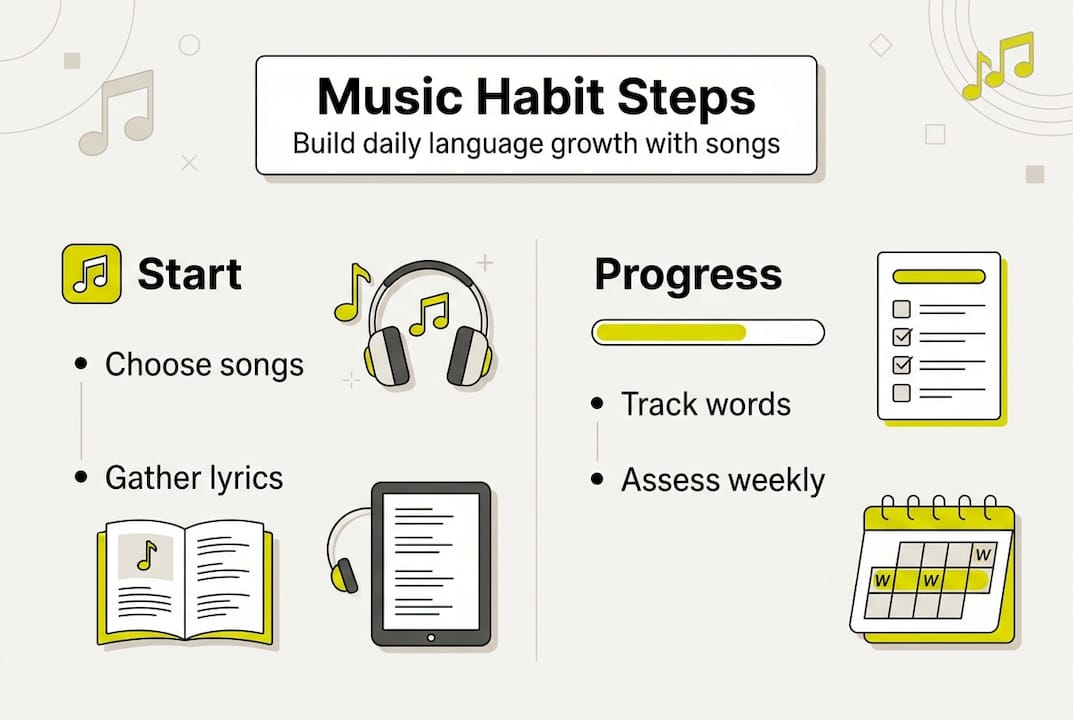
Adjust song difficulty progressively. Once you understand 90% of a song’s lyrics without translation, it’s time to level up. Introduce slightly more complex tracks that stretch your abilities without overwhelming you. This graduated challenge maintains engagement while preventing frustration.
Pro Tip: Use playback speed controls to slow songs to 0.75x speed when learning pronunciation. Speed up to 1.25x once comfortable to challenge your listening comprehension and prepare for natural conversation pace.
Explore different language learning methods for music lovers to find approaches that resonate with your learning style. Some students prefer lyric analysis, others thrive with karaoke-style practice, and many benefit from combining multiple techniques.
| Week | Focus Area | Song Difficulty | Expected Outcome | | — | — | — | | 1-2 | Basic vocabulary, pronunciation | Very simple, repetitive | Sing chorus confidently | | 3-4 | Verb tenses, common phrases | Simple, clear enunciation | Understand 70% without help | | 5-6 | Idiomatic expressions | Moderate complexity | Follow full song meaning | | 7-8 | Cultural context, slang | Moderate to challenging | Discuss song themes |
Troubleshooting common challenges in music-based language learning habits
Motivation dips happen to everyone. When songs feel stale, shake up your routine by exploring different genres or artists. If you’ve been studying ballads, try upbeat dance tracks. Regional variations within your target language offer fresh perspectives; Brazilian Portuguese differs significantly from European Portuguese, providing new learning angles.
Difficult lyrics frustrate many learners. When comprehension stalls, use translation apps to get rough meanings, then refine understanding through context. Slow playback to 0.5x speed reveals individual words that blur together at normal tempo. Break problematic lines into individual words, practice each separately, then gradually combine them.
Inconsistent practice derails habit formation faster than any other factor. Combat this by setting phone reminders, pairing music study with existing routines (like morning coffee), or using accountability partners who check your progress. Missing one day is recoverable; missing three starts a negative pattern.
Language learning gamification transforms practice into play, making consistency easier. Set challenges like “master one song per week” or “learn 50 new words this month through music.” Reward milestones with new song downloads or sharing achievements with fellow learners.
Common obstacles and solutions:
- Can’t understand fast rap sections: Start with slowed versions, focus on one bar at a time, and accept that some artists challenge even native speakers
- Vocabulary doesn’t stick: Create physical flashcards linking words to specific song moments, review during non-study time like commutes
- Pronunciation feels impossible: Record native speakers and yourself saying the same phrase, compare waveforms visually to spot differences
- Boredom with repetition: Rotate between five songs rather than drilling one, return to earlier tracks periodically for confidence boosts
- No one to practice with: Join online communities where learners share song interpretations and pronunciation tips
Burnout signals you’re pushing too hard. Language acquisition is a marathon, not a sprint. If 30-minute sessions feel draining, cut back to 15 minutes. Quality engagement beats exhausted grinding every time. Some days, passive listening while doing chores counts as practice and maintains your habit streak.
Pro Tip: When motivation crashes, return to the song that originally inspired you to learn the language. Reconnecting with your initial enthusiasm often reignites commitment and reminds you why this journey matters.
Group dynamics provide powerful accountability. Find language exchange partners who share your musical interests. Discuss song meanings, debate lyric interpretations, or challenge each other to learn the same track and compare progress. Social pressure in a positive context keeps you showing up even when solo motivation wanes.
“The best language learning habit is the one you’ll actually maintain. If music makes you excited to practice daily, you’ve found your method.” - Experienced polyglot and music educator
Measuring progress and maximizing results with music-driven language habits
Define clear metrics before starting your musical language journey. Quantifiable goals might include: understanding 80% of lyrics without translation, singing along with 95% accuracy, or learning 200 new vocabulary words through songs within three months. Vague aspirations like “improve my French” provide no feedback mechanism.
Self-assessment through singing reveals pronunciation progress objectively. Record yourself monthly singing the same song. Compare recordings to track improvement in accent, flow, and confidence. You’ll hear dramatic differences that daily practice obscures, providing motivational fuel to continue.
Comprehension checks validate learning. After studying a song, write a summary of its meaning without referencing translations. Explain the story, emotions, or message in your own words. This synthesis demonstrates true understanding versus superficial memorization.
Passive listening differs fundamentally from active engagement. Hearing songs in the background while cooking provides some exposure benefit, but focused study with lyric annotation, repetition, and pronunciation practice yields exponentially better results. Track both types separately to understand their distinct contributions.
Language learning communities offer external validation and fresh perspectives. Share your song interpretations, ask native speakers about slang meanings, or participate in group challenges. Feedback from others identifies blind spots in your understanding and pronunciation.
Progress tracking methods:
- Weekly vocabulary counts from songs studied
- Monthly recordings comparing pronunciation accuracy
- Comprehension percentages for new versus mastered songs
- Time required to learn new songs (should decrease)
- Ability to discuss song themes with native speakers
Adjust your routine based on data. If vocabulary retention lags, increase flashcard review time. When pronunciation improves rapidly but comprehension stalls, add more translation work. Personalize your approach using evidence from your own progress rather than generic advice.
Compare different learning approaches to optimize results. Spend two weeks using only passive listening, then two weeks with active annotation and singing. Measure vocabulary retention and comprehension for each method. Most learners discover active engagement wins decisively, but personal experimentation convinces more than external claims.
Pro Tip: Create a “mastery playlist” containing only songs you understand completely. Play this during workouts or commutes for confidence-building passive exposure that reinforces existing knowledge while your brain rests from active learning.
| Metric | Beginner Target | Intermediate Target | Advanced Target | | — | — | — | | Songs mastered monthly | 2-3 | 4-6 | 6-8 | | Vocabulary acquired | 30-50 words | 60-100 words | 100-150 words | | Comprehension without help | 60-70% | 80-90% | 95%+ | | Pronunciation accuracy | 70-80% | 85-95% | 95%+ |
Celebrate milestones meaningfully. When you master your tenth song, share it on social media or perform for friends. These celebrations reinforce positive associations with language learning, strengthening habit formation through emotional rewards.
Boost your language learning with Canary
Building effective language learning habits requires the right tools and community support. Canary combines music-driven learning with interactive features designed specifically for active learners and music enthusiasts. The platform offers synchronized lyrics, pronunciation practice, and vocabulary cards built around your favorite songs.
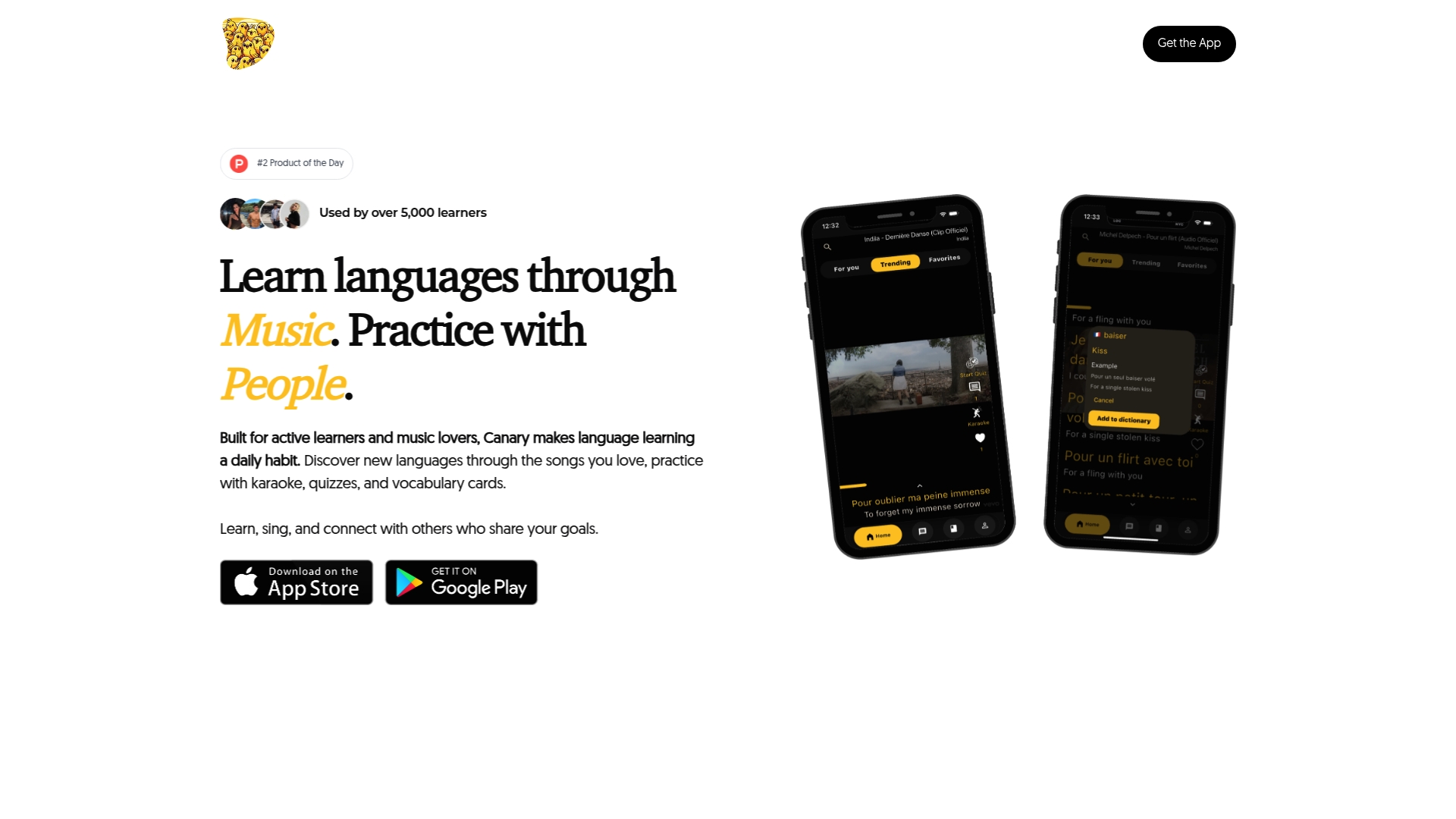
New learners benefit from Canary’s structured language learning workflow for beginners, which guides you through song selection, active listening techniques, and progress tracking. The karaoke feature lets you practice pronunciation in a fun, pressure-free environment while quizzes reinforce vocabulary retention.
What sets Canary apart is its emphasis on social language learning with music. Connect with international learners who share your musical tastes, exchange feedback on pronunciation, and stay motivated through community challenges. This social dimension transforms solitary study into an engaging shared experience.
Ready to learn languages with music that actually sticks? Canary’s platform turns your favorite songs into powerful learning tools, helping you build the daily habits that lead to genuine fluency.
How can I start building language learning habits with songs?
Begin by selecting three to five songs at your current proficiency level that you genuinely enjoy. Focus on learning one song thoroughly before adding new ones, using lyrics to guide your listening and pronunciation practice. Establish a consistent daily time for music study, even if just 10 minutes initially, to trigger habit formation.
Implement a structured approach: listen without text first, then follow along with lyrics while annotating unfamiliar words, and finally sing along to practice pronunciation. Master learning with lyrics by combining passive listening with active engagement techniques. Track your progress weekly to maintain motivation and adjust difficulty as you improve.
What if I struggle to understand song lyrics in my target language?
Difficulty understanding lyrics is completely normal, especially with fast-paced songs or unfamiliar accents. Use playback speed controls to slow songs to 0.5x or 0.75x speed, making individual words clearer. Access translations to understand overall meaning, then work backward to connect specific phrases with their English equivalents.
Break challenging songs into small sections, focusing on one verse or even one line at a time. Repeat these segments until comprehension improves before moving forward. Translation apps and lyric annotation tools help bridge gaps in understanding while you build vocabulary organically through repeated exposure.
How do music-based language learning habits improve fluency?
Music enhances language acquisition through multiple cognitive pathways simultaneously. Melody and rhythm aid memorization more effectively than rote vocabulary lists, while emotional connections to songs create stronger neural associations. Singing along provides pronunciation practice in a natural, contextualized way that mirrors real conversation.
Regular exposure to authentic language use through songs trains your ear for native speech patterns, including contractions, slang, and cultural expressions rarely found in textbooks. The repetitive nature of choruses and verses reinforces vocabulary without tedious drilling, making learning feel effortless. Combined with active engagement techniques, music-based habits accelerate fluency development while maintaining high motivation levels.
How long does it take to see results from music-based language learning?
Most learners notice improved pronunciation and vocabulary retention within two to three weeks of consistent daily practice. Comprehension gains become apparent after mastering three to five songs, typically around the one-month mark. Fluency improvements require longer commitment, usually three to six months of regular music-based study combined with other practice methods.
Results vary based on practice intensity, language difficulty, and prior experience. Beginners starting from zero may need more time to build foundational vocabulary, while intermediate learners often see faster progress. The key is consistency; 15 minutes daily outperforms sporadic hour-long sessions for habit formation and retention.
Can I learn a language using only music, or do I need other methods too?
Music provides excellent vocabulary, pronunciation, and listening comprehension practice, but complete fluency requires additional methods. Songs offer limited grammar instruction and don’t develop writing skills or formal conversation abilities. Use music as your primary motivation and daily habit anchor, supplementing with grammar study, speaking practice, and reading.
The most effective approach combines music’s engagement benefits with structured learning for comprehensive skill development. Let songs drive your daily practice habit while dedicating separate time to grammar, conversation exchange, or formal lessons. This balanced strategy leverages music’s motivational power without neglecting essential language components that songs alone can’t teach.