Ever notice how you can remember song lyrics from years ago, yet struggle to recall yesterday’s vocabulary flashcards? That’s because our brains process music and language through interconnected neural pathways, making songs uniquely powerful tools for language acquisition. This guide reveals how to harness lyrics strategically to accelerate your learning, improve pronunciation, expand vocabulary, and build genuine confidence in your target language.
Table of Contents
- Why Song Lyrics Make Language Learning Effective
- How Song Lyrics Improve Vocabulary, Pronunciation, And Listening Skills
- Practical Strategies To Learn Languages Effectively Through Lyrics
- Overcoming Challenges And Maximizing Results With Lyrics
- Enhance Your Language Journey With Canary’s Music-Driven Learning
- FAQ
Key takeaways
| Point | Details |
|---|---|
| Vocabulary boost | Music enhances memory encoding and strengthens the ability to recall new vocabulary with proven gains of 32%. |
| Pronunciation gains | Exposure to authentic lyrics improves pronunciation accuracy by 22% through natural speech patterns. |
| Listening skills | Songs increase listening comprehension by 28% while reducing language anxiety. |
| Cognitive advantage | Neurological overlap between music and language processing creates multisensory learning pathways. |
| Social motivation | Practicing with others through music builds speaking confidence and maintains daily learning habits. |
Why song lyrics make language learning effective
Your brain treats music and language as close relatives. The neurological antecedents of language processing may be closely related to that of the processing of music, creating a powerful cognitive foundation for acquisition. When you listen to songs, rhythmic timing aligns perfectly with how your brain naturally processes speech patterns.
Melodies create predictable structures that act like mental scaffolding. Your mind expects certain sounds at specific intervals, making it easier to anticipate and remember new words. This predictability transforms random vocabulary into memorable sequences you can recall effortlessly.
Lyrics expose you to authentic pronunciation that textbooks rarely capture. You hear how native speakers link words, drop sounds, and use idioms in natural contexts. Songs also engage your emotions, which lowers anxiety and creates positive associations with the language you’re learning.
Research confirms these benefits quantitatively. Music enhances memory encoding and strengthens the ability to recall new vocabulary, with studies showing significant improvements across multiple language skills. The multisensory experience of combining audio, rhythm, and meaning creates stronger neural connections than traditional study methods alone.
The emotional component matters immensely. When you connect with a song, your brain releases dopamine, the same neurotransmitter involved in motivation and reward. This chemical response makes learning feel less like work and more like entertainment, encouraging you to practice more frequently.
Pro Tip: Choose songs with clear, repetitive lyrics to maximize retention. Artists who enunciate well and use choruses with repeated phrases give you multiple opportunities to internalize new vocabulary without overwhelming your working memory. Try music boosts vocabulary retention strategies to identify ideal songs for your level.
How song lyrics improve vocabulary, pronunciation, and listening skills
The impact of lyric-based learning extends across core language competencies in measurable ways. Research tracking learners using English songs found vocabulary scores increased by 32%, pronunciation by 22%, and listening comprehension by 28%. These aren’t marginal gains; they represent substantial skill development from an enjoyable activity.
Songs provide contexts that make vocabulary stick. Instead of memorizing isolated words, you learn them embedded in phrases with emotional resonance and narrative meaning. When you hear “break my heart” in a ballad, you understand both the literal and figurative meanings simultaneously, creating richer mental associations.
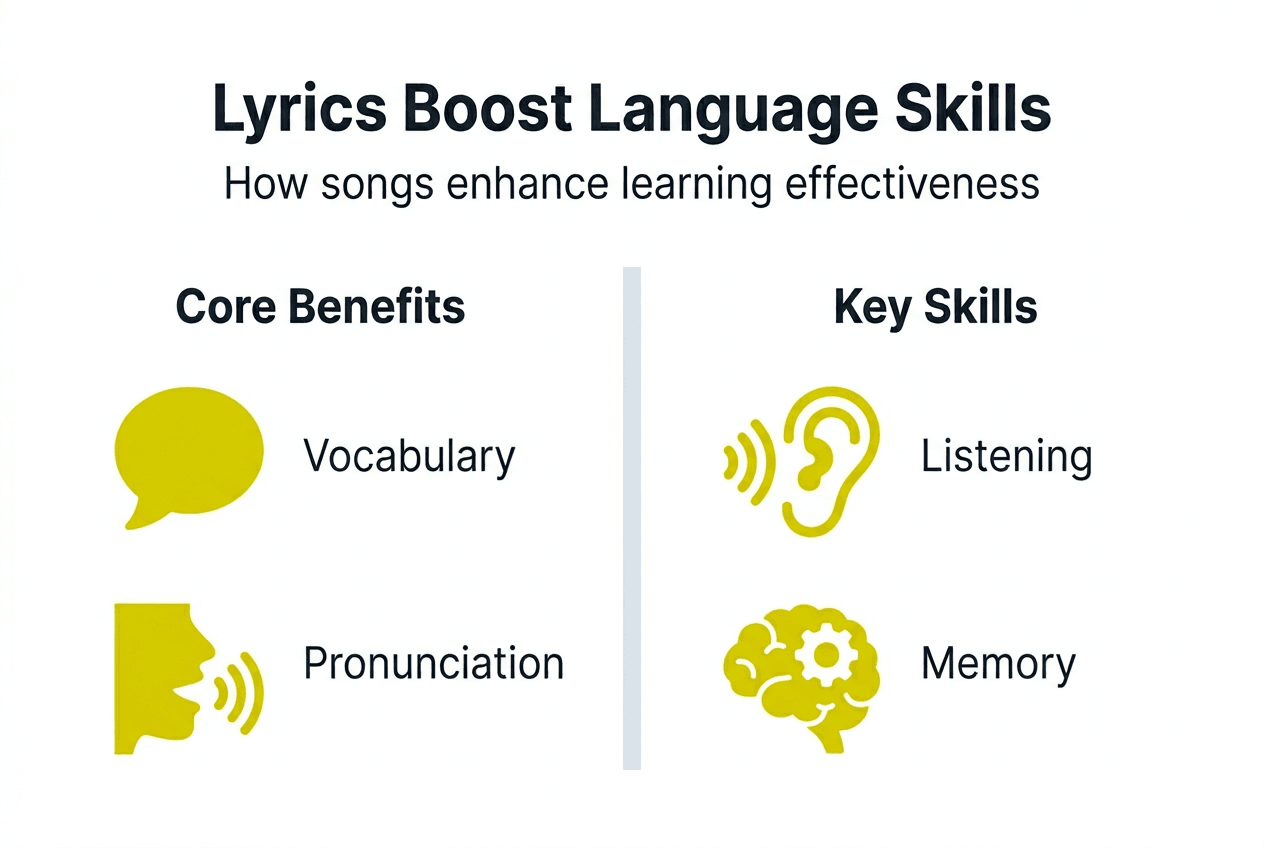
Pronunciation improves because lyrics model natural connected speech. You hear how native speakers blend sounds, drop consonants, and modify vowels in rapid conversation. Singers demonstrate rhythm, stress patterns, and intonation in exaggerated but authentic ways that make these features easier to identify and imitate.
Listening skills develop through repeated exposure to varied vocal styles and speeds. Students showed a big improvement in hearing linking sounds and felt more confident using music for learning. The combination of melody and lyrics trains your ear to pick out individual words within flowing speech, a critical skill for real conversations.
Music creates a relaxed, low-pressure environment that reduces the anxiety often associated with language practice. When you’re enjoying a song, you’re not worried about making mistakes or being judged. This psychological safety allows your brain to process and absorb language more effectively.
Here’s how to use lyrics to develop these skills systematically:
- Listen first without reading to challenge your ear and identify familiar words.
- Read lyrics while listening to connect sounds with written forms.
- Sing along to practice pronunciation and build muscle memory.
- Analyze interesting phrases to understand grammar and usage patterns.
- Test yourself by filling in missing words from memory.
- Record yourself singing to identify pronunciation areas needing improvement.
Explore learning with music examples to see how different learners apply these steps across proficiency levels and learning goals.
Practical strategies to learn languages effectively through lyrics
Selecting appropriate songs makes or breaks your lyric-based learning success. Choose music that matches your current proficiency level while pushing you slightly beyond your comfort zone. Beginners benefit from children’s songs or pop tracks with simple, repetitive structures. Intermediate learners can tackle more complex narratives and varied vocabulary. Advanced students should explore genres with poetic language, wordplay, or regional dialects.
Active listening differs dramatically from passive background music. Read lyrics before listening to prime your brain for new vocabulary. Follow along during playback to connect sounds with written words. Pause frequently to look up unfamiliar terms and understand their context. Sing along repeatedly until pronunciation feels natural. This intentional engagement transforms entertainment into education.
Technology amplifies lyric-based learning effectiveness. Sing & Spell with AI improved spelling accuracy and vocabulary recall among younger learners through structured, game-based lyric practice. Apps can slow down playback, highlight vocabulary, provide translations, and create interactive quizzes based on song content.
Balancing music appreciation with linguistic analysis optimizes results. Don’t dissect every song so thoroughly that you lose enjoyment. Some sessions should focus purely on listening pleasure, while others involve detailed vocabulary study. Music-based instruction significantly improves oral fluency, vocabulary retention, and phonological awareness when learners alternate between these approaches.
Integrate lyric learning into your daily routine with minimal disruption. Listen during commutes, workouts, or household chores. Dedicate 15 minutes each morning to focused lyric study. Create themed playlists for different moods or learning objectives. The key is consistency over intensity; brief daily practice outperforms sporadic marathon sessions.
| Approach | Passive Listening | Active Lyric Study |
|---|---|---|
| Focus | Background enjoyment | Intentional analysis |
| Vocabulary gains | Minimal, incidental | Substantial, targeted |
| Pronunciation | Limited modeling | Direct practice |
| Time investment | Flexible, ongoing | Focused, scheduled |
| Best for | Exposure, motivation | Skill development |
Pro Tip: Practice with others socially to boost motivation and speaking skills. Join language exchange groups focused on music, participate in karaoke sessions, or discuss song meanings with native speakers. The social accountability and immediate feedback accelerate your progress while making learning genuinely enjoyable. Discover diverse musical language learning methods to find approaches matching your learning style and social preferences.
Overcoming challenges and maximizing results with lyrics
Songs present unique obstacles that can frustrate learners. Slang and colloquialisms appear frequently, especially in contemporary music, using expressions dictionaries don’t always explain. Fast-paced delivery in rap or rock songs overwhelms beginners trying to distinguish individual words. Unfamiliar accents and regional pronunciations add another layer of complexity.
Research reveals an interesting dynamic: music plays a more dominant role than lyrics in conceptual interpretation in song. Your brain often prioritizes melody and emotional tone over precise word meanings, which can distract from vocabulary learning if you’re not intentional. Recognizing this tendency helps you compensate by dedicating specific practice time to lyric comprehension separate from pure listening enjoyment.
The good news is music helps lower language anxiety during learning, making it easier to absorb meaning and remember phrases. Even when songs contain challenging elements, the positive emotional state they create facilitates better retention than stress-inducing study methods.
Here are practical solutions for common lyric-learning challenges:
- Slow down playback using apps or YouTube’s speed controls to hear individual words clearly.
- Use lyric sheets or subtitles during initial listening to connect sounds with spellings.
- Research unfamiliar slang through online dictionaries or language forums for cultural context.
- Start with acoustic or ballad versions of fast songs for clearer pronunciation.
- Focus on choruses first since repetition aids comprehension and memory.
- Accept imperfect understanding; partial comprehension still builds skills over time.
- Record yourself singing to identify specific pronunciation weaknesses objectively.
Embrace creative expression despite imperfections. You don’t need perfect pronunciation or complete vocabulary mastery to benefit from singing. Making mistakes reveals exactly what you need to practice. The goal is progress, not perfection. Each attempt, even flawed ones, strengthens your neural pathways and builds confidence.
Understanding the role of music in language learning helps you anticipate challenges and adjust your approach accordingly. When music dominates your attention, deliberately shift focus to lyrics by reading along or creating lyric-based flashcards. When fast delivery overwhelms you, choose slower songs temporarily before returning to challenging tracks with improved skills.
Enhance your language journey with Canary’s music-driven learning
Now that you understand how lyrics accelerate language acquisition, it’s time to apply these strategies systematically. Canary offers AI-powered tools specifically designed to optimize lyric-based learning, transforming casual listening into structured skill development. You’ll access curated playlists matched to your proficiency level, interactive karaoke for pronunciation practice, and vocabulary cards generated from your favorite songs.
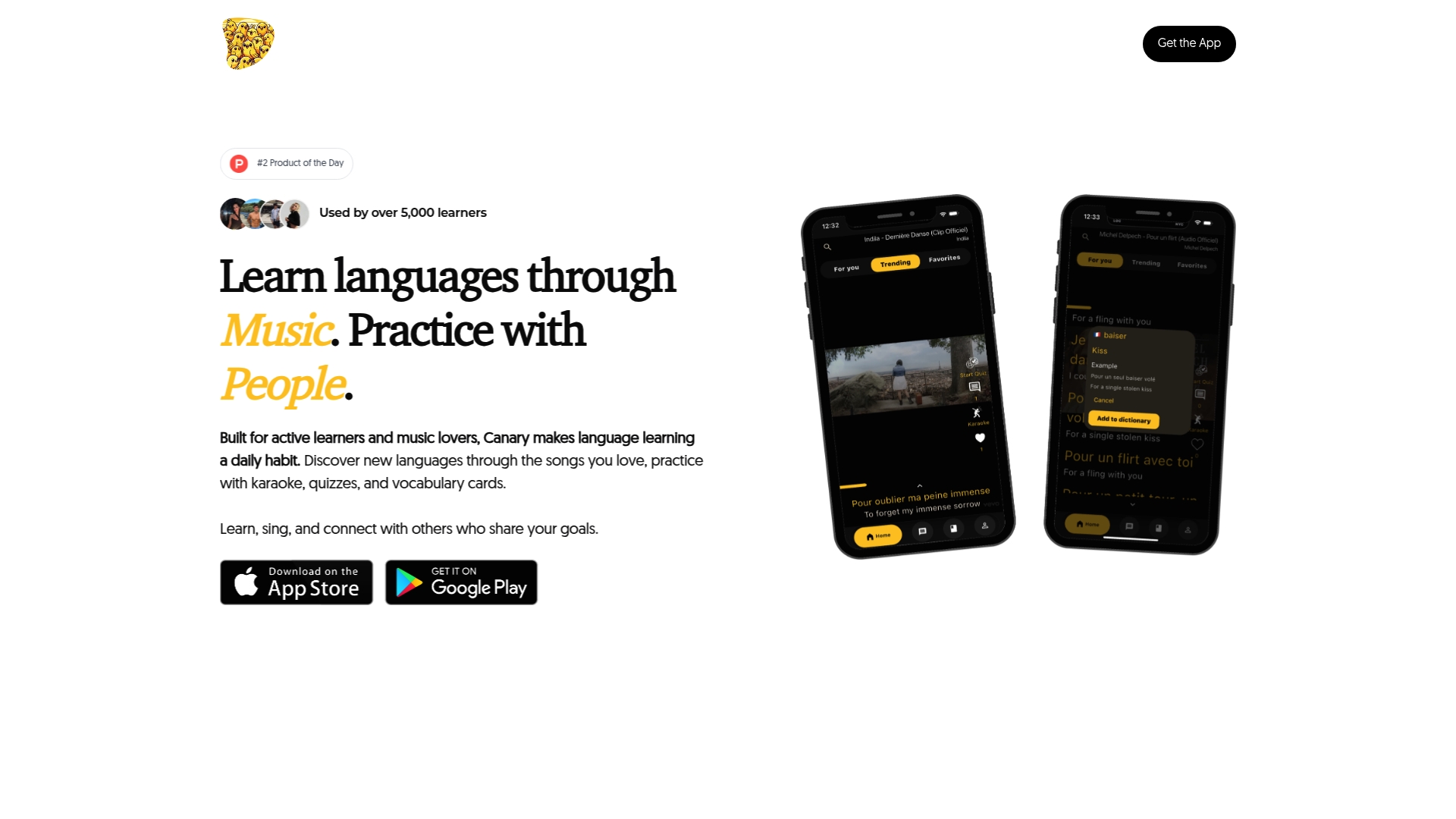
What sets Canary apart is its social dimension. You don’t learn in isolation; instead, you learn languages with music alongside international learners who share your passion. Practice conversations about songs, participate in group karaoke sessions, and receive feedback from native speakers in real time. This social language learning with music approach builds confidence faster than solo study ever could.
The platform supports various proficiency levels with features that adapt to your progress. Beginners access simplified tracks and guided vocabulary building. Advanced learners explore complex genres and cultural contexts. Everyone benefits from the educational benefits of music in language learning, making daily practice feel less like obligation and more like entertainment.
FAQ
What languages can I learn effectively through lyrics?
Most languages with rich music cultures benefit significantly from lyric-based learning. Popular choices include English, Spanish, French, German, Italian, Portuguese, Mandarin, Japanese, Korean, and Arabic, each offering diverse musical genres from which to learn. The key factor is availability of quality music with clear lyrics in your target language, which exists for virtually every major language today.
How often should I use songs to improve my language skills?
Regular, consistent practice yields the best results, ideally daily or several times weekly. Short, focused sessions of 15 to 30 minutes outperform infrequent long study marathons because they maintain momentum without causing fatigue. Use diverse songs to maintain interest and challenge different aspects of your language skills, preventing boredom while ensuring comprehensive development.
Can I learn advanced vocabulary and grammar through songs?
Songs excel at teaching idiomatic expressions and conversational language that textbooks often miss. However, complex grammar structures may require supplementary study through formal lessons or grammar guides. Combining lyric-based learning with traditional methods yields optimal results, using songs for authentic usage examples and textbooks for systematic rule explanations.
Do I need musical talent to learn languages through lyrics?
Absolutely not; musical ability is irrelevant to language learning success through songs. Your goal is linguistic comprehension and pronunciation practice, not vocal performance. Even tone-deaf learners benefit equally from reading, listening, and analyzing lyrics. Focus on the language content rather than singing quality, and you’ll develop skills regardless of musical background.
How do I choose songs at the right difficulty level?
Start with songs where you understand roughly 60 to 70 percent of lyrics without translation. This sweet spot challenges you without overwhelming your comprehension. Pay attention to speech speed, vocabulary complexity, and use of slang. Children’s songs and acoustic ballads typically suit beginners, while rap and poetic genres challenge advanced learners effectively.