TL;DR:
- Contextual vocabulary learning involves acquiring new words by encountering them within meaningful language situations rather than through isolated memorization. Research shows that guided contextual strategies, such as pre-teaching and varied exposure, significantly outperform traditional word lists in building long-term retention and language flexibility. Combining explicit instruction with rich contextual practice, like reading widely or using music, is the most effective approach for mastering vocabulary in a second language.
Contextual vocabulary learning is defined as the process of acquiring new word meanings by encountering them within meaningful language contexts, such as texts, conversations, or song lyrics, rather than through isolated word lists or rote memorization. This approach, formally studied under the broader field of vocabulary acquisition, produces deeper retention because your brain processes words alongside grammar, tone, and real usage. Research confirms that contextual learning provides implicit information about collocations, connotations, and grammatical patterns, enabling flexible word use. Methods like semantic mapping, context clue analysis, and spaced repetition all draw on this principle. Understanding how it works gives you a clear advantage over learners who still rely on flashcard lists alone.
What is contextual vocabulary learning and how does it work?
Contextual vocabulary learning works through an active inference process. When you encounter an unfamiliar word, your brain pulls meaning from the surrounding text, the situation, and what you already know about the topic. This is not passive absorption. It is a deliberate cognitive act that builds stronger form-meaning connections than simply reading a definition.

The process follows a recognizable pattern. You notice an unknown word, predict its meaning using surrounding clues, check that prediction against the broader passage, and then practice using the word yourself. This iterative inference pipeline integrates prior knowledge with co-text to stabilize word knowledge over time. Each repetition in a new context adds another layer of understanding.
Context clues come in four main types, and recognizing them is a skill you can train:
- Definition clues: The text directly explains the word. Example: “The word arid, meaning extremely dry, describes the Sahara.”
- Synonym or antonym clues: A familiar word nearby signals the meaning. Example: “She was elated, not just happy, when she heard the news.”
- Example or illustration clues: The text gives specific instances that point to the meaning. Example: “Citrus fruits, such as lemons, oranges, and limes, are high in vitamin C.”
- General contextual clues: The overall tone, subject, or situation narrows down the meaning without a direct signal.
Inferring word meanings from context ranks among the most effective vocabulary development strategies available to learners. That matters because it scales. Every book, article, podcast, or song you consume becomes a vocabulary lesson the moment you apply this skill.
Pro Tip: When you hit an unknown word, resist the dictionary reflex for at least 30 seconds. Force yourself to predict the meaning from context first, then verify. This prediction step is where the real learning happens.
What evidence supports contextual vocabulary learning?
The research case for contextual vocabulary learning is strong, though it comes with one important nuance. Studies consistently show that encountering words in meaningful contexts outperforms traditional list-based methods for long-term retention and reading comprehension. The nuance is that guided context use beats unguided guessing.
A study comparing pre-teaching and contextual guessing strategies among Saudi EFL learners found that pre-teaching combined with contextual guessing significantly improved vocabulary achievement more than contextual guessing alone. This means that walking into a rich text with some vocabulary preparation amplifies the benefit of contextual inference. Unguided guessing, without any prior instruction, produced weaker statistical results. The takeaway is clear: context is powerful, but it works best when paired with some explicit support.
“Learners benefit most when contextual guessing is supported with explicit instruction, especially in environments with limited language input.” — Research insight from the International Journal of Language Education and Applied Linguistics (2025)
Broader evidence reinforces this. A 2026 study on middle school students found that context-based learning produced significantly higher post-test scores compared to traditional instruction methods. That result held across academic subjects, not just language learning, which suggests the cognitive benefits of contextual learning transfer widely.
Here is how the evidence stacks up across key outcome measures:
| Outcome measure | Contextual learning result | Traditional method result |
|---|---|---|
| Vocabulary retention | Significantly higher with guided context | Lower with list memorization |
| Reading comprehension | Improved through inference skill development | Limited transfer from word lists |
| Flexible word use | Strong: collocations and connotations acquired | Weak: recognition only |
| Academic achievement | Higher post-test scores (2026 study) | Lower post-test scores |
The pattern across these findings points to one conclusion: contextual vocabulary learning, when guided, outperforms traditional methods on every measure that actually matters for real-world language use.
How does contextual learning compare with rote memorization?
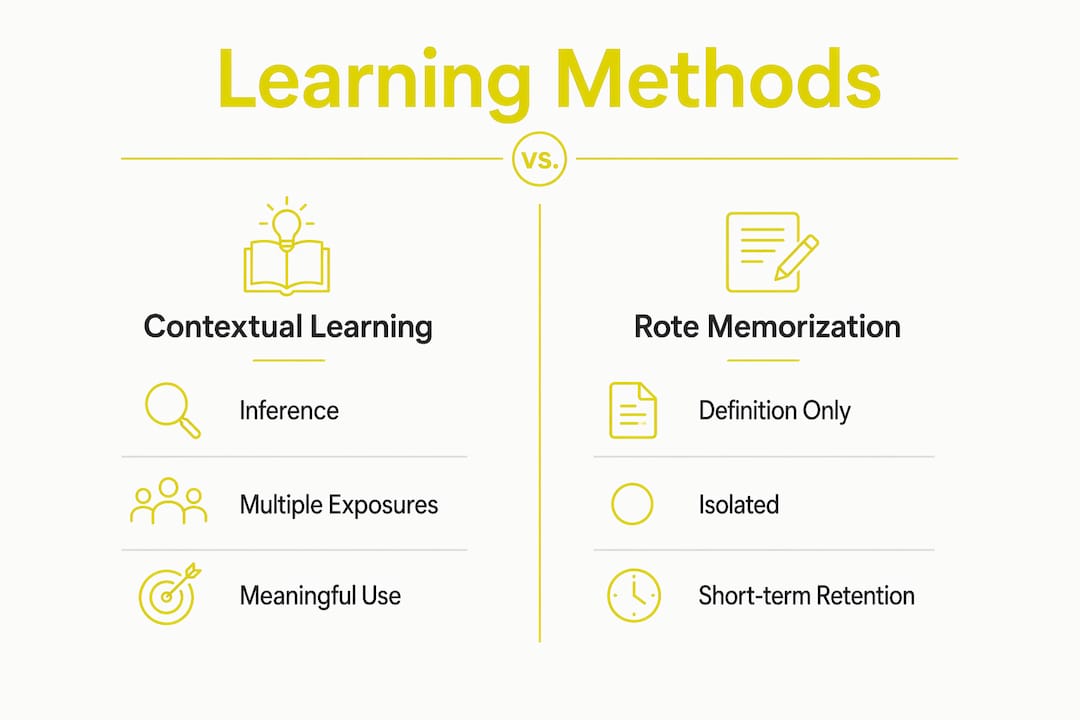
Rote memorization gives you a word and its definition, stripped of everything that makes language work. You might recognize the word on a test, but you will struggle to use it naturally in conversation or writing. Contextual learning, by contrast, gives you the word inside a living sentence, alongside the grammar it prefers, the register it belongs to, and the emotions it carries.
The practical difference shows up fast. A learner who memorizes that melancholy means “sadness” may still write “I feel melancholy about the weather today” and sound unnatural. A learner who has read melancholy in literary fiction, heard it in a song, and seen it in a news article understands that it carries a specific weight, a quiet, reflective sadness, not a sharp or sudden one.
Pro Tip: Do not abandon explicit instruction entirely. Use pre-teaching to learn the form and basic meaning of a word before you encounter it in context. Then let the context do the deeper work of showing you how the word actually lives in the language.
That said, contextual learning has real limitations when used without support. Unguided guessing from context may not significantly outperform traditional teaching on its own, particularly when learners have limited exposure to the language. The most effective approach combines explicit instruction with rich contextual exposure, using each method to strengthen the other.
What are effective contextual vocabulary strategies you can use?
Applying contextual vocabulary learning does not require a classroom or a tutor. These strategies work for independent learners at any level.
- Read widely and read often. Novels, news articles, song lyrics, and social media posts all expose you to words in natural contexts. The more varied your reading, the more contexts each word appears in, and repeated exposure in varied contexts strengthens the neural connections that make words stick.
- Pre-teach yourself before reading. Scan a text for unfamiliar words, look them up briefly, then read the full passage. This primes your brain to recognize the words in context and deepens the learning when you encounter them naturally.
- Practice the predict-check-use cycle. When you hit an unknown word, predict its meaning from context clues, check your prediction, then write one original sentence using the word. This three-step habit turns passive reading into active acquisition.
- Use semantic mapping. Draw a web connecting a new word to related words, synonyms, antonyms, and example sentences. This visual technique mirrors how your brain stores vocabulary in networks rather than isolated slots.
- Leverage song lyrics as context. Music provides emotionally charged, rhythmically memorable contexts for vocabulary. Platforms that embed vocabulary learning in song lyrics give you the repetition and emotional engagement that accelerate retention.
Beyond these core strategies, a few supporting habits make a measurable difference:
- Keep a vocabulary journal organized by context, not alphabetically. Write the sentence where you found the word, not just the definition.
- Use quizzes that test words in sentences, not in isolation. Research shows that quizzes that reinforce vocabulary in context produce stronger retention than simple recall tests.
- Review your vocabulary building checklist regularly to track which strategies you are actually using and which you have skipped.
- Talk with native speakers or language partners as often as possible. Conversation forces you to retrieve words in real contexts, which is the most demanding and most effective form of practice.
The combination of wide reading, guided pre-teaching, active inference, and social practice covers every stage of the vocabulary acquisition process. No single strategy does all of this alone.
Key takeaways
Contextual vocabulary learning outperforms rote memorization because it builds word knowledge through meaning, grammar, and repeated real-world exposure rather than isolated definitions.
| Point | Details |
|---|---|
| Definition of contextual learning | Acquiring word meanings through meaningful texts and situations, not isolated lists. |
| Guided context beats unguided guessing | Pre-teaching combined with contextual inference produces the strongest vocabulary gains. |
| Four types of context clues | Definition, synonym/antonym, example, and general clues each signal meaning differently. |
| Repeated varied exposure matters | Encountering words across multiple contexts stabilizes form-meaning connections in memory. |
| Best strategy is combined | Pair explicit instruction with rich contextual reading for maximum vocabulary growth. |
Why I stopped trusting word lists after my third language
I spent two years learning Portuguese with flashcard apps and vocabulary lists. My test scores were fine. My conversations were not. I would blank on words I had “learned” dozens of times because I had only ever seen them next to their English translations, never inside a sentence that meant something to me.
The shift happened when I started reading Brazilian news articles and listening to music with lyrics in front of me. Words I had failed to retain from lists started locking in after one or two encounters in context. Saudade is the obvious example everyone uses, but the real revelation was ordinary words. Prepositions, connectors, filler phrases. The stuff that makes you sound fluent. None of that lives in a word list.
What I have seen consistently, both in my own learning and in watching others, is that learners who read and listen widely in their target language outpace learners who study harder but in isolation. The role of context in language learning is not a soft benefit. It is the mechanism by which real fluency is built.
The uncomfortable truth is that most learners underestimate how much input they need. You do not learn a word from one contextual encounter. You need multiple exposures across different situations before it becomes truly yours. Patience with that process, and trust in it, is what separates learners who plateau from learners who break through.
— Ben
Learn vocabulary in context with Singwithcanary
Singwithcanary is built on exactly the principle this article describes. Every song on the platform is a contextual vocabulary lesson, with lyrics that show you how words live inside real, emotionally resonant language.
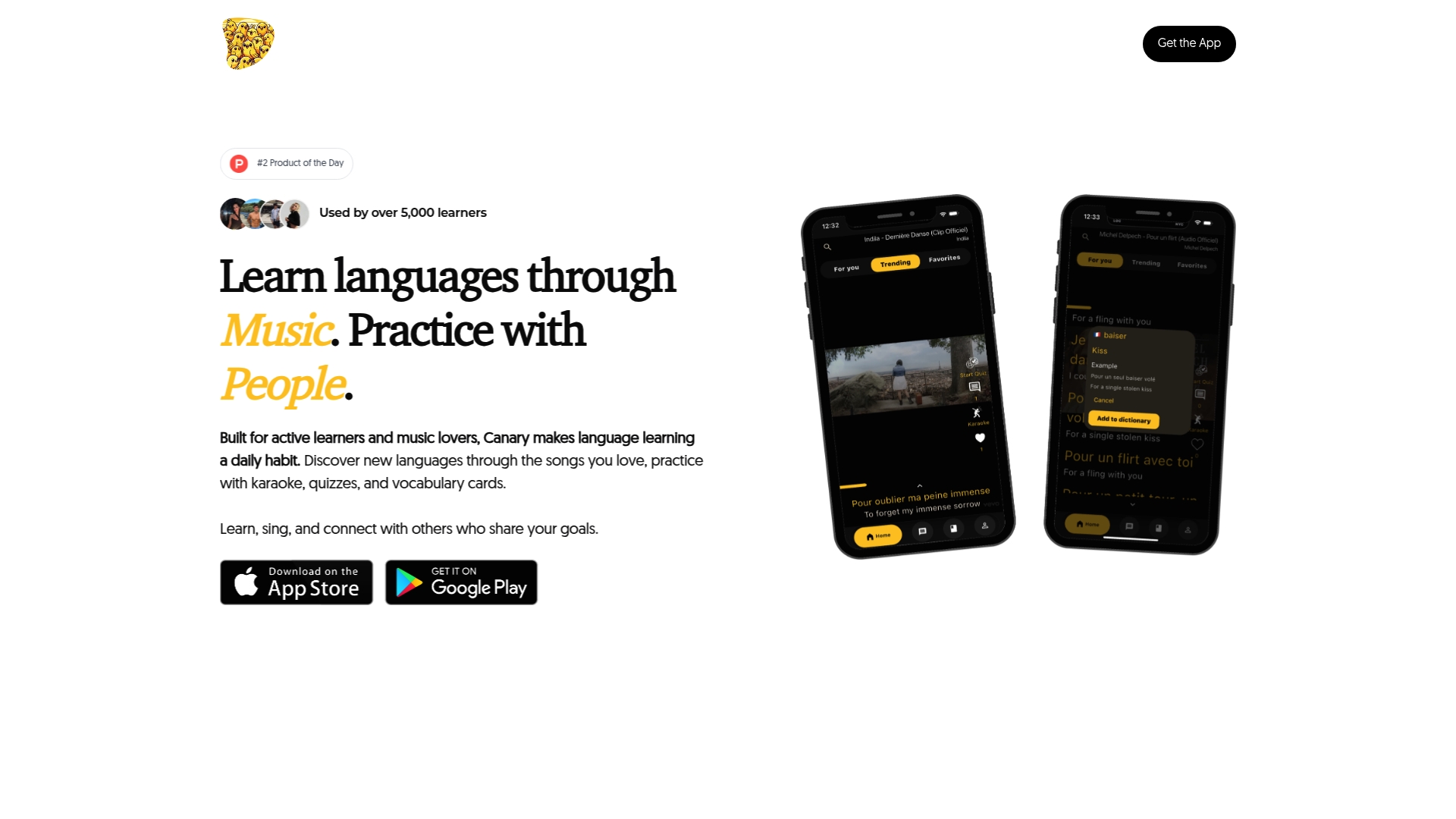
Canary’s interactive features, including karaoke, vocabulary cards, and quizzes, give you the guided repetition that research identifies as the key to turning contextual exposure into lasting knowledge. You are not just hearing words. You are hearing them in melody, rhythm, and cultural context, which is the richest possible learning environment. Start with the vocabulary building checklist to map your current approach, then learn languages with music on Singwithcanary to put contextual learning into daily practice.
FAQ
What is contextual vocabulary learning in simple terms?
Contextual vocabulary learning means picking up new word meanings by reading or hearing them inside real sentences and situations, rather than memorizing definitions from a list. Your brain retains words better when they come with surrounding meaning.
Is contextual guessing enough on its own?
Research shows that unguided contextual guessing alone is not sufficient for strong vocabulary growth. Combining pre-teaching with contextual inference produces significantly better results than either method used independently.
How many times do you need to see a word in context to learn it?
There is no single fixed number, but research consistently points to multiple exposures across varied contexts as necessary for stable acquisition. Each new context adds a layer of meaning that a single encounter cannot provide.
Can music help with contextual vocabulary learning?
Yes. Song lyrics provide emotionally charged, rhythmically memorable contexts that support retention. Platforms like Singwithcanary embed vocabulary directly inside lyrics, giving learners the contextual repetition that accelerates word knowledge.
What are the four types of context clues?
The four types are definition clues, synonym or antonym clues, example or illustration clues, and general contextual clues. Each type signals an unfamiliar word’s meaning differently, and recognizing these clue types is a trainable skill that improves with practice.