TL;DR:
- Active recall through quizzes significantly improves vocabulary retention, understanding, and motivation.
- Gamified quiz platforms like Quizlet and Duolingo enhance learning via rewards, streaks, and adaptive challenges.
- Combining quizzes with music, context, and multisensory practice leads to more engaging and effective language mastery.
Passive studying feels productive. You highlight words, read through lists, maybe flip a few flashcards, and assume the vocabulary is sinking in. But research keeps pointing to the same uncomfortable truth: passive review leaves most new words behind. Quizzes, on the other hand, force your brain to actively retrieve information, and that struggle is exactly what builds lasting memory. Frequent quizzes enhance motivation, engagement, and academic performance in ways passive methods simply cannot match. In this guide, you’ll learn why quizzes work so well for vocabulary, which tools and techniques deliver the best results, and how combining quizzes with music and context can transform your language learning routine.
Table of Contents
- How quizzes drive better vocabulary retention and understanding
- Fun, gamified learning: Tools and approaches that work
- Supporting active and multisensory learners, including music fans
- Quiz + context: Best practices and real-world tips
- Our perspective: Why a playful, multisensory approach wins
- Ready to level up your vocabulary journey?
- Frequently asked questions
Key Takeaways
| Point | Details |
|---|---|
| Quizzes boost recall | Regular quizzes create strong memory links, driving long-term vocabulary improvement. |
| Gamification makes learning fun | Quiz apps with points, rewards, and interactive features keep you motivated and engaged. |
| Active methods outperform passive | Retrieval through quizzes beats word list memorization for retention and understanding. |
| Combine quizzes with context | Use quizzes alongside reading and listening for a well-rounded, fluent language experience. |
| Music aids pronunciation | Pairing quizzes with songs or audio helps you master both vocabulary and pronunciation. |
How quizzes drive better vocabulary retention and understanding
Retrieval practice is the engine behind quiz-based learning. When you try to recall a word from memory, your brain strengthens the neural pathway connected to that word. Each successful retrieval makes the next one easier and faster. This is fundamentally different from re-reading a word list, where your brain stays passive and the information fades quickly.
The numbers behind this are striking. A recent study found strong correlations between quizzing and three critical outcomes:
| Outcome | Correlation (R²) |
|---|---|
| Retention | 0.504 |
| Understanding | 0.585 |
| Motivation | 0.724 |
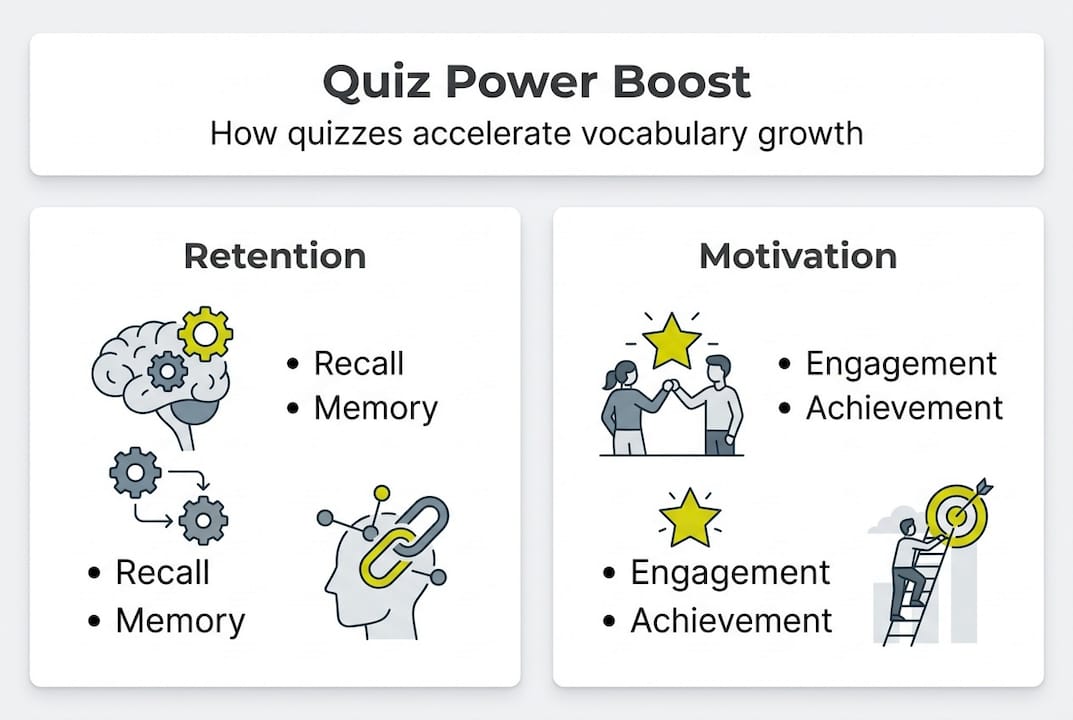
That motivation score is the real surprise. A correlation of R²=0.724 means quizzes don’t just help you remember words. They make you want to keep learning. That’s a feedback loop most language learners never tap into with traditional study methods.
Students who quiz regularly consistently outperform those who rely on passive review. The gap isn’t small. Understanding how quizzes impact memory shows that the testing effect, the cognitive boost from active recall, applies directly to vocabulary acquisition in a second language.
Here’s what makes quiz-based learning especially powerful for vocabulary:
- Immediate feedback corrects wrong assumptions before they become habits
- Spaced repetition schedules harder words more often, maximizing recall
- Variety in question formats keeps your brain from going on autopilot
- Timed challenges sharpen word recognition speed, which matters in real conversation
“The act of retrieving a memory changes the memory itself, making it more durable and accessible in the future.” This is why quizzes outperform re-reading every time.
Pro Tip: Always review your wrong answers immediately after a quiz. That moment of error correction is where the deepest learning happens, because your brain is primed and paying attention.
If you want to add music to your language routine, pairing song-based vocabulary with quiz review creates a powerful one-two punch for retention.
Fun, gamified learning: Tools and approaches that work
Knowing quizzes work is one thing. Making them a daily habit is another. This is where gamification steps in. Platforms like Quizizz, Quizlet, Memrise, and Duolingo wrap quiz mechanics inside game-like experiences, complete with streaks, leaderboards, rewards, and timers. The result is a learning environment that feels more like play than study.
The data backs this up. Quizlet and Quizizz significantly boost vocabulary achievement compared to traditional methods. In one study, Quizizz users showed a 30.5% improvement versus 19.3% in the control group. That’s a meaningful edge, especially over weeks and months of consistent practice.
Here’s how the leading platforms compare for vocabulary learning:
| Platform | Key feature | Best for |
|---|---|---|
| Quizizz | Live game mode, instant feedback | Group and solo practice |
| Quizlet | Flashcard plus test hybrid | Building word lists fast |
| Memrise | Native video clips, spaced repetition | Real-world context |
| Duolingo | Streaks, XP rewards, adaptive lessons | Daily habit formation |
Combining quizzes with spaced repetition and gamification optimizes learning in ways neither approach achieves alone. Spaced repetition schedules review at the exact moment you’re about to forget a word, and gamification keeps you showing up. Together, the effect size reaches g=1.251, which is considered a very large educational impact.
Here are the top reasons gamified quizzes outperform plain study sessions:
- Streaks and rewards create a daily commitment that feels personal
- Leaderboards add a social layer that increases effort and attention
- Timers simulate real-world pressure, building faster word recall
- Adaptive difficulty keeps the challenge in the sweet spot, not too easy, not overwhelming
- Instant scoring gives you a clear picture of progress, which fuels motivation
Pro Tip: Use adaptive quiz settings when available. Platforms that adjust question difficulty based on your performance help you learn at your optimal pace instead of grinding through words you already know.
For learners who love music, music-based quiz methods take this a step further by embedding vocabulary in song lyrics, making every quiz feel like a game and a cultural experience at once. And if you’re curious how gamification in language learning works on a deeper level, the mechanics are surprisingly well-studied.
Supporting active and multisensory learners, including music fans
Not everyone learns the same way. Some people absorb vocabulary by reading. Others need to hear it, say it, or connect it to a rhythm before it sticks. Quizzes are uniquely flexible because they can incorporate text, audio, images, and even music, making them one of the most adaptable tools in any learner’s kit.
Quizzes support active learners via gamification and multisensory engagement, which is especially relevant for music fans. When a quiz plays an audio clip and asks you to identify a word or phrase, you’re training your ear and your memory at the same time. That’s a level of engagement a static word list can never offer.
Here’s why multisensory quizzes work so well for music-oriented learners:
- Audio prompts train your ear to recognize words in natural speech, not just in print
- Rhythm and melody create emotional memory anchors that make words stick longer
- Visual cues paired with sound reinforce meaning from multiple angles
- Active response (typing, speaking, selecting) keeps attention sharp throughout
“Duolingo-style pretesting improved cued recall with effect sizes of d=0.18 to 0.40, even when learners answered incorrectly before seeing the right answer.”
This is called the pretesting effect, and it’s a fascinating quirk of memory. Being wrong first actually helps you remember the correct answer better. Music fans who already enjoy interactive and music-driven learning will find that quizzes fit naturally into a song-based routine.
Pro Tip: After learning vocabulary from a song, create or find a quiz based on those same lyrics. The familiar melody acts as a retrieval cue, making it easier to recall words during the quiz and later in real conversation.
Building a consistent language learning workflow that includes both music and quizzes doesn’t have to be complicated. Even 10 minutes a day of quiz practice tied to songs you enjoy can produce noticeable gains in pronunciation and vocabulary. And if you want a structured path, expanding vocabulary with music offers a practical starting point.
Quiz + context: Best practices and real-world tips
Quizzes are powerful, but they’re not magic on their own. The biggest mistake learners make is treating vocabulary as a list of isolated words to memorize. Real fluency means knowing how a word sounds, what it feels like in a sentence, and when to use it. Quizzes handle the recall side brilliantly, but context fills in the rest.
“While superior for retention, quizzes alone may not build deep contextual use. They’re best combined with reading and input-based practice for genuine fluency.”
Retrieval practice via quizzes outperforms elaborative study methods for vocabulary, but the smartest learners use both. Think of quizzes as the foundation and reading or listening as the walls. One without the other leaves the structure incomplete.
Here’s the most effective learning sequence to follow:
- Encounter the word in context (song lyrics, a short story, a podcast clip)
- Quiz yourself immediately to test initial recognition
- Review feedback and note any errors right away
- Use the word actively in a sentence, out loud if possible
- Return for a spaced quiz 24 to 48 hours later to lock it in
Common pitfalls to avoid:
- Relying only on multiple-choice quizzes, which can feel easier than they actually are
- Skipping the review of wrong answers, which wastes the most valuable learning moment
- Studying word lists without ever hearing the words spoken naturally
- Quizzing the same words every day instead of spacing them out over time
Quiz and reading strategies work best when they reinforce each other. Read a passage, quiz yourself on key vocabulary, then read again. You’ll notice how much more meaning you extract the second time. The importance of context when using quizzes cannot be overstated, especially for learners aiming for conversational fluency rather than just test scores.
Our perspective: Why a playful, multisensory approach wins
Here’s what years of watching language learners succeed and struggle has taught us: the method that feels fun is the method that gets repeated. And repetition is everything in language learning.
Conventional memorization feels like work because it is work, with very little payoff in the short term. Quizzes flip that equation. They give you immediate feedback, a score, a sense of progress. Add music to the mix, and something deeper happens. A melody becomes a memory hook. A lyric becomes a vocabulary lesson you didn’t even realize you were taking.
We believe the combination of quizzes, music, and spaced repetition isn’t just more effective. It’s more human. It reduces the anxiety that kills motivation for so many learners and replaces it with genuine curiosity. When you boost vocabulary with songs and test yourself on what you’ve heard, you’re not just learning words. You’re building a relationship with the language.
Playfulness isn’t a shortcut. It’s the strategy.
Ready to level up your vocabulary journey?
If you’ve made it this far, you already know that quizzes paired with music and context are one of the smartest ways to grow your vocabulary and sharpen your pronunciation. The next step is putting it into practice with tools built for exactly this kind of learning.
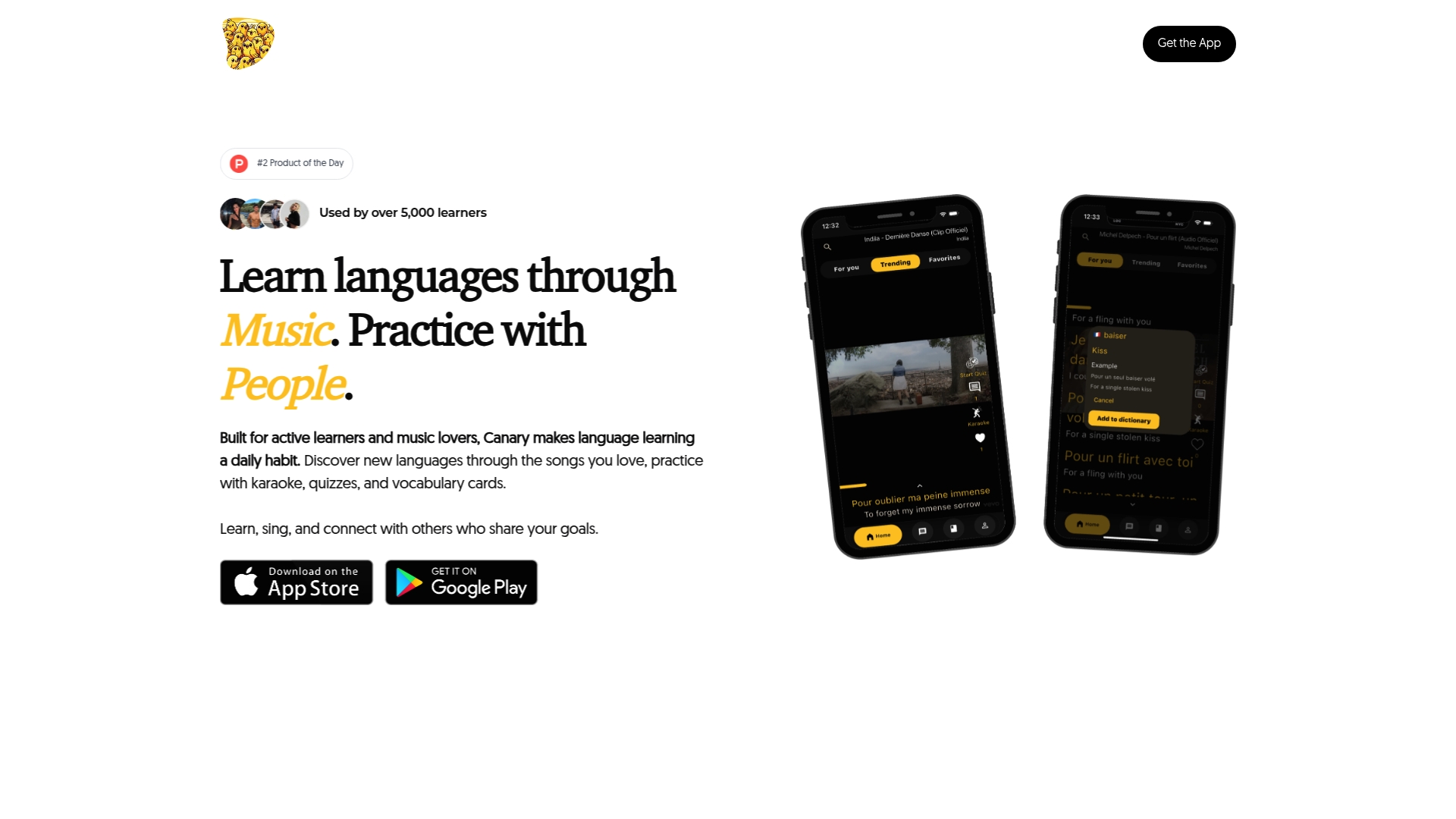
Canary combines music-based language learning with interactive quizzes, karaoke, and vocabulary cards so every session feels like a discovery rather than a chore. Whether you’re just starting out or pushing toward fluency, you’ll find language learning tips for music lovers and practical tools that fit your style. Dive into the educational benefits of music in language and see how a song-powered routine can make vocabulary growth feel effortless and genuinely enjoyable.
Frequently asked questions
Are quizzes better than flashcards for vocabulary improvement?
Both tools help, but quizzes that space and randomize questions deliver stronger motivation and deeper memory benefits. Frequent quizzes enhance recall and motivation more than passive review methods like standard flashcards.
How often should I take vocabulary quizzes?
Aim for short quiz sessions several times a week and always review your mistakes right after. Benefits increase with more repetitions and timely feedback, so consistency matters more than session length.
Can quizzes help with pronunciation too?
Absolutely. Using quizzes that include audio prompts or song-based content trains your ear alongside your memory. Quizzes with multisensory engagement directly support pronunciation development, not just word recognition.
Do quizzes alone make me fluent?
Quizzes are excellent for recall and recognition, but fluency also requires reading, listening, and real conversation practice. Quizzes alone may not build deep contextual understanding, so pair them with input-rich activities for the best results.