Peer-to-peer learning reliably improves knowledge retention, transferable skill development, and engagement for both the person teaching and the person being taught. The research base is substantial: multiple meta-analyses and systematic reviews confirm positive effects across post-secondary education, clinical training, and workplace settings.
Here is what the evidence consistently shows:
- Cognitive gains: Learners retain and apply material more effectively when they explain it to peers, not just receive it from an instructor.
- Social and emotional lift: Peer formats lower anxiety, build a sense of belonging, and increase engagement in ways that solo study rarely matches.
- Metacognitive growth: Both tutors and tutees develop stronger self-monitoring, communication, and feedback skills through the act of teaching and being taught.
- Practical scale: Peer programs cost less to run than instructor-led sessions and scale across large cohorts without proportional increases in faculty time.
The evidence base draws from peer-reviewed meta-analyses, randomized controlled trials, and practitioner reviews spanning medical education, higher education, and language learning.
Table of Contents
- What are the benefits of peer-to-peer learning, and how does it work?
- Why peer learning delivers across cognitive, social, and workplace domains
- What does the research actually say about peer learning effectiveness?
- Which peer-to-peer model fits your learning goal?
- How to run a peer-to-peer learning session that actually works
- Where peer learning fails and how to fix it
- How peer practice accelerates language learning
- Key Takeaways
- Why small, structured pilots beat grand peer learning rollouts
- Peer-driven language practice with music and social interaction
- Useful sources
What are the benefits of peer-to-peer learning, and how does it work?
Peer-to-peer learning, also called peer-assisted learning (PAL), is a structured approach in which learners at similar levels teach, coach, and give feedback to one another rather than relying solely on an instructor. The key word is structured: casual study groups are not the same thing. Effective peer learning involves defined roles, clear tasks, and some form of facilitation or oversight.
Several cognitive and social mechanisms explain why it works.
Cognitive congruence
A peer tutor who recently mastered a concept remembers what confused them. That shared experience lets them pitch explanations at exactly the right level, avoiding the “curse of knowledge” that affects expert instructors. Research in health professional education identifies cognitive congruence as one of the primary reasons PAL produces strong outcomes: peers with similar knowledge bases provide more relatable explanations and more targeted scaffolds than distant experts can.
Zone of Proximal Development (ZPD)
Lev Vygotsky’s ZPD describes the gap between what a learner can do alone and what they can do with support. A peer tutor who is only slightly ahead sits naturally in that zone. They can stretch the tutee without overwhelming them, which is harder for an instructor operating from a much higher level of mastery.
Retrieval practice and the protégé effect
Preparing to teach forces you to retrieve and reorganize what you know. The act of explaining to someone else consolidates that knowledge far more than re-reading notes. This “protégé effect” means tutors often gain as much as tutees, sometimes more, in terms of long-term retention and conceptual organization.
Social scaffolding
Learning alongside peers creates a low-stakes environment where questions feel safer to ask. That psychological safety encourages deeper engagement with difficult material. Social interaction also provides accountability: knowing a peer is counting on you to show up and contribute changes behavior in ways that solo deadlines rarely do.
One note on modality: cognitive congruence and retrieval practice work in any format, but social scaffolding tends to be stronger in synchronous settings (face-to-face or live video), while asynchronous online formats often produce more thoughtful written feedback. A review comparing online and face-to-face peer learning found that online modalities can match or modestly outperform face-to-face on cognitive outcomes, while blended models tend to capture the best of both.
Why peer learning delivers across cognitive, social, and workplace domains
The advantages of peer learning fall into four categories. Each maps to a different outcome you can actually measure.
Cognitive and achievement benefits
Learners who teach or explain material to peers consistently outperform those who only receive instruction on retention tests and transfer tasks. The mechanism is active processing: explaining requires you to identify gaps, resolve contradictions, and build coherent mental models. Peer review tasks, where learners critique each other’s work, produce similar gains because they require analytical engagement rather than passive reading.
- Stronger long-term retention compared to lecture-only formats
- Better transfer of knowledge to novel problems and real-world tasks
- Higher exam performance in structured peer tutoring programs
Social and emotional benefits
Peer formats reduce the anxiety that often accompanies high-stakes instructor evaluation. When a fellow learner asks you to explain something, the social cost of being wrong feels lower. Practitioner guidance from WGU notes that peer learning increases engagement, lowers barriers to participation, and supports the social bonds that aid long-term retention. A scoping review of PAL in health professional education found that peer programs improve self-efficacy and reduce stress for both tutors and tutees.
- Lower test anxiety and higher confidence in applying skills
- Stronger sense of community and belonging within a cohort
- Reduced burnout risk through shared workload and mutual support
Metacognitive and communication skills
Teaching is one of the most demanding metacognitive tasks there is. To explain something clearly, you have to know what you know, identify what you do not, and find language that bridges the gap. Tutors develop these skills rapidly. They also build leadership, professional communication, and feedback literacy, skills that transfer directly to workplace performance.
The protégé effect is well-documented: a PLOS One meta-analysis of 81 randomized controlled trials found that PAL often surpassed traditional methods for both knowledge transfer and practical skill acquisition, with tutors showing gains in organization of knowledge and communication alongside tutees’ content gains.
Practical and organizational benefits
Peer programs scale. Once a cohort of trained peer tutors is in place, the program can serve far more learners than a single instructor could reach. Costs per learner drop significantly compared to additional faculty hours. Peer networks also persist beyond the formal program: learners who study together often continue supporting each other informally, extending the program’s value without additional investment.
Pro Tip: When designing a peer program for a large cohort, train a small group of peer leaders first, then have them train the next tier. This “train-the-trainer” cascade scales quality without scaling cost.
What does the research actually say about peer learning effectiveness?
The evidence base is solid but not uniform. Here is what the strongest studies show and where the limits are.
Representative meta-analyses
A multilevel meta-analysis published in the Journal of Peer Learning examined 28 post-secondary studies and reported an average effect size of approximately 0.36 standard deviations for cognitive achievement compared with non-peer-led groups. That is a moderate effect, and serves as the main quantitative benchmark for cognitive gains. Task type and tutor training were the two strongest moderators: problem-based learning tasks and trained peer leaders produced substantially higher effects than content-review tasks with untrained tutors.
In clinical education, the evidence is even stronger. A PLOS One meta-analysis of 81 RCTs found that PAL frequently outperformed traditional instruction for both theoretical knowledge and practical skills, with higher student satisfaction scores. A separate PubMed meta-analysis reported a positive overall effect on clinical knowledge and skills, again flagging task type and tutor training as key moderators.
Key caveats
| Caveat | What it means in practice |
|---|---|
| High heterogeneity across studies | Effect sizes vary widely; a result from clinical training may not transfer directly to corporate onboarding |
| Measurement limits | Most studies measure short-term knowledge tests; long-term transfer and behavioral change are rarely tracked |
| Tutor training as a moderator | Untrained tutors produce inconsistent results; structured preparation is not optional |
| Task type matters | Problem-based and application tasks outperform simple content-review tasks in most meta-analyses |
| Publication bias | Studies with positive outcomes are more likely to be published; real-world averages may be somewhat lower |
Metrics worth tracking in a pilot
When you run a peer learning pilot, measure at least three things: knowledge retention at two weeks post-session (not just immediately after), self-reported confidence before and after, and participation rates across sessions. If you can add a transfer task, a problem the learners have not seen before that requires applying what they learned, you will have a much clearer picture of whether the format is actually working.
Which peer-to-peer model fits your learning goal?
Different formats serve different purposes. Matching the model to the goal is where most programs either succeed or stall.
| Model | Structure | Best fit | Example use case |
|---|---|---|---|
| Peer instruction | Instructor poses a question; learners discuss in pairs before responding | Large classes, conceptual content | Physics or economics courses using clicker questions |
| Peer tutoring | One learner (tutor) works with one or a small group (tutees) | Skill gaps, remediation, clinical training | Medical students practicing physical examination techniques |
| Study groups | Small groups review and discuss material collaboratively | Exam preparation, content-dense subjects | Law students working through case briefs together |
| Peer review | Learners critique each other’s written or practical work | Writing, project-based learning, design | MBA students reviewing each other’s business plans |
| Mentoring | More experienced learner guides a less experienced one over time | Onboarding, career development, leadership | Senior employee mentoring a new hire |
| Communities of practice | Practitioners share knowledge and solve problems together informally | Professional development, knowledge management | Software developers sharing solutions in a Slack channel |
Structured peer programs with trained leaders consistently outperform unstructured ones. The table above is a starting point; the right choice depends on cohort size, content complexity, and whether the goal is knowledge acquisition, skill transfer, or professional development.
A review of online versus face-to-face peer learning suggests that blended models, combining asynchronous peer review with synchronous discussion, often capture the strongest cognitive and social outcomes. For distributed teams or language learners spread across time zones, this is worth building into the design from the start.
How to run a peer-to-peer learning session that actually works
Implementation is where good intentions meet reality. This checklist covers the full cycle.
Where peer learning fails and how to fix it
Peer learning is not self-correcting. Left unmanaged, several failure modes will undermine even a well-designed program.
Common failure modes
Inaccurate explanations. An undertrained tutor who is confident but wrong can entrench misconceptions faster than a lecture ever could. This is the most serious risk in content-dense or high-stakes subjects.
Free-riding. In group formats, one or two participants often do most of the cognitive work while others coast. Defined roles and individual accountability tasks (each person submits their own transfer task) largely solve this.
Weak facilitation. Peer sessions without any oversight drift toward social conversation or surface-level review. A facilitator who circulates and asks probing questions keeps the cognitive load where it belongs.
Trust and status dynamics. Learners sometimes resist being taught by a peer, particularly in professional or hierarchical settings. Framing the tutor role as a learning opportunity for the tutor, not just a service to the tutee, reduces this resistance.
Surface learning. Peer discussion can feel productive while producing only shallow understanding. Problem-based tasks and transfer assessments are the antidote.
Mitigation tactics
- Train tutors before the program starts, not during it.
- Use calibration checks: compare tutor explanations against a model answer or expert review.
- Mix peer sessions with instructor-led consolidation, especially for complex or error-prone content. A PMC literature review is clear that PAL works best as a complement to faculty-led instruction, not a wholesale replacement.
- Define assessment rubrics in advance and share them with both tutors and tutees.
- Run faculty spot-checks on at least a sample of peer sessions, particularly early in the program.
When to bring the instructor back in: If transfer task scores are flat after two or three peer sessions, or if tutors are consistently struggling to explain a concept accurately, that is a signal to run an instructor-led session on that specific content before continuing peer work.
How peer practice accelerates language learning
Language learning is one of the clearest cases where peer-to-peer methods pay off fast. Pronunciation, vocabulary retention, and listening comprehension all improve with repeated social practice, and the feedback loop between peers is often more immediate and less intimidating than instructor correction.
The social dimension of language practice matters here in a specific way: learners who practice with peers make more attempts, tolerate more ambiguity, and recover from errors faster than those who only practice alone or in formal instructor-led settings.
Concrete peer activities for language learners
Lyric breakdown pairs. Two learners take a song in the target language and work through the lyrics line by line: one explains what they think a phrase means and why, the other challenges or confirms. This combines retrieval practice with cognitive congruence, since both learners are at a similar level and share the same gaps. Song-based practice is particularly effective for vocabulary retention because the melodic context creates an additional memory hook.
Karaoke shadowing sessions. One learner sings or speaks a line; the other listens and gives specific feedback on pronunciation, stress, or intonation. Roles then switch. The musical structure keeps the activity focused and low-stakes, which is exactly the environment where pronunciation practice is most productive.
Peer feedback cycles on spoken output. Learners record a short spoken response to a prompt, share it with a partner, and receive written or voice feedback using a simple rubric (clarity, accuracy, naturalness). This asynchronous format works well for learners in different time zones and produces more considered feedback than real-time correction.
A short implementation checklist for language learning pairs:
- Agree on one specific focus per session (pronunciation, vocabulary, grammar) rather than trying to cover everything.
- Use a shared rubric so feedback is consistent and not just “that sounded good.”
- Rotate the tutor and tutee roles every session so both learners get the protégé effect.
- Track vocabulary items that come up repeatedly across sessions; these are your highest-priority items to consolidate.
- Keep sessions to 20–30 minutes. Shorter, frequent sessions outperform long, infrequent ones for language retention.
Platforms that combine music, social interaction, and structured feedback, like Singwithcanary’s approach of pairing karaoke, vocabulary cards, and peer practice, align directly with these principles. The best group language learning ideas often involve exactly this kind of structured social activity built around shared content.
Key Takeaways
Peer-to-peer learning produces gains in knowledge retention, skill transfer, and engagement when sessions are structured, tutors are trained, and tasks require active problem-solving rather than passive review.
| Point | Details |
|---|---|
| Moderate, consistent effect | A multilevel meta-analysis of post-secondary studies found an average effect size of approximately 0.36 standard deviations for cognitive achievement. |
| Tutor training is non-negotiable | Untrained tutors produce uneven results; structured preparation is the single strongest design lever. |
| Both roles benefit | The protégé effect means tutors gain in retention, communication, and leadership alongside tutees’ content gains. |
| Blended formats work best | Combining asynchronous peer review with synchronous discussion captures stronger cognitive and social outcomes than either alone. |
| Singwithcanary as a peer practice tool | For language learners, Singwithcanary’s music-based, social practice approach directly supports the peer feedback and retrieval practice mechanisms that drive retention. |
Why small, structured pilots beat grand peer learning rollouts
The conventional advice is to “implement peer learning at scale.” The better advice is to run a two-week structured pilot with one cohort, measure three things (retention, confidence, participation), and then decide whether to expand.
Most programs that fail do so not because peer learning does not work but because they skip the calibration step. Tutors are assigned without training, tasks are vague, and facilitators assume the format will carry itself. It will not. The research is consistent on this: structured programs with trained leaders outperform unstructured ones by a meaningful margin, and that gap widens in content-dense or high-stakes subjects.
The other thing practitioners underestimate is the tutor’s gain. Programs are often sold to tutors as a service they provide to others. Reframe it honestly: teaching is one of the most effective learning strategies available, and the tutor typically comes out ahead on long-term retention. That framing changes who volunteers, how seriously they prepare, and how much they get out of the experience.
Start small. Train the tutors. Use a problem-based task. Measure transfer, not just satisfaction. Then scale what works.

Peer-driven language practice with music and social interaction
If you are a language learner looking to put peer-to-peer principles into practice, Singwithcanary gives you a ready-made environment for exactly that. The platform pairs song-based vocabulary and pronunciation work with social features: karaoke sessions, lyric quizzes, vocabulary cards, and practice with other learners and native speakers from around the world. That combination directly activates the mechanisms this article covers, retrieval practice through lyric work, cognitive congruence through peer feedback, and social scaffolding through community interaction.
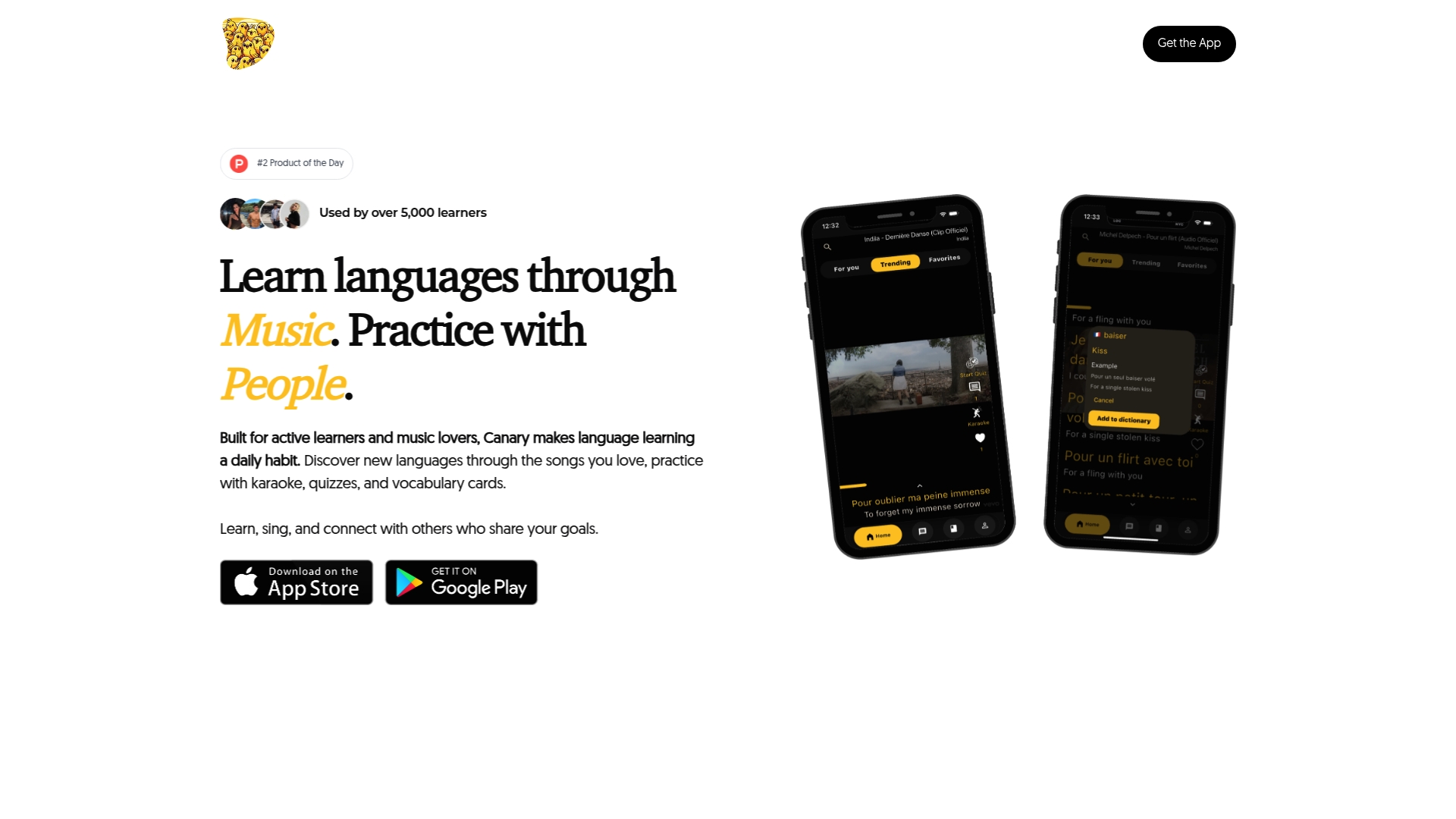
It is not a replacement for structured study, but it is one of the most natural ways to build the daily practice habit that peer learning research consistently points to as the difference between short-term gains and lasting fluency. Learn languages with music at Singwithcanary or sign up to start practicing today.
Useful sources
-
Effectiveness of Peer-assisted learning in medical education: A meta-analysis study — (PLOS One) — Meta-analysis of 81 RCTs; documents the protégé effect and PAL’s advantage over traditional methods for knowledge transfer and practical skills.
-
Effectiveness of Peer-Assisted Learning in medical education: a meta-analysis study — (PubMed) — Meta-analysis reporting moderate positive effects on clinical knowledge and skills; identifies task type and tutor training as key moderators.
-
Journal of Peer Learning: multilevel meta-analysis of peer-led learning in post-secondary education — Reports an average effect size of ~0.36 SD across 28 post-secondary studies; the clearest quantitative benchmark for expected cognitive gains.