Singing new vocabulary can improve your long-term retention by up to 30% compared to traditional memorization. If you’ve struggled to remember words or perfect your accent in French, Spanish, Italian, or German, music might be the missing ingredient. This guide reveals how music activates memory pathways, sharpens pronunciation, and keeps you motivated through social engagement.
Table of Contents
- The Neurological Basis Of Music And Memory In Language Learning
- How Music Enhances Vocabulary Retention
- Mechanisms Behind Pronunciation Improvement With Music
- The Social Dimension: Learning Languages Through Music Together
- Choosing The Right Songs And Techniques For Language Learning
- Comparing Music-Based Learning With Traditional Methods
- Practical Steps To Incorporate Music In Your Language Learning Routine
- Discover The Best Platform To Learn Languages With Music
- Frequently Asked Questions
Key takeaways
| Point | Details |
|---|---|
| Music engages memory centers | Activates auditory cortex and hippocampus for stronger vocabulary consolidation. |
| Singing improves retention | Vocabulary learned through song sticks 30% better than rote methods. |
| Rhythm sharpens pronunciation | Musical practice can boost accent accuracy by 25%. |
| Social music increases practice | Group singing and karaoke raise practice frequency by 40%. |
| Song selection matters | Moderate tempo (80-100 BPM) and repetitive choruses optimize learning. |
The neurological basis of music and memory in language learning
Your brain treats music differently than spoken language. When you listen to a song in your target language, music activates the auditory cortex and hippocampus, two regions essential for memory consolidation. The hippocampus encodes new information while the auditory cortex processes sound patterns, creating dual pathways that strengthen recall.
Rhythm adds another layer. When you sing along, your brain’s motor areas light up alongside speech centers. This coordination between rhythm and vocalization creates what neuroscientists call “motor memory,” where your mouth literally remembers the movements needed for accurate pronunciation. Research shows this rhythmic engagement improves pronunciation accuracy by stimulating the same neural circuits you use for native speech.
Melody acts as a mnemonic device. The same way you remember song lyrics from decades ago, pairing vocabulary with melody creates hooks that make retrieval easier. Consider these neurological advantages:
- Dual encoding through melody and lyrics creates redundant memory traces
- Emotional responses to music strengthen memory consolidation
- Repetitive musical structures reinforce vocabulary through natural repetition
- Rhythmic patterns help chunk information into memorable units
Pro Tip: Choose songs with emotional resonance. Your brain releases dopamine during pleasurable music, which enhances memory formation and makes vocabulary stick longer.
Understanding the role of music in language learning from a brain science perspective explains why this method feels effortless compared to flashcards. The neuroscientific research on music and memory confirms what language learners have intuited for generations.
How music enhances vocabulary retention
Traditional vocabulary drills force your brain to create arbitrary associations. Music provides context, emotion, and structure that make words memorable without conscious effort. Studies demonstrate that singing new vocabulary improves retention by up to 30% compared to rote memorization.
Repetitive choruses work like spaced repetition on autopilot. Each time the chorus returns, you encounter target vocabulary in the same melodic context. This repetition happens naturally as you enjoy the song, not through forced review sessions. Your brain registers each exposure, strengthening neural pathways without the fatigue of drilling.
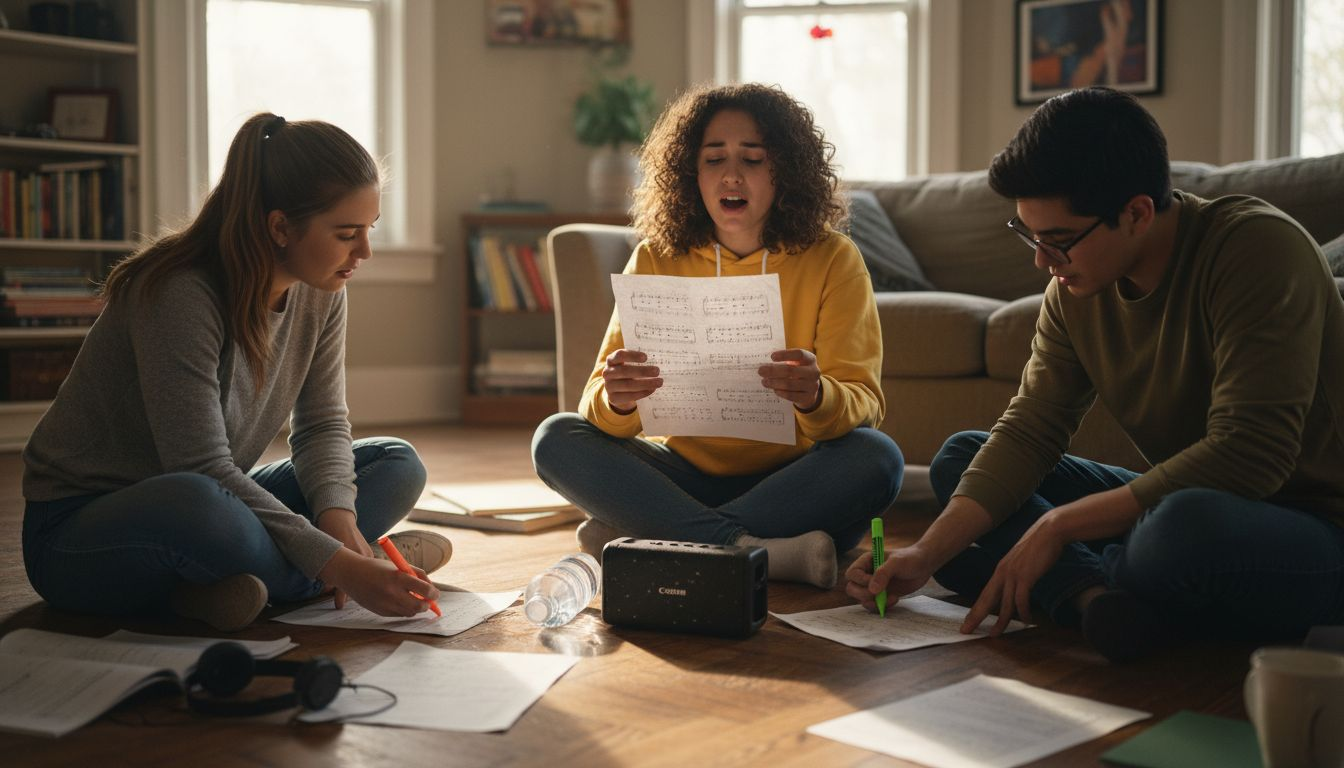
Emotional anchoring makes the difference. When a song moves you, your amygdala tags associated memories as important. Vocabulary learned during emotional experiences gets prioritized in long-term storage. Compare remembering “tristeza” from a grammar list versus hearing it in a melancholic ballad. The emotional version sticks.
The benefits of learning languages with songs extend beyond simple memorization:
- Context clues from lyrics help infer meaning without translation
- Cultural references embedded in songs deepen understanding
- Natural word order and colloquialisms appear in authentic usage
- Multiple senses engage simultaneously during musical learning
Real examples of learning with music show learners absorbing vocabulary they never formally studied. You pick up prepositions, verb conjugations, and idiomatic expressions through repeated listening. The study on singing and memory retention measured this effect quantitatively, proving music’s superiority for vocabulary acquisition.

Mechanisms behind pronunciation improvement with music
Accurate pronunciation requires training your mouth and ear simultaneously. Music accomplishes both through rhythm and melody. Research indicates that integrating rhythm and melody enhances pronunciation accuracy by engaging motor centers responsible for speech production.
Follow these steps to leverage music for pronunciation:
- Listen actively to identify sounds that differ from English
- Shadow sing by mimicking the vocalist’s accent and timing
- Record yourself to compare against the original
- Focus on rhythmic patterns that carry stress and intonation
- Practice problem sounds repeatedly within musical phrases
Rhythm forces precision. When you sing on beat, you can’t mumble through difficult sounds. The tempo pushes you to articulate clearly and match the vocalist’s timing. This constraint actually helps by eliminating the option to slow down and overthink.
Ear training happens passively. As you listen repeatedly, your auditory system tunes into subtle distinctions between similar phonemes. You start hearing the difference between the French “u” and “ou” or the rolled Spanish “r” versus the single tap. This discrimination ability transfers directly to your speaking.
Pro Tip: Use slow playback features on music apps to catch pronunciation details at half speed, then gradually increase tempo as you master the sounds.
Platforms offering music-infused pronunciation practice provide structured ways to apply these principles. The research on rhythm and pronunciation improvement demonstrates measurable gains in accent accuracy for learners who incorporate musical practice consistently.
The social dimension: learning languages through music together
Language learning thrives on interaction, yet traditional methods isolate you with textbooks. Music naturally creates opportunities for social practice. Studies show social interaction during musical language learning boosts motivation and practice frequency significantly.
Group singing multiplies engagement. When you join others in karaoke or sing-alongs, social pressure and encouragement keep you participating. Research indicates these collaborative activities increase practice frequency by 40% compared to solo study. You show up because others expect you, creating accountability that solitary learning lacks.
Online music communities offer global connections. You can practice with native speakers who share your musical taste, making conversations feel natural rather than forced. These interactions provide:
- Real-time feedback on pronunciation from peers
- Cultural context that textbooks miss
- Motivation through friendly competition and shared goals
- Diverse accents and speaking styles for comprehensive listening practice
Confidence builds through performance. Singing in front of others, even virtually, reduces speaking anxiety. Each karaoke session desensitizes you to the fear of making mistakes. This confidence transfers to regular conversations, making you more willing to speak up.
The role of music in language learning extends beyond individual practice to community building. Weekly challenges like the song of the week feature create shared experiences that bond learners. The study on social musical language learning confirms that this social element dramatically improves outcomes and reduces dropout rates.
Choosing the right songs and techniques for language learning
Not all songs work equally well for learning. Strategic selection maximizes your progress and prevents frustration. Research shows songs with 80-100 BPM and repeated vocabulary yield 25% better retention than randomly chosen tracks.
Tempo matters significantly. Songs that are too fast overwhelm beginners, while very slow songs lack the rhythmic drive that aids memory. The sweet spot of 80-100 beats per minute gives you time to process lyrics without losing momentum. Check BPM using music apps before committing to a new song.
Repetition amplifies learning. Look for choruses that repeat target vocabulary three to five times. Each repetition strengthens memory without feeling tedious because it’s embedded in an enjoyable song. Verses can introduce new vocabulary while choruses reinforce core words.
| Song Feature | Beginner | Intermediate | Advanced |
|---|---|---|---|
| Tempo (BPM) | 70-90 | 80-100 | 90-120 |
| Vocabulary density | 30-50 unique words | 50-80 unique words | 80+ unique words |
| Repetitions of key words | 5-7 times | 3-5 times | 2-3 times |
| Slang/idioms | Minimal | Moderate | Extensive |
| Accent clarity | Very clear | Standard | Regional/fast |
Match difficulty to proficiency. Beginners should choose children’s songs or pop with simple vocabulary. Intermediate learners can handle mainstream pop and folk. Advanced students benefit from rap, poetry-heavy indie, or regional genres with dialectical features.
Pro Tip: Create themed playlists around topics like travel, emotions, or food to build vocabulary clusters that reinforce each other contextually.
Explore the educational benefits of music language learning through various types of musical learning methods that suit your style. The research on song features for vocabulary learning provides evidence-based criteria for making smart choices.
Comparing music-based learning with traditional methods
Each approach has strengths. Understanding the differences helps you combine methods effectively rather than choosing one exclusively.
| Aspect | Music-Based Learning | Traditional Methods |
|---|---|---|
| Vocabulary retention | 30% higher than rote methods | Effective with spaced repetition systems |
| Pronunciation | 25% improvement through rhythm | Depends on instructor feedback quality |
| Learner motivation | High engagement, 40% more practice | Variable, often decreases over time |
| Grammar focus | Implicit through context | Explicit, systematic coverage |
| Social interaction | Built-in through group activities | Limited to classroom or tutoring |
| Dropout rate | 15-20% lower than traditional | Higher due to monotony |
| Cultural immersion | Natural through authentic songs | Requires supplemental materials |
| Cost | Often free or low cost | Classes and materials add up |
Music excels at retention and motivation. When vocabulary appears in songs, your brain encodes it with melody, emotion, and context. This multi-sensory encoding beats flashcards for long-term recall. The social and emotional aspects keep you coming back, reducing the dropout rates that plague language learning.
Traditional methods provide structure. Grammar rules and systematic vocabulary building create a foundation that music alone might miss. You need to understand verb conjugations and sentence structure to construct your own sentences, not just sing along.
The optimal strategy combines both:
- Use music for vocabulary acquisition and pronunciation training
- Supplement with grammar study to understand structure
- Practice speaking with tutors or language partners
- Read texts to see written forms of vocabulary you know from songs
Explore different types of language learning methods for music lovers to find your ideal mix. Neither approach alone suffices, but together they create comprehensive learning that’s both effective and enjoyable.
Practical steps to incorporate music in your language learning routine
Ready to start? Follow these steps to build a music-centered practice that delivers results.
- Select three songs at your level using the tempo and repetition criteria discussed earlier
- Listen actively for one week, reading lyrics while playing tracks daily
- Practice karaoke-style by singing along with lyrics visible until you can match the vocalist
- Remove lyrics and sing from memory to test your retention
- Join an online community or local group for weekly sing-alongs
- Rotate in new songs monthly while keeping favorites for continued practice
Consistency beats intensity. Fifteen minutes of daily singing outperforms hour-long weekend sessions. Your brain consolidates musical memories during sleep, so regular exposure creates stronger pathways than cramming.
Active engagement matters more than passive listening. Simply playing songs in the background provides minimal benefit. You need to sing, read lyrics, and consciously notice pronunciation to gain the full advantages. Challenge yourself with quizzes on lyrics or try singing without looking at the text.
Pro Tip: Record yourself singing once per month to track pronunciation improvement over time. You’ll hear progress that’s hard to notice day-to-day.
The examples of learning with music shared by successful learners provide inspiration and proven tactics. Start simple, stay consistent, and gradually increase difficulty as your skills grow.
Discover the best platform to learn languages with music
If you’re excited to apply these methods but unsure where to start, Canary makes it effortless. You’ve learned why music works, now it’s time to experience it.
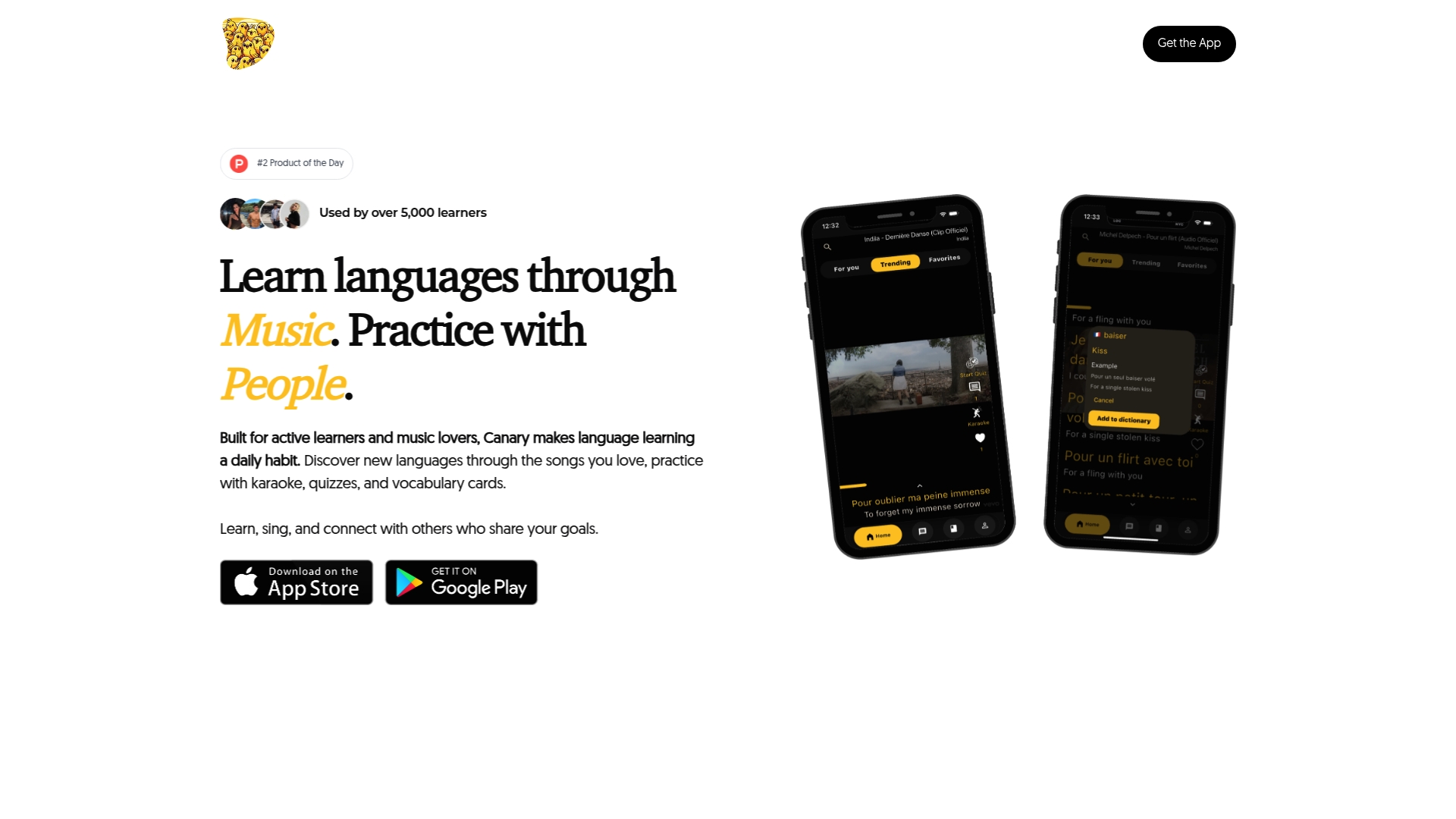
Canary combines everything discussed in this guide into one platform. You’ll find curated songs matched to your proficiency in French, Spanish, Italian, or German. Interactive karaoke features let you practice pronunciation with instant feedback. Vocabulary quizzes reinforce what you learn from lyrics, while social features connect you with fellow music lovers worldwide.
The song of the week challenge keeps you motivated with fresh content and community participation. Track your progress as vocabulary and pronunciation improve week by week. Join thousands who’ve discovered that learning languages with music transforms study from a chore into something you genuinely look forward to. Sign up now to access your first song and start your musical language journey today.
Frequently asked questions
Who benefits most from music in language learning?
Anyone learning French, Spanish, Italian, or German benefits, especially those who struggle with traditional methods or love music. Adults find it particularly effective because emotional engagement compensates for age-related memory changes.
Can music replace traditional study methods?
Music excels at vocabulary and pronunciation but should supplement grammar study. Combine musical practice with structured lessons for comprehensive skills. Neither alone provides complete fluency.
What types of songs work best for beginners?
Choose pop songs with clear vocals, 70-90 BPM tempo, and simple vocabulary. Children’s songs and folk music offer repetitive structures that reinforce basics. Avoid rap or heavily accented regional songs initially.
How often should I practice with music?
Daily 15-minute sessions beat longer weekly practices. Your brain needs regular exposure to consolidate musical memories. Aim for at least one new song weekly plus review of previous favorites.
Is singing necessary to gain benefits from music learning?
Singing amplifies benefits but isn’t mandatory. Active listening with lyrics visible improves retention versus background music. Singing adds pronunciation practice and motor memory that passive listening misses.