Most language learners assume that more lessons equal more progress. You sit through another grammar drill, replay the same audio clip, and hope something sticks. But repetition alone is not the engine behind real fluency gains. Quizzes are. Research on apps like Duolingo and Babbel shows that active recall through quizzes drives vocabulary retention and pronunciation improvement far beyond passive review. This guide breaks down exactly how quiz-based learning works, why music makes it even more powerful, and how practicing with international peers can accelerate your results in ways no textbook ever could.
Table of Contents
- How quizzes transform language learning apps
- Music-integrated quizzes: Making vocabulary and pronunciation stick
- Strategies for leveling up with quizzes and peers
- Expert tips and limitations: What quizzes can and can’t do
- What most language apps get wrong—and how to truly master pronunciation and vocabulary
- Bring music, quiz power, and community into your language journey
- Frequently asked questions
Key Takeaways
| Point | Details |
|---|---|
| Quizzes boost memory | Quiz-based practice leverages active recall and spaced repetition to lock in vocabulary better than passive study. |
| Music makes learning engaging | Integrating music into quizzes strengthens pronunciation, listening, and vocabulary while making practice fun. |
| Peer features drive progress | Leaderboards and challenges in language apps motivate you to practice consistently with international peers. |
| Balance quizzes with conversation | Use quizzes as a foundation but add peer or live speaking sessions for full fluency. |
How quizzes transform language learning apps
Now that you know quizzes are at the heart of real learning progress, let’s break down how these features actually work in your favorite apps.
Quiz-based learning is fundamentally different from traditional lessons. A standard lesson presents information and asks you to absorb it. A quiz forces your brain to retrieve that information, which is a much more demanding and effective process. This act of retrieval, called active recall, strengthens the neural pathways connected to a word or phrase every time you successfully pull it from memory.
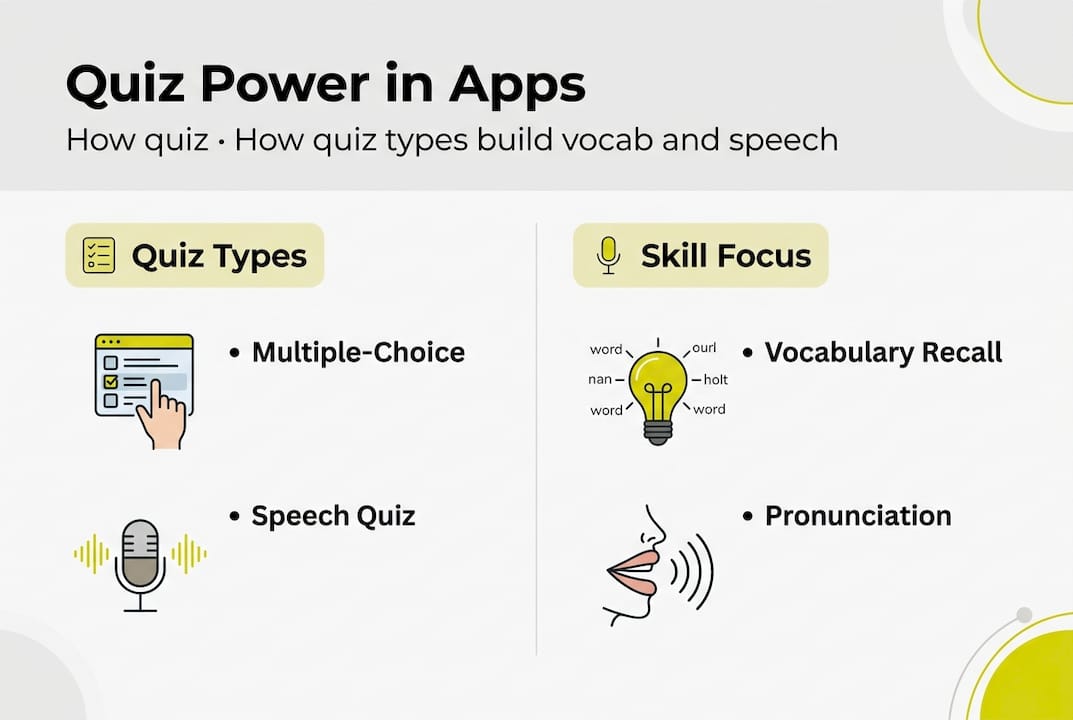
Modern language apps have built entire systems around this principle. Language app gamification uses mechanics like multiple-choice questions, fill-in-the-blank prompts, matching exercises, and speech recognition tools, all reinforced with spaced repetition, to drive better vocabulary recall and pronunciation practice. Spaced repetition means you see harder words more frequently and easier ones less often, keeping your brain challenged without overwhelming it.
Duolingo’s research on pretesting and guessing before learning new material shows recall improvements with effect sizes ranging from d=0.18 to d=0.40. That might sound like a small number, but in learning science, that range represents a meaningful, consistent advantage over passive study. Babbel layers flashcard-style quizzes with spaced repetition to produce similar gains in real-world speaking confidence.
Statistic spotlight: Duolingo’s pretesting studies show recall effect sizes of d=0.18 to d=0.40, meaning quizzes consistently outperform passive review for vocabulary retention.
| Quiz type | Primary learning boost |
|---|---|
| Multiple-choice | Vocabulary recognition and speed |
| Fill-in-the-blank | Contextual word usage |
| Speech recognition | Pronunciation accuracy |
| Matching exercises | Word-meaning association |
| Spaced repetition flashcards | Long-term retention |
Each quiz format targets a slightly different skill. Speech recognition quizzes, for example, give you instant feedback on your accent and intonation, something a passive listening exercise simply cannot replicate. Matching exercises build the mental connections between a word and its meaning faster than reading a definition ever would.
Pro Tip: Keep quiz sessions short and consistent. Ten minutes daily beats a two-hour cramming session every weekend. Your brain consolidates vocabulary during rest, so frequent, smaller sessions give it more opportunities to lock new words in.
Music-integrated quizzes: Making vocabulary and pronunciation stick
Understanding basic quiz mechanics sets the stage, but integrating music can take your vocabulary and pronunciation to the next level.

Songs are memory machines. Melody, rhythm, and rhyme all work together to make words easier to recall. When you combine those elements with quiz formats, something remarkable happens: vocabulary stops feeling like a list and starts feeling like something you already know by heart.
Lyric gap-fill quizzes ask you to listen to a song and fill in the missing words. This format trains your ear to catch sounds in context, which is exactly what you need for real conversations. Sing-along challenges push you to reproduce those sounds yourself, giving your mouth and brain practice with the rhythm and stress patterns of a new language. Rhythm matching exercises connect word stress to musical beats, making pronunciation feel intuitive rather than mechanical.
Music-based learning methods activate multiple memory systems at once. You are not just memorizing a word; you are encoding it with melody, emotion, and context. Apps like LingoClip use music-integrated quizzes to enhance vocabulary, listening, and pronunciation with global peer competition, showing that music-based formats can also build community and motivation alongside skills.
Here is what the research and real learning examples show about why music works so well:
- Songs activate emotional memory, making words more memorable than isolated flashcards
- Singing along mimics the rhythm and intonation of native speakers, training your accent naturally
- Peer singing challenges create social accountability, pushing you to practice more consistently
- Listening to songs repeatedly builds passive vocabulary that surfaces in active speech
- Music from different regions exposes you to cultural context, not just vocabulary
You can see real music learning examples of how learners use these methods to break through plateaus that traditional apps never address.
| Feature | Music-integrated quizzes | Standard app quizzes |
|---|---|---|
| Vocabulary recall | High (melody aids memory) | Moderate |
| Pronunciation practice | Natural (rhythm and singing) | Mechanical (drills) |
| Engagement level | Very high | Moderate |
| Peer/social features | Built-in challenges | Limited |
Pro Tip: Start with songs from genres you already love in your target language. Familiarity with the style reduces anxiety and increases how long you stay engaged with the quiz, which directly improves retention.
Strategies for leveling up with quizzes and peers
Knowing the impact of music-integrated quizzes, here is how you can make quizzes work even harder for your language growth and confidence.
“Active quiz approaches with pretesting and active recall outperform passive learning, and 96% of Babbel users improved after regular practice sessions.”
That number is not a coincidence. Consistent, structured quiz practice creates a feedback loop that passive study never triggers. Here is a step-by-step plan to build that loop for yourself:
- Set a daily quiz routine. Pick a fixed time, even just ten minutes, and stick to it. Consistency matters more than session length. Use the benefits of learning with songs as motivation to keep going when progress feels slow.
- Alternate quiz formats. Do not rely on one type. Mix speech recognition with gap-fill lyrics and flashcard drills. Each format trains a different skill, and variety prevents mental fatigue.
- Link quizzes to peer practice. After a quiz session, send a voice message to a language partner using the words you just practiced. This bridges recognition and production, the two biggest gaps in quiz-only learning.
- Use leaderboards strategically. Competing with international peers on leaderboards gives you a real benchmark. It also introduces you to learners at your level who can become practice partners.
- Track your weak spots. Most apps flag words you miss repeatedly. Spend extra time on those, and use a beginner learning workflow to organize your review sessions systematically.
One common pitfall is relying too heavily on recognition quizzes, where you pick the right answer from a list, without ever forcing yourself to produce the word from scratch. Recognition feels easier and more satisfying, but production is what you need in real conversation. Balance both.
Expert tips and limitations: What quizzes can and can’t do
To fully benefit from quiz-based language practice, it is important to know its limits and how to effectively combine it with authentic interaction.
Quizzes are powerful, but they are not a complete solution. The biggest limitation is the recognition versus production gap. When you pick an answer from four options, your brain is matching, not generating. Real conversation requires generation, pulling a word from nothing and placing it correctly in a sentence under pressure. Quizzes rarely replicate that pressure.
Music-based quizzes face an additional constraint. Song and language availability varies widely across apps. If you are learning a less common language, your music quiz options may be thin. And even with a rich library, quiz-based learning can prioritize recognition over production, and music selection may be limited to certain languages or song catalogs.
Here is how to fill those gaps with peer interaction and musical learning method types:
- Record yourself singing or speaking after a quiz and compare it to the original audio
- Join group chats or voice rooms with native speakers to practice the words you just quizzed on
- Use peer challenges to create your own quiz content, forcing production rather than recognition
- Schedule weekly voice calls with an international partner to use quiz vocabulary in real dialog
- Combine app quizzes with journaling in your target language to reinforce active word use
Quizzes are excellent at sustaining daily motivation and building a strong vocabulary foundation. But real fluency, the kind where you think in the language without translating, requires live conversation. Use quizzes to build the raw material, then use peer practice to put it to work.
What most language apps get wrong—and how to truly master pronunciation and vocabulary
Most mainstream language guides celebrate daily streaks as the gold standard of progress. Keep your streak alive, the thinking goes, and fluency will follow. That is only half true.
Streaks build habits, but habits without the right inputs do not produce fluency. What most apps undervalue is the combination of music and peer challenge layered on top of quiz mechanics. A gap-fill lyric quiz alone is useful. But when you record yourself singing that lyric, share it with a friend in another country, and get honest feedback on your pronunciation, the learning compounds in a way no streak counter can measure.
We have seen this pattern repeatedly: learners who combine language music benefits with peer challenges and live conversation reach speaking confidence months faster than those who rely on quizzes alone. The uncomfortable truth is that most apps are designed to keep you engaged with the app, not necessarily to push you into the uncomfortable territory of real conversation.
Experiment deliberately. Use gap-fill lyrics, then record yourself. Challenge a friend. Join a global leaderboard. The combination is what unlocks real pronunciation gains, not any single feature on its own.
Bring music, quiz power, and community into your language journey
Ready to put these insights to work in your own language journey? Here is your chance to try everything you have learned, plus connect with music-loving peers.
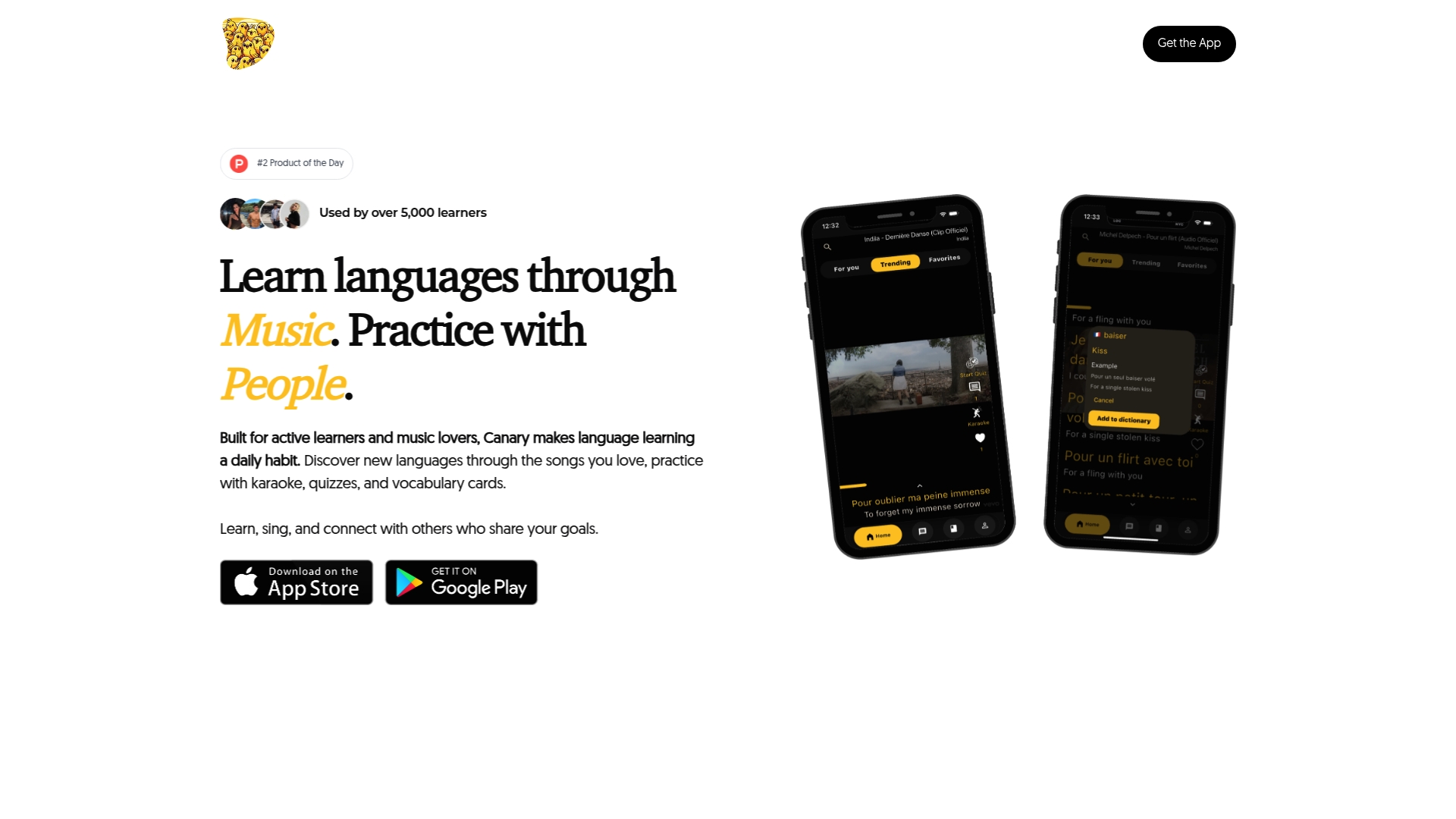
Canary brings together everything this guide covers: music-integrated quizzes, vocabulary cards, karaoke-style pronunciation practice, and a global community of learners who are just as passionate about music as you are. You can learn languages with music in a way that feels like entertainment, not homework. Explore music-based methods that match your style, or jump straight into Spanish music quiz apps to see how song-based quizzes work in practice. Your next vocabulary breakthrough might be one chorus away.
Frequently asked questions
How do quizzes improve vocabulary compared to traditional study methods?
Active recall quizzes and spaced repetition force your brain to retrieve words rather than passively absorb them, which research consistently shows produces stronger long-term retention than reading or listening alone.
Can music really help with pronunciation in language apps?
Music-integrated quizzes like gap-fill and sing-along formats train pronunciation by combining melody, rhythm, and real-time speech feedback, making accent improvement feel natural rather than forced.
Are peer challenges or leaderboards important for language learning?
Yes, peer leaderboards and challenges increase motivation by giving you social benchmarks and accountability, which keeps daily practice consistent and pushes you to use vocabulary actively.
What are the main limitations of quiz-based language learning?
Quiz-based apps often emphasize recognition over real speaking production, and music libraries may be limited to popular languages or specific song catalogs, making peer conversation an essential complement.