TL;DR:
- Most German learners struggle because they lack a structured vocabulary-building process despite studying hard and collecting words. Implementing a repeatable, level-appropriate system using spaced repetition, context, and consistent review accelerates retention and active usage. Tracking progress and engaging with content in real-world contexts help learners achieve fluency and build confidence in conversation.
Most German learners hit the same wall: they study hard, collect words, and still can’t hold a real conversation. The problem usually isn’t effort. It’s the lack of a structured german vocabulary building process. Without a repeatable system, you end up with scattered vocabulary that fades fast. This article gives you a practical, tested framework covering everything from your first word list to measuring real progress. Whether you’re at A1 or pushing toward B2, you’ll leave with a plan you can actually follow.
Table of Contents
- Key takeaways
- The german vocabulary building process: starting right
- Your step-by-step vocabulary workflow
- Frameworks and resources that accelerate learning
- Common pitfalls and how to avoid them
- Measuring your progress
- My take on what actually moves the needle
- Learn German vocabulary with Singwithcanary
- FAQ
Key takeaways
| Point | Details |
|---|---|
| Start with a structured workflow | Collecting, studying, and pruning your word list on a regular cycle beats random memorization. |
| Match words to your level | Vocabulary goals differ by proficiency. A2 and B2 learners need different breadth and depth. |
| Use spaced repetition consistently | Reviewing words at increasing intervals is the single most efficient way to lock vocabulary in long-term memory. |
| Balance all four learning strands | Combine reading, listening, writing, and speaking practice to avoid passive-only vocabulary that never shows up in real conversation. |
| Measure your progress | Track vocabulary size benchmarks and adjust your study focus based on what you’ve mastered and what’s still slipping. |
The german vocabulary building process: starting right
Before you add a single word to a flashcard, you need to know where you stand and what you’re working toward. Skipping this step is why so many learners study for months and still feel stuck.
Understand the vocabulary benchmarks
German proficiency levels run from A1 to C2, and each level comes with a realistic vocabulary target. Here’s what the research shows:
| Level | Approximate vocabulary size | What it enables |
|---|---|---|
| A1 | 500–800 words | Basic greetings, simple questions |
| A2 | 1,000–1,500 words | Handle everyday topics, short texts, simple conversations |
| B1 | 2,000–2,500 words | Navigate most travel and daily situations |
| B2 | 3,250–4,000 words | Independent reading, abstract topics, professional contexts |
| C1/C2 | 6,000–10,000+ words | Near-native fluency, nuanced expression |
These numbers are estimates based on lemmas, which are base word forms. They also differ from word families, so don’t get too attached to any single figure. Use them as a compass, not a strict rulebook.
Active versus passive vocabulary
One of the most important distinctions in learning German vocabulary is the difference between words you recognize when you hear them and words you can produce on demand. Most learners have far more passive vocabulary than active vocabulary. Your goal is to deliberately convert the passive into the active through practice that forces you to retrieve words, not just recognize them.

Tools you need before you start
Set yourself up with the right tools before you begin building your German word bank:
- A dedicated vocabulary notebook or digital app for logging new words
- A spaced repetition system (SRS) such as a German language flashcards app to schedule your reviews
- A reliable German dictionary with example sentences, not just translations
- A simple tracking sheet to log your daily word count and review sessions
Pro Tip: Don’t try to build the perfect system on day one. Start with a notebook and a free SRS app. Complexity is the enemy of consistency, especially in the first month.
Your step-by-step vocabulary workflow
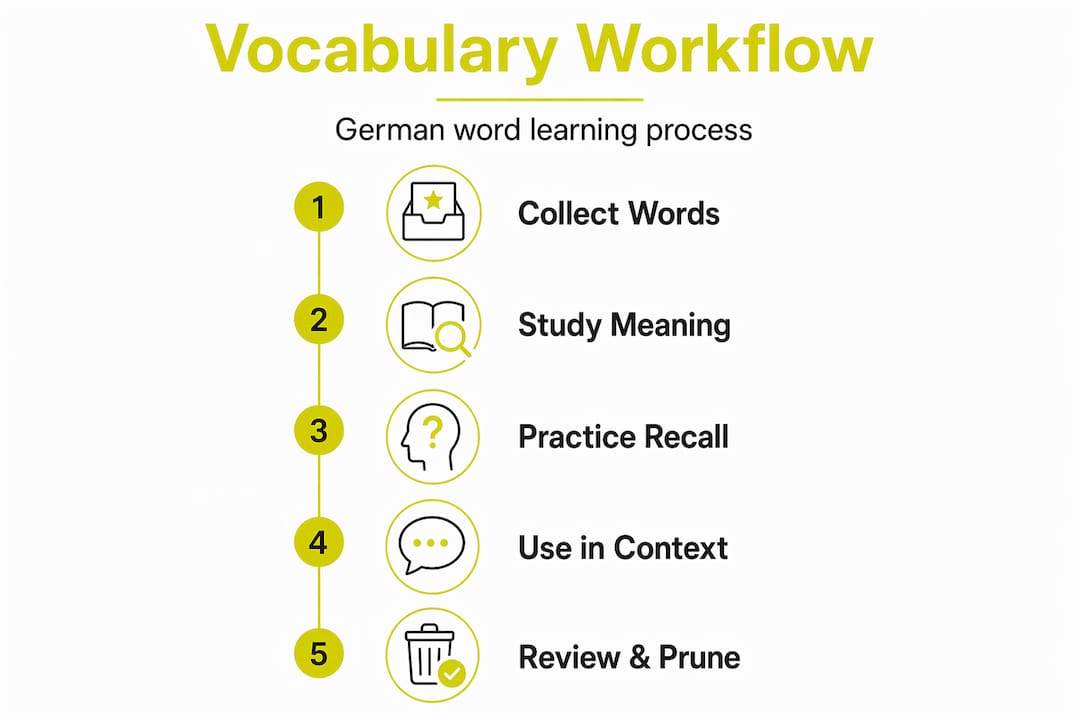
The most effective learners follow a repeatable five-step cycle that keeps the process moving without burning you out. Adding around 5 new words per day leads to roughly 150 new words learned each month, which adds up fast if you stay consistent.
The five-step cycle
-
Collect unknown words. When you read a text, watch a video, or listen to a podcast, note every word you don’t know. Focus on words that come up repeatedly or matter for your specific context, not every obscure term.
-
Look up meanings in context. Don’t just grab a one-word translation. Find an example sentence that shows how the word is used. This context is what makes the word stick.
-
Create a flashcard or digital entry. Include the German word, its gender (for nouns), a sample sentence, and your target-language translation. Automating cloze-style flashcards from text snippets cuts prep time dramatically and keeps you focused on learning rather than organizing.
-
Review on a spaced repetition schedule. Study your cards daily, letting the SRS algorithm space out reviews based on how well you know each word. This is where the actual retention happens.
-
Cleanse your list regularly. Every two to four weeks, go through your active list and retire words you now know confidently. This keeps your review sessions focused on genuine gaps.
Pro Tip: Try the word first before you look it up. Attempting to guess the meaning from context, even if you’re wrong, creates a memory hook that makes the correct definition land harder.
Building a daily and weekly routine
A strong music-based study routine can anchor your vocabulary work to something you already enjoy. Here’s a practical structure:
| Time | Activity | Goal |
|---|---|---|
| Morning (10 min) | SRS flashcard review | Consolidate yesterday’s words |
| Midday (5 min) | Read a short German text or article | Collect 3–5 new words |
| Evening (10 min) | Create new flashcards, study new words | Add to active word bank |
| Weekly (30 min) | Cleanse word list, test yourself | Remove mastered words, assess gaps |
Twenty-five minutes a day is enough to make serious progress if you protect those time blocks and stay consistent.
Frameworks and resources that accelerate learning
Knowing what to study is one thing. Knowing how to structure your study is another. Two frameworks stand out as genuinely useful for learners who want to learn German vocabulary in a principled way.
Paul Nation’s four strands
Nation’s framework argues that effective vocabulary programs need four equally weighted components: meaning-focused input (reading and listening), meaning-focused output (speaking and writing), deliberate language-focused study, and fluency development. Most learners over-index on deliberate study and neglect the other three. The result is vocabulary that works on flashcards but disappears in conversation.
The practical fix is simple. For every session of flashcard drilling, match it with time spent reading a German news article, listening to a German podcast, or writing a short paragraph using your new words.
Goethe-Institut’s guidance
The Goethe-Institut consistently emphasizes that robust vocabulary enables more precise self-expression across all four language skills: reading, listening, writing, and speaking. Their exam preparation resources recommend repeating vocabulary in the context of each skill area, not in isolation.
“Expanding your vocabulary directly improves your ability to express yourself precisely across all four language skills.” — Goethe-Institut exam preparation guidance
The Goethe-Institut also offers free interactive exercises covering levels A1 through B2, including apps, videos, podcasts, and games. These are genuinely useful, not just filler resources, and they’re free.
Here are additional resource types that support vocabulary enhancement techniques at every level:
- Music and song-based learning, which reinforces words through melody and repetition
- Vocabulary quizzes that force active recall rather than passive recognition
- Graded readers matched to your current proficiency level
- Conversation practice with native speakers to test vocabulary in real conditions
Understanding how music aids retention is particularly useful if you find traditional study methods dry. Song lyrics embed words in emotional and musical memory, which creates a second retrieval path beyond rote repetition.
Common pitfalls and how to avoid them
Even learners with solid systems run into the same recurring problems. Knowing them in advance saves weeks of frustration.
The biggest trap is the overwhelming word list. Collecting hundreds of words without any system for review creates anxiety, not fluency. Keep your active review list under 200 words at any time. When it grows past that, prioritize cleansing before adding new items.
Study fatigue is the second major problem, and it usually comes from treating vocabulary study as a chore. Limiting daily new word intake to 5 to 10 words protects your motivation and keeps review sessions from feeling unmanageable. High-frequency words first is a reliable approach. Build a core of the most common 1,000 to 2,000 German words before branching into specialized vocabulary.
Here are the most common mistakes to address directly:
- Studying words in isolation without sentences or context
- Reviewing the same words at the same interval regardless of how well you know them
- Spending all study time on input (reading and listening) without producing language
- Never testing yourself under pressure or in conversation
Pro Tip: Use word banks in structured exercises to bridge the gap between passive recognition and active use. Filling in context-based gaps with known words forces retrieval without the pressure of a blank page.
Multiple exposures across different contexts are what separate vocabulary you own from vocabulary you’ve merely seen. Aim to encounter each new word at least seven times in varied settings before you consider it learned.
Measuring your progress
Progress in vocabulary acquisition is genuinely hard to feel from the inside. You need external markers to stay motivated and to know when to adjust your strategy.
| Proficiency goal | Vocabulary target | Practical test |
|---|---|---|
| A2 | ~1,200 words | Can you read a short ad or schedule without a dictionary? |
| B1 | ~2,500 words | Can you follow a slow German podcast with minimal lookups? |
| B2 | ~3,500–4,000 words | Can you read a newspaper article independently? |
Self-assessment strategies that work
- Take a free vocabulary size test online every four to six weeks to track your growth
- Use a German pronunciation guide to check whether your new words are going in with correct sounds from the start
- Write a short paragraph using only your newest vocabulary, then check it against a dictionary
- Have a conversation with a native speaker and note which words you couldn’t recall
Set SMART goals for each month. Something like “I will learn 100 new words at B1 level by the end of April” is measurable and motivating. Vague goals like “I’ll study more” produce vague results. Celebrate hitting your milestones. Small wins compound over time into significant vocabulary growth.
My take on what actually moves the needle
I’ve watched a lot of learners go through the german vocabulary building process, and the ones who make the fastest progress share one trait. They treat vocabulary as a living part of language, not a list to be memorized and filed away.
Cramming 50 words the night before a test produces almost nothing lasting. Spending 20 minutes a day over 30 days produces a vocabulary that actually shows up when you speak. Consistency always beats intensity in language learning. Always.
What I’ve also found is that technology helps most when it reduces friction, not when it adds features. An SRS app that you actually open every morning beats a complex platform you touch once a week. The vocabulary cards approach works because it’s simple and repeatable, not because it’s clever.
The hardest part for most learners is staying in the uncomfortable middle period between knowing nothing and knowing enough to enjoy the language. That period lasts longer than anyone wants. The way through it is real-context exposure. Watch a German TV show. Listen to German music. Read something that actually interests you in German. The vocabulary you pick up through genuine engagement with content you care about tends to stick far better than words you studied because they were on a list.
— Ben
Learn German vocabulary with Singwithcanary
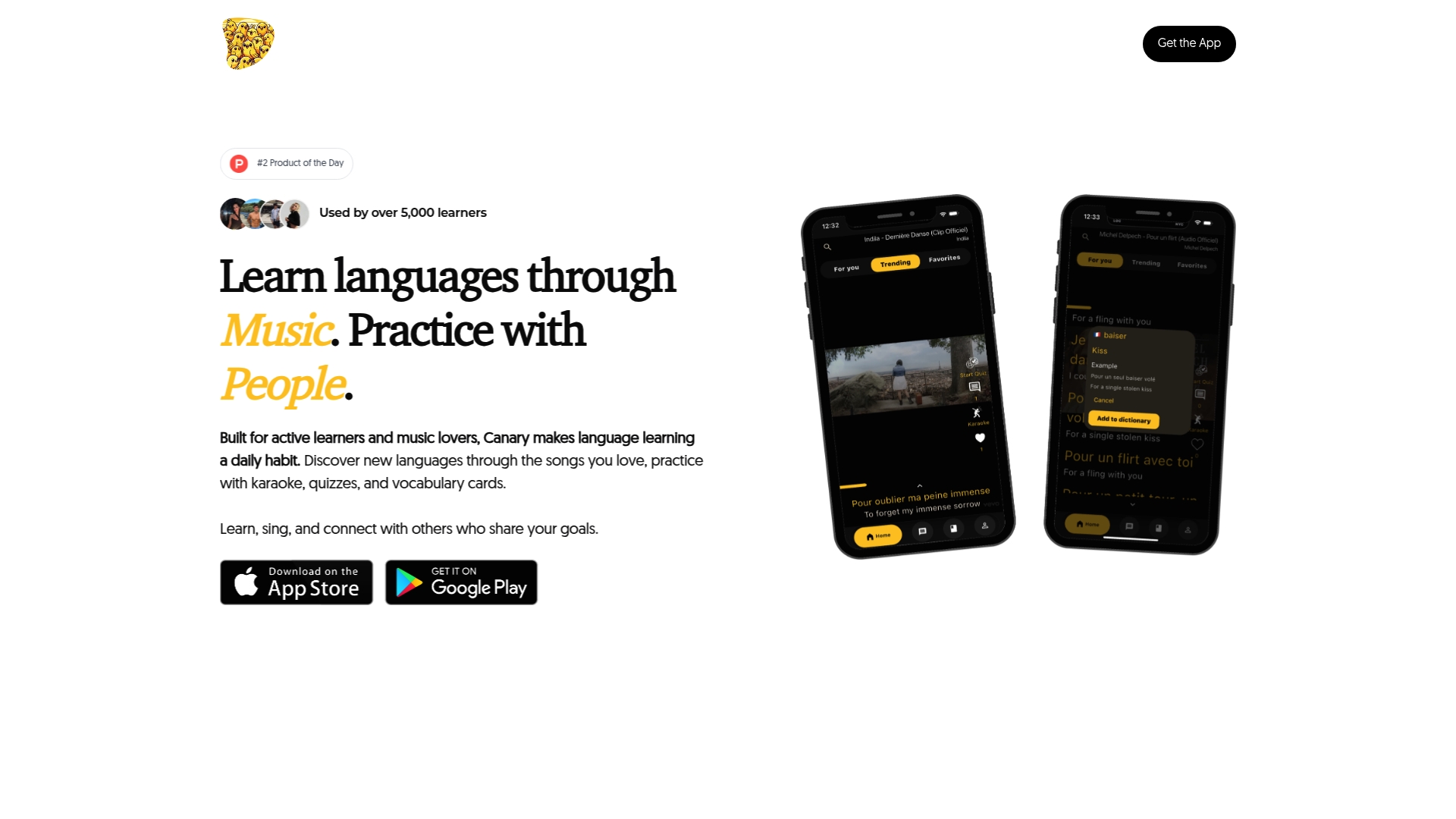
Singwithcanary is built for exactly this kind of structured yet enjoyable vocabulary work. The platform combines song-based learning with German language flashcards, karaoke practice, and vocabulary quizzes, so you’re building your German word bank in context rather than in a vacuum. If you’re looking at language learning apps that make daily practice feel less like homework, Singwithcanary is worth trying. You can listen to real German songs, pick up vocabulary from lyrics, and test yourself through interactive features. The social element also lets you practice with other learners and native speakers, turning passive vocabulary into language you can actually use. Combine the workflow in this article with Singwithcanary’s tools, and you have a German vocabulary building process that’s both systematic and genuinely enjoyable.
FAQ
How many German words do I need for basic fluency?
A2 level requires around 1,000 to 1,500 words and enables basic communication in everyday situations. B2 fluency typically requires 3,250 to 4,000 words for independent reading and conversation.
How many new German words should I study per day?
Adding about 5 new words daily results in roughly 150 new words per month. This pace is sustainable and avoids the fatigue that comes with larger daily targets.
What is the best method for retaining German vocabulary?
Spaced repetition combined with active recall practice is the most research-supported approach. Trying to recall a word before checking the answer strengthens memory more than passive review.
Should I study German words in isolation or in sentences?
Always study words in sentences. Context gives your brain a second retrieval path and shows you how the word actually behaves in real German usage, including word order and case requirements.
How do I know when to move on to new vocabulary?
Cleanse your active list every two to four weeks by retiring words you recall correctly without hesitation. This keeps your study sessions efficient and focused on genuine gaps rather than words you already own.