TL;DR:
- Using music in language learning enhances vocabulary retention and pronunciation through emotional engagement and rhythmic patterns.
- A consistent 15 to 30-minute daily routine with song-based activities significantly improves language skills over time.
- Music boosts motivation and long-term habit formation by making learning enjoyable and emotionally rewarding.
Step-by-step language learning routine with music for faster results
You study every day, you do the exercises, you even review flashcards before bed. Yet new words slip away by morning, and your pronunciation still sounds off. It’s one of the most common frustrations in language learning, and it’s not because you’re not working hard enough. The problem is that traditional methods rarely trigger the deep memory pathways your brain actually uses to lock in new language. Music does. This guide walks you through a practical, research-backed daily routine that fuses song-based learning with consistent practice, so every session feels engaging and actually moves the needle.
Table of Contents
- What you need to start: Tools, mindset, and time
- Designing your routine: A step-by-step daily plan
- Maximizing vocabulary growth with lyric micro-sequences
- Getting pronunciation right: Singing, rhythm, and review
- Measuring progress and keeping motivation high
- Why most routines fail and how music changes everything
- Take your routine further with music-powered resources
- Frequently asked questions
Key Takeaways
| Point | Details |
|---|---|
| Consistency matters most | Short daily music routines outperform long but sporadic sessions for memory and engagement. |
| Lyrics boost vocabulary | Micro-sequence lyric study accelerates word retention compared to traditional drills. |
| Singing sharpens pronunciation | Singing along improves accent, stress, and intonation up to 20 percent versus non-music practice. |
| Track and adapt progress | Using quizzes, recordings, and music variety keeps you motivated and exposes you to more language patterns. |
What you need to start: Tools, mindset, and time
Before you build any new habit, you need the right setup. Not a perfect setup, just a workable one. The biggest mistake learners make is waiting until conditions feel ideal. They think they need hours each day or expensive software. You don’t. What matters most is showing up consistently, even for short sessions.
Mindset first. Consistency beats intensity every time. A 20-minute daily session with music will outperform a two-hour weekly cram session. Your brain learns language through repeated, low-pressure exposure, and music is one of the fastest ways to deliver that. Research published by Frontiers in Education confirms that music enhances language learning through affective regulation, rhythmic entrainment, and memory reinforcement via lyric repetition. Translation: songs keep you engaged, help your brain sync with speech rhythm, and make words stick.
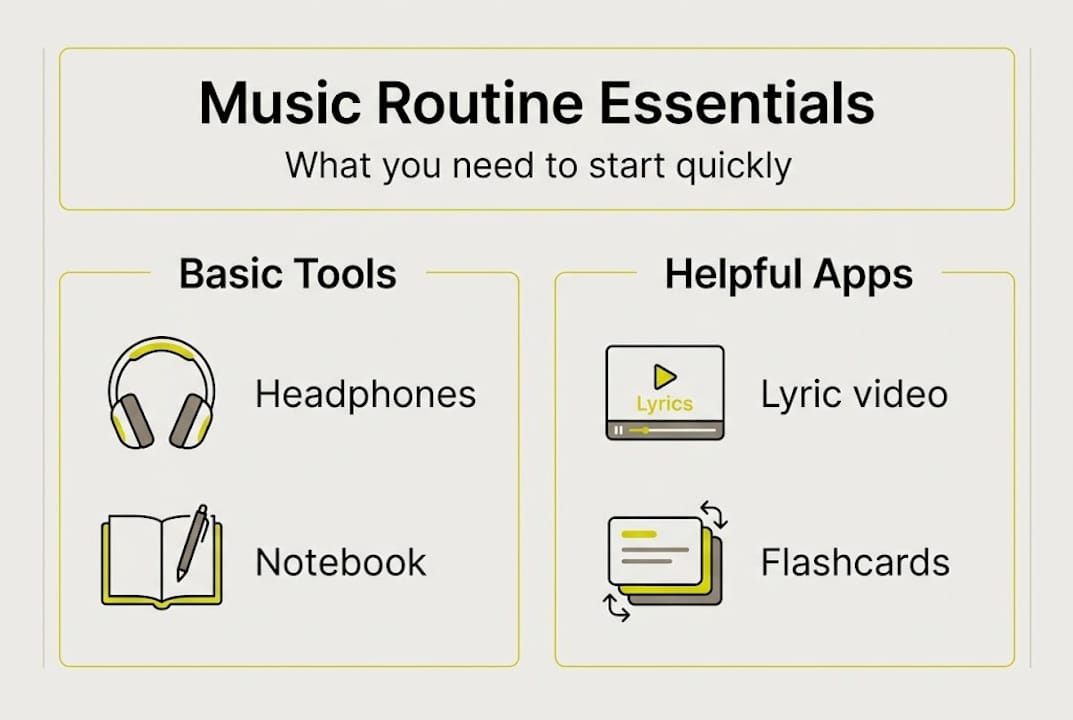
Your core toolkit looks like this:
- A playlist of at least 5 to 10 songs in your target language
- A lyrics source (YouTube, Genius, or a dedicated app)
- A quiet space with minimal distraction
- A notebook or digital doc for vocabulary notes
- A translation tool for meaning checks (Google Translate or DeepL work fine)
Optional but helpful: lyric video apps, language-specific karaoke platforms, and vocabulary flashcard tools. Building solid language learning habits with music is easier when your environment supports the habit from day one.
For time, 15 to 30 minutes daily is your target window. Here’s a quick comparison of session formats:
| Session length | Best for | Expected results |
|---|---|---|
| 15 minutes | Busy schedules, beginners | Solid vocabulary exposure |
| 20 to 25 minutes | Most learners | Vocabulary + pronunciation gains |
| 30 minutes | Dedicated learners | Full routine with review |
Pro Tip: When choosing songs, match the difficulty to your level. A track with rapid slang and complex slang will frustrate a beginner. A song that’s too simple won’t stretch your skills. Aim for songs where you understand roughly 60 to 70 percent of the lyrics without help. This is your sweet spot for growth. Check out this song-based learning guide for beginners for curated starting points.
Designing your routine: A step-by-step daily plan
With your tools ready, the next step is turning good intentions into a repeatable structure. A daily routine works because it removes decision fatigue. When the steps are the same each day, your brain stops resisting and starts learning automatically.
Here is a proven daily workflow:
- Warm-up listen (3 to 5 minutes): Play your chosen song without reading the lyrics. Just listen and feel the rhythm. Notice which words you catch and which ones blur together.
- Lyric read-through (5 minutes): Pull up the lyrics and read them line by line. Highlight any words you don’t recognize. Look up their meanings and write them in your notebook.
- Sing along with lyrics (5 to 7 minutes): Play the song again while reading the lyrics. Sing along, even quietly. Don’t worry about being perfect. Focus on matching the melody and rhythm.
- Pronunciation focus (3 to 5 minutes): Pick two or three lines that felt unnatural. Repeat them slowly, matching the singer’s stress and intonation as closely as you can.
- Review (2 to 3 minutes): Quiz yourself on today’s new words. Cover the definitions and try to recall them from memory.
This workflow for beginners is simple enough to do every day but structured enough to drive real results. Studies back this approach: learners using song-based methods showed a 33-point vocabulary gain compared to control groups, a 20% improvement in pronunciation accuracy, and engagement scores that doubled over 10 weeks. Those are meaningful numbers for a 20-minute daily habit.
Here is a snapshot of what results typically look like across 10 weeks:
| Metric | Traditional method | Music-based routine |
|---|---|---|
| Vocabulary points gained | Baseline | +33 points |
| Pronunciation accuracy | Baseline | +20% |
| Engagement score | 3.06 average | 7.0 average |
To keep things fresh, rotate your song each week or every few days. Switching genres and artists exposes you to different dialects, speech speeds, and vocabulary styles. Latin pop one week, folk ballads the next. This variety prevents boredom and expands the range of your target language. You can read more about the music learning benefits that come from a diversified listening diet.
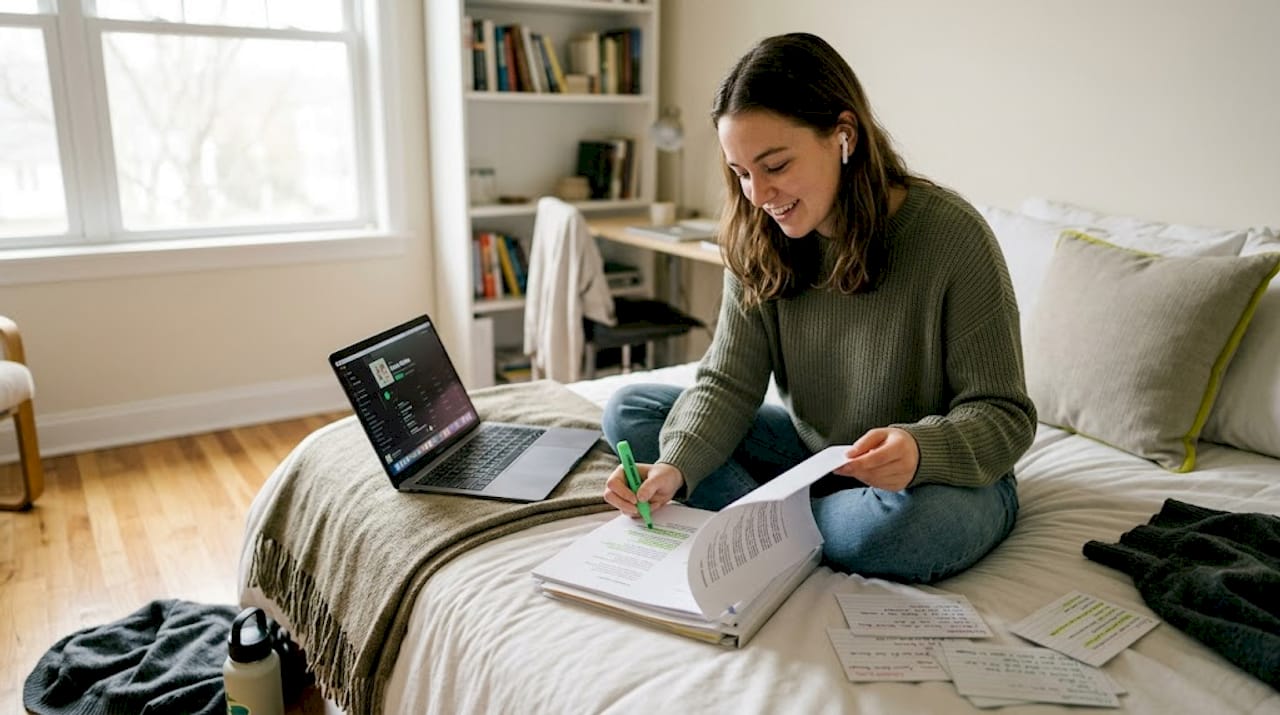
Pro Tip: Record a short 60-second clip of yourself singing or speaking a song excerpt once a week. Save them all in one folder. After 4 to 6 weeks, compare your earliest clip to your latest. The improvement you hear will be a bigger motivator than any progress bar in an app.
Maximizing vocabulary growth with lyric micro-sequences
Inside your daily plan, you can add an extra layer of power by using lyric micro-sequences. This means focusing intensely on just 2 to 4 lines of a song rather than trying to absorb the entire track at once. It sounds too small to matter. It isn’t.
Why micro-sequences work so well:
- Short segments are easier to memorize completely, building confidence fast
- Repetition of a small chunk activates deeper memory encoding than skimming a full song
- Moving or tapping with the beat during repetition ties the memory to a physical rhythm cue
- Delayed testing (quizzing yourself on yesterday’s segment) compounds retention over time
Research in Frontiers in Psychology confirms that music and singing compound verbal memory gains significantly when paired with movement and delayed recall practice. The micro-sequence method is essentially applied mnemonics using music as the vehicle.
Here is how to run a micro-sequence session:
- Choose 2 to 4 lines from today’s song
- Read the lines aloud three times, slowly
- Tap your hand or foot with the beat as you repeat them
- Sing those lines five to seven times with the recording
- Close the lyrics and try to recall the lines from memory
- Write the new vocabulary from those lines in your notebook
- The next day, before opening any new material, test yourself on yesterday’s lines
The 33-point vocabulary gain seen in music-based learning studies aligns closely with this micro-sequence approach. Small, focused, rhythmic repetition is far more effective than passive listening. Learn more about how to build vocabulary with music using these structured techniques.
“Music does not just make language learning more enjoyable. It creates a compounding memory effect where emotional engagement, rhythmic structure, and repeated retrieval work together to make words truly unforgettable.” — Research perspective from Frontiers in Psychology, 2025
Pairing micro-sequences with the educational benefits of music for language research gives you a framework that is both enjoyable and deeply effective for long-term vocabulary growth.
Getting pronunciation right: Singing, rhythm, and review
Growing your vocabulary is only half the equation. Sounding natural when you speak is the other half, and it’s where many learners feel stuck longest. Singing is uniquely powerful here because it forces you to stretch syllables, feel stress patterns, and match intonation in ways that reading and writing never demand.
Studies show that rhythmic-prosodic entrainment — meaning your brain syncing with the rhythm and stress patterns of music — directly improves timing and intonation. Learners using music-based routines reported up to a 20% improvement in pronunciation accuracy. That’s a measurable shift in how you sound.
Follow these steps to sharpen your pronunciation through song:
- Start with a slower-tempo song or use a playback speed feature to slow down fast tracks to 75 or 80 percent speed.
- Listen to a single line three times before attempting to sing it. Focus on where the stress falls and how the vowels open and close.
- Use call-and-response practice: pause the song after each line, repeat it exactly as the singer delivered it, then play the next line.
- Spot-check yourself on words that feel awkward. Repeat those words in isolation five to ten times before putting them back into the full line.
- Once you’re comfortable at slower speeds, return to full tempo and sing along naturally.
Common pronunciation challenges and how music helps:
- Stress patterns: Songs lock stress into melody, so you physically feel where emphasis falls
- Connected speech: Singing reveals how words blend together in natural flow
- Vowel sounds: Sustained notes force you to hold and shape vowel sounds correctly
- Intonation: Melody trains rising and falling pitch patterns that signal meaning
For visual reinforcement, explore song-based language learning through lyric videos and karaoke tracks. Watching mouth shapes and reading lyrics simultaneously trains multiple sensory pathways at once, which accelerates accuracy. You can also expand vocabulary with songs while working on pronunciation in the same session.
Pro Tip: Use karaoke tracks (instrumentals only) and sing the vocal part yourself without the singer’s voice as a crutch. This reveals exactly which words and sounds you’re still approximating versus actually mastering.
Measuring progress and keeping motivation high
A routine without tracking is a routine that fades. You need simple, consistent ways to see that your effort is working, because visible progress is the single best motivator for continuing.
How to track vocabulary progress:
- Weekly vocabulary quiz: Write down 10 to 15 words from the week’s songs, cover the definitions, and test your recall
- Flashcard apps like Anki let you track your retention rates automatically
- Review your notebook at the end of each week and highlight words you’ve used naturally in a sentence
- Notice when you recognize a word in a new song you haven’t studied — that’s a sign it’s truly sticking
How to track pronunciation progress:
- Record one 60-second clip weekly, speaking or singing a set passage
- Compare clips every four weeks to hear improvement clearly
- Ask a language partner or community member to give you feedback on specific sounds
Engagement is the fuel that keeps a routine alive. Research shows that engagement scores doubled — from 3.06 to 7.0 — after 10 weeks of music-based learning routines, largely because variety and personal interest kept learners coming back. Rotating genres, discovering new artists, and sharing favorites with others all contribute to sustaining that enthusiasm.
Additionally, background music effects vary depending on learner age and task type, with the strongest evidence pointing to teens and adults benefiting most from music-integrated routines. This means your routine is well-matched to maximize results if you’re in that range.
| Tracking method | Music-based routine | Traditional method |
|---|---|---|
| Vocabulary check | Weekly song quiz | Flashcard review only |
| Pronunciation review | Recorded clips compared over time | Teacher feedback sessions |
| Motivation tool | Genre rotation + community sharing | Progress bars in app |
| Engagement over 10 weeks | Doubled (3.06 to 7.0) | Often declines |
Joining a community is one of the most underrated tools for staying consistent. Share a song of the week with fellow learners, compare notes on tricky lyrics, and celebrate small wins together. Accountability through shared enthusiasm is far more powerful than willpower alone.
Why most routines fail and how music changes everything
Here’s the uncomfortable truth most language learning advice won’t say outright: traditional routines don’t fail because of laziness. They fail because they’re boring. Repetition without emotional reward is the fastest path to quitting. Your brain doesn’t prioritize information it finds dull, no matter how important you tell it the content is.
Music solves this problem at the root. It ties language to emotion, melody, and rhythm — three elements that your brain treats as inherently worth remembering. When you love a song, you replay it voluntarily, which creates repetition without the grind. That’s the key insight most learners miss: the goal isn’t to force yourself to study more. It’s to set up a system where practice feels like something you want to do.
Research shows that music boosts motivation, recall, and routine adherence for teens and adults in ways that traditional methods consistently fail to match. The emotional connection to a song rewires how the brain classifies the learning experience — from obligation to reward. Once that shift happens, consistency follows naturally. You stop fighting yourself to practice. The habit runs on its own momentum, powered by genuine enjoyment.
Take your routine further with music-powered resources
Building a daily music-based language routine is one of the smartest moves you can make as an active learner. The steps in this guide give you a strong foundation, but the tools and community you surround yourself with will determine how far you go.
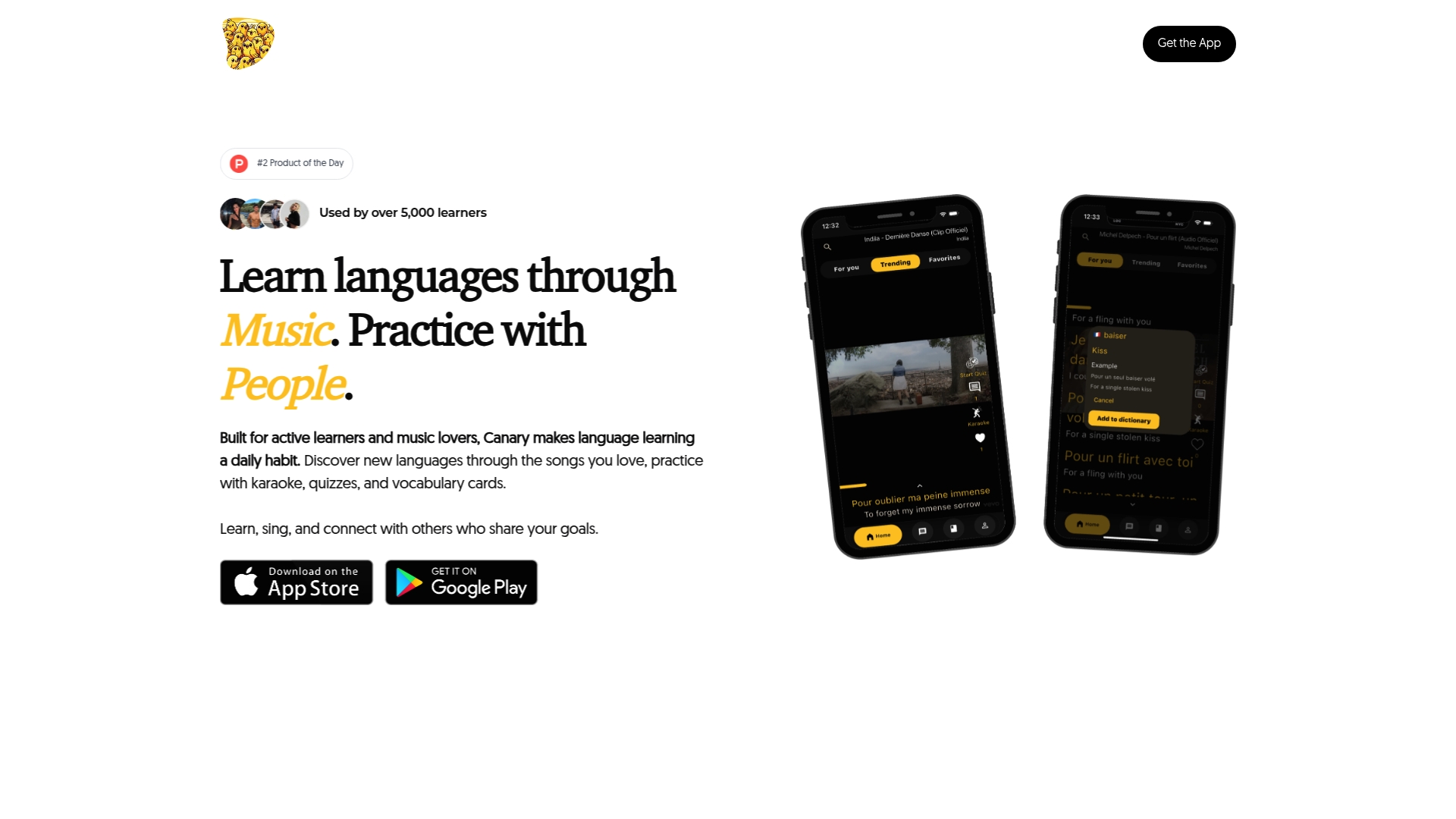
Canary is built exactly for learners like you — people who want to learn languages with music in a way that’s engaging, social, and genuinely effective. From structured lyric challenges to interactive karaoke sessions and vocabulary quizzes, the platform turns your daily music habit into a full language practice system. Explore the song of the week feature to get curated picks matched to your learning level, or dig into the research behind the benefits of song-based learning to deepen your understanding. Your next level is one playlist away.
Frequently asked questions
How long should my daily music-based practice take?
Just 15 to 30 minutes each day is enough to see measurable gains. Studies show a 33-point vocabulary increase and 20% pronunciation improvement with consistent short sessions over 10 weeks.
What kind of songs are best for language learning?
Choose songs with clear pronunciation and vocabulary that stretches but doesn’t overwhelm you. Music that uses affective engagement and rhythmic exposure naturally accelerates vocabulary and intonation learning.
Is there evidence music actually improves pronunciation?
Yes. Studies found up to a 20% accuracy improvement in pronunciation when learners followed music-based routines, driven by rhythmic-prosodic entrainment.
Can these routines help absolute beginners?
Absolutely. Lyric repetition and mimicry are especially suited to beginners since music compounds verbal memory gains across all proficiency levels, making it accessible and effective from day one.
Does music-based learning work for children?
The evidence is mixed for young children. Speech may outperform song for very early word learning, while teens and adults show the strongest and most consistent benefits from music-integrated routines.