TL;DR:
- Accent training aims to improve clarity without erasing cultural identity by modifying speech patterns and prosody. Daily practice and perception-focused training significantly enhance listener understanding and build vocal flexibility for different contexts. Most adult learners see noticeable improvements within 4 to 8 weeks, especially in prosody and intelligibility.
Accent training is the deliberate modification of speech patterns to improve clarity and comprehensibility without erasing your cultural identity. Also called accent modification or pronunciation coaching, it targets phonological features like vowel sounds, consonants, stress, rhythm, and intonation. The goal is not to sound like a native speaker. The goal is to be clearly understood. Whether you work with a professional coach or follow a self-directed routine, the methods are grounded in the same evidence-based principles: perception first, then production, then real-world transfer.
What is accent training, and how does it work?

Accent training focuses on adjusting phonological patterns to improve listener comprehension, not to eliminate your first-language accent. That distinction matters. Pronunciation coaching treats your existing accent as a starting point, not a problem to fix. The practice reshapes how you produce sounds, where you place stress in words, and how your intonation rises and falls across sentences.
The field uses several terms interchangeably. “Accent reduction” is the most common search phrase, but many speech-language pathologists and coaches prefer “accent modification” because it reflects the actual goal: adjusting, not erasing. Understanding this terminology helps you find the right resources and set realistic expectations from day one.
Professional coaching sessions typically cost over $100 per hour. Self-directed daily practice of around 10 minutes produces measurable improvements at a fraction of that cost. Both paths work. The difference is speed of feedback and personalization.
What are the main methods and stages of effective accent training?
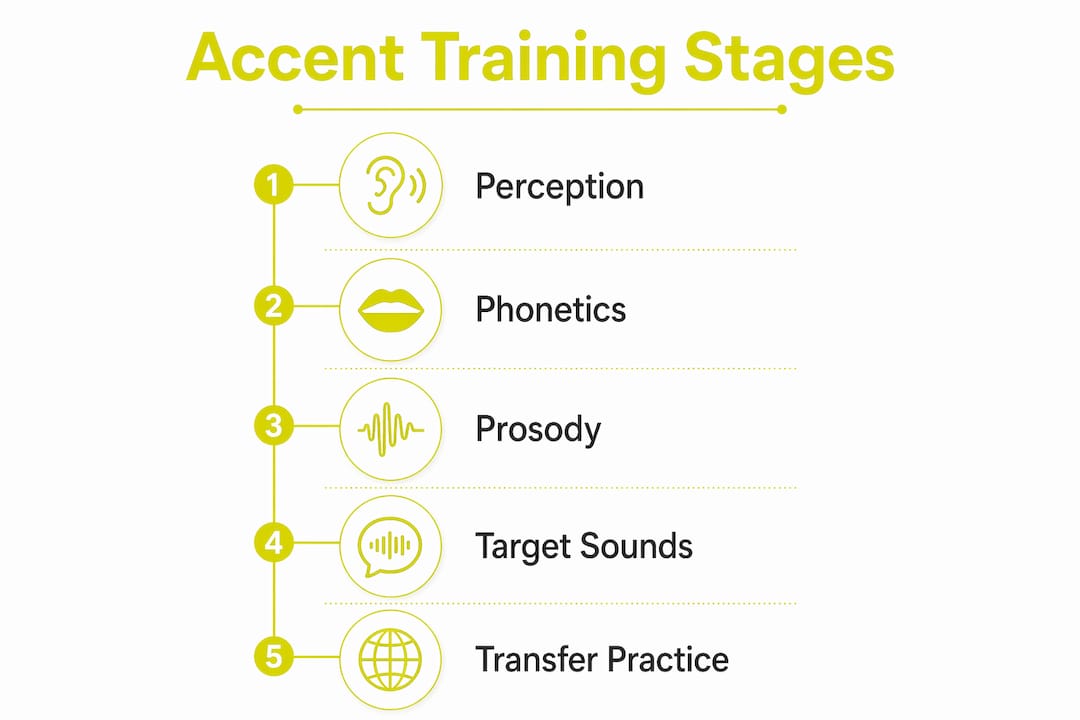
Effective accent training is structured into five core areas: perception training, phonetic awareness and articulation, prosody (stress, rhythm, and intonation), targeted sound work, and transfer to real-world conversation. Each stage builds on the previous one. Skipping perception training and jumping straight to sound drills is the most common mistake adult learners make.
Stage 1: Perception training
Accurate hearing of sound contrasts must come before effective physical pronunciation changes. Your brain needs an accurate auditory target before your mouth can hit it. Perception training involves listening to minimal pairs (words that differ by one sound, like “ship” and “sheep”), identifying stress patterns in sentences, and training your ear to notice intonation shifts. This stage is often skipped, which is why many learners plateau early.
Stage 2: Phonetic awareness and articulation
Once your ear is calibrated, you work on the physical mechanics of speech. Mouth agility exercises warming up the tongue, lips, and jaw are science-backed components of successful training. These drills build the muscle memory needed to produce unfamiliar sounds consistently. Think of it as physical therapy for your articulators.
Stage 3: Prosody mastery
Prosody is the highest-impact factor for improving listener intelligibility in adult learners. Stress, rhythm, and intonation carry more communicative weight than individual sound accuracy. A learner who places stress correctly and uses natural sentence rhythm will be understood far more easily than one who perfects every vowel but speaks in a flat, monotone pattern. Prosody is where the biggest gains happen fastest.
Stages 4 and 5: Targeted sounds and transfer practice
After prosody, you focus on the specific sounds that cause the most confusion for your listeners. Finally, transfer practice with self-recording and analysis applies learned patterns to spontaneous conversation. Without this stage, mastered sounds in quiet practice environments often break down under the cognitive load of real conversation.
Pro Tip: Pick one or two high-frequency sounds to work on at a time. Trying to fix every sound at once slows progress and kills motivation.
How does accent training improve pronunciation without erasing cultural identity?
The most persistent myth about pronunciation coaching is that it requires you to sound like someone else. It does not. The goal of accent modification is clearer communication, not a loss of personal voice. Your accent carries cultural history, regional identity, and personality. A good coach or training program works to make you more intelligible, not more generic.
The key concept here is vocal flexibility. Accent training builds the ability to adjust pronunciation for different social or professional contexts without losing your identity. A Spanish speaker presenting at an international conference may choose to soften certain phonological patterns for clarity. That same speaker at home with family uses their full natural accent. Vocal flexibility is a skill, not a compromise.
The psychological benefits are real and measurable. Learners who complete structured pronunciation coaching report reduced speaking anxiety, greater willingness to initiate conversations, and stronger professional confidence. These outcomes come from intelligibility gains, not from sounding “more native.”
“Accent modification is not about erasing who you are. It is about giving you the tools to be heard clearly, in any room, on your own terms.”
For learners concerned about identity, the benefits of accent training for professionals consistently show that intelligibility improvement and cultural authenticity are not in conflict. They reinforce each other.
What practical exercises and daily routines support effective accent training?
Ten minutes of focused daily practice produces faster and more sustainable improvements than longer, less frequent sessions. Consistency beats volume every time. A structured daily routine removes the guesswork and keeps progress moving.
A practical 10-minute daily routine looks like this:
- Warm up (1–2 minutes): Tongue twisters, lip trills, and jaw stretches to activate your articulators. Physical agility directly correlates with your ability to imitate new sounds.
- Shadowing (3 minutes): Listen to a short clip of native audio, then repeat it immediately, matching rhythm, stress, and intonation as closely as possible. Shadowing trains prosody and perception simultaneously.
- Focused sound drills (2 minutes): Work on one or two target sounds using minimal pairs or word lists. Repeat each word or phrase five to ten times with full attention.
- Intonation practice (2 minutes): Read a short sentence aloud, then vary the stress to change meaning. For example, “I never said she stole the money” carries seven different meanings depending on which word you stress.
- Self-recording and review (1 minute): Record yourself and listen back. Structured routines including shadowing and self-monitoring with recordings yield stronger pronunciation adaptation over time.
Music is a surprisingly effective tool for this routine. Singing along to songs in your target language trains rhythm and intonation in a way that feels natural rather than mechanical. Platforms that integrate music-driven accent improvement techniques make this kind of daily practice far more sustainable.
Pro Tip: Record yourself on Monday, then again on Friday using the same passage. Comparing recordings across a week shows progress that daily practice alone can make invisible.
What are the measurable benefits and realistic expectations of accent training?
Adult learners rarely achieve a native-like accent due to biological factors related to how the brain processes phonology after the critical period of language acquisition. That is not a failure. It is a normal outcome. The realistic and achievable goal is substantial intelligibility improvement, and the evidence supports that outcome strongly.
One of the most underappreciated benefits is cognitive. Training shifts speaking from conscious performance to instinctive use, reducing the mental load of pronunciation. When you no longer have to think about how to say a word, you free up mental resources for what you are actually saying. That shift makes conversation faster, more natural, and less exhausting.
The evidence-based methods used in professional coaching consistently show that prosody mastery and perceptual recalibration produce the clearest gains for adult learners. These are not abstract improvements. Listeners notice them within weeks of consistent practice.
| Outcome | What to expect |
|---|---|
| Intelligibility improvement | Noticeable gains within 4–8 weeks of daily focused practice |
| Prosody and rhythm | Often the fastest area to improve with shadowing and intonation drills |
| Individual sound accuracy | Slower to develop; requires targeted drills and muscle memory work |
| Speaking confidence | Increases alongside intelligibility, often before full accuracy is achieved |
| Native-like accent | Rare for adult learners; not the goal of modern accent modification |
The role of music and rhythm in accent acquisition is worth noting here. Musical practice trains the same prosodic features that accent training targets: stress, rhythm, and intonation. Learners who incorporate song-based practice alongside traditional drills often report faster progress in the prosody stage.
Key Takeaways
Accent training is most effective when it targets prosody first, builds perception before production, and applies learned patterns through daily transfer practice in real conversation.
| Point | Details |
|---|---|
| Prosody drives intelligibility | Stress, rhythm, and intonation improve listener comprehension faster than perfecting individual sounds. |
| Perception comes before production | Training your ear to hear sound contrasts accurately is the foundation of effective pronunciation change. |
| Identity is preserved, not erased | Accent modification builds vocal flexibility, not conformity. |
| Daily practice beats long sessions | Ten minutes of focused daily work produces more sustainable gains than occasional long sessions. |
| Cognitive load decreases over time | As pronunciation becomes habitual, mental resources shift from how you speak to what you say. |
Why I think most learners approach accent training backwards
Most learners start with sounds. They pick a vowel they mispronounce, drill it for a week, and wonder why their overall intelligibility barely moves. The problem is not effort. The problem is sequence.
In my experience watching learners progress, the ones who improve fastest are the ones who spend the first two weeks doing nothing but listening. They train their ear before they train their mouth. That perceptual foundation changes everything. Once you can hear the difference between how you sound and how you want to sound, your brain starts correcting automatically, even outside of practice sessions.
The second thing most learners get wrong is treating accent training as a pronunciation problem when it is really a rhythm problem. English, Spanish, French, and most major languages have distinct rhythmic patterns. A learner who masters the rhythm of a language sounds fluent even when individual sounds are imperfect. A learner who perfects sounds but ignores rhythm sounds stilted and is harder to follow.
Patience is not optional here. Adult learners carry years of phonological habits. Rewiring those habits takes structured repetition over months, not days. The learners who stick with it, even when progress feels invisible, are the ones who eventually stop thinking about pronunciation at all. That is the real finish line.
How Singwithcanary supports your pronunciation practice
Accent training works best when practice feels like something you want to do every day, not a chore you schedule and skip.
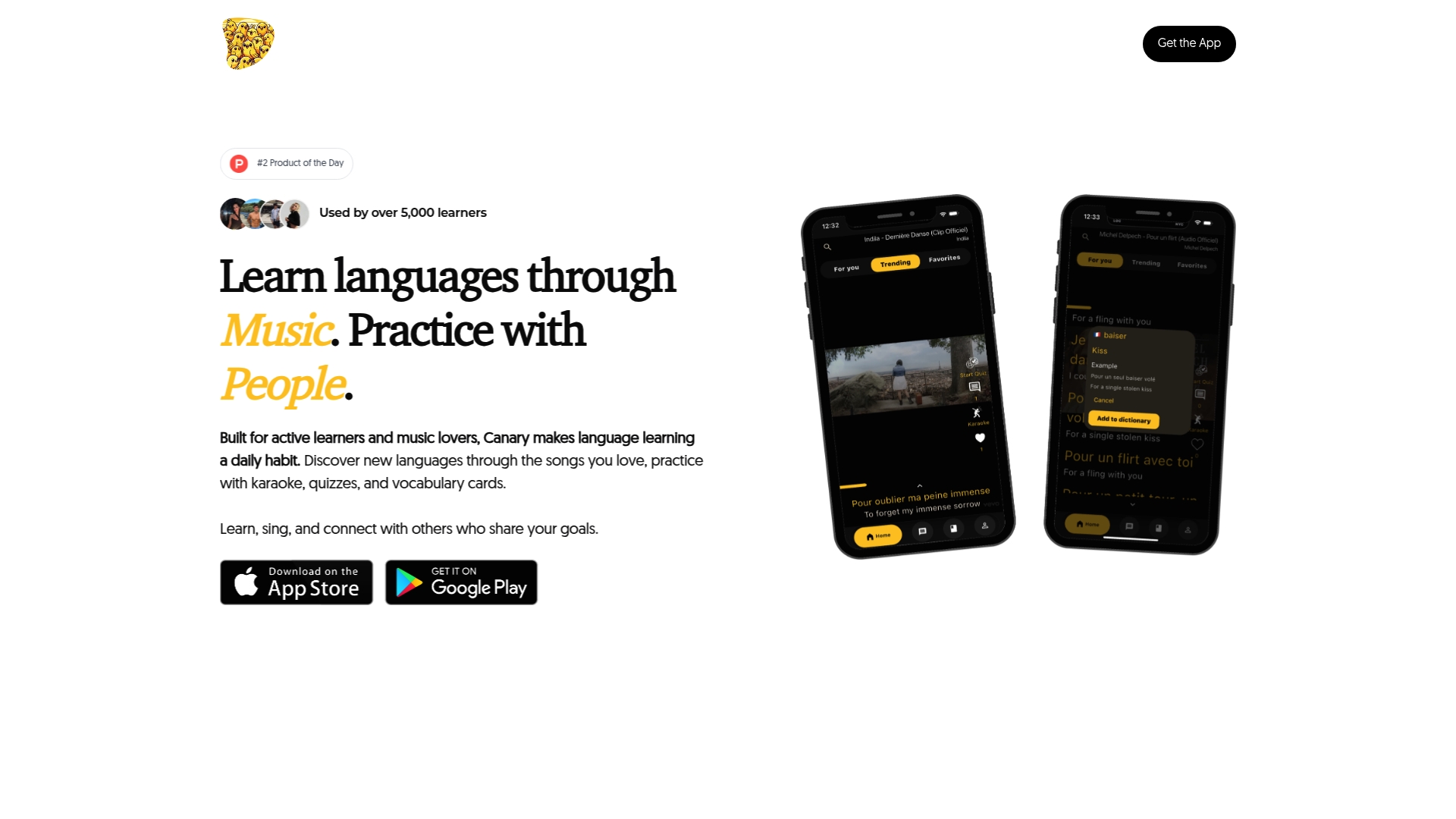
Singwithcanary combines music and social interaction to make daily pronunciation practice genuinely engaging. The platform uses song lyrics, karaoke features, and vocabulary cards to train the same prosodic patterns that accent modification targets: rhythm, stress, and intonation. Learners practice with international speakers, which builds the real-world transfer skills that structured drills alone cannot replicate. If you want to learn languages with music in a way that sticks, Singwithcanary gives you a daily habit that doubles as pronunciation training. You can also explore tips for speaking more clearly to complement your practice.
FAQ
What is accent training in simple terms?
Accent training, also called accent modification or pronunciation coaching, is the structured practice of adjusting how you produce sounds, stress, and intonation to be more clearly understood. It does not aim to eliminate your accent.
Is accent training effective for adult learners?
Adult learners consistently achieve meaningful intelligibility improvements through structured accent training, even if a fully native-like accent is rare. Prosody and perception training produce the fastest and most noticeable gains.
How long does it take to see results from accent training?
Most learners notice measurable clarity improvements within 4–8 weeks of consistent daily practice. Ten minutes of focused work each day produces faster results than occasional longer sessions.
What is the difference between accent reduction and accent modification?
Accent reduction implies removing an accent entirely, while accent modification describes the more accurate goal of adjusting speech patterns for better intelligibility. Most speech professionals prefer the term accent modification.
Can music help with accent training?
Music trains the same prosodic features that accent modification targets, including rhythm, stress, and intonation. Song-based practice is a research-supported complement to traditional pronunciation drills, particularly for building natural speech rhythm.
— Ben