TL;DR:
- Accent improvement prioritizes clarity and confidence over erasing native speech.
- Singing and music accelerate acquisition by practicing rhythm, intonation, and connected speech naturally.
- Consistent, enjoyable music practice leads to measurable progress without boring drills.
Accent improvement has a reputation for being stiff, repetitive, and frankly boring. Phonetic drills, tongue twisters, and hours of isolated sounds can feel more like a chore than a skill-building habit. But here’s the thing: some of the most effective accent work happens when you’re not even thinking about it, like when you’re singing along to your favorite song. Music and karaoke create the kind of relaxed, repeated exposure that actually rewires how you speak. This guide breaks down what accent improvement really means, why music accelerates it, and how you can start making real progress today, no boring drills required.
Table of Contents
- What is accent improvement?
- How does music accelerate accent improvement?
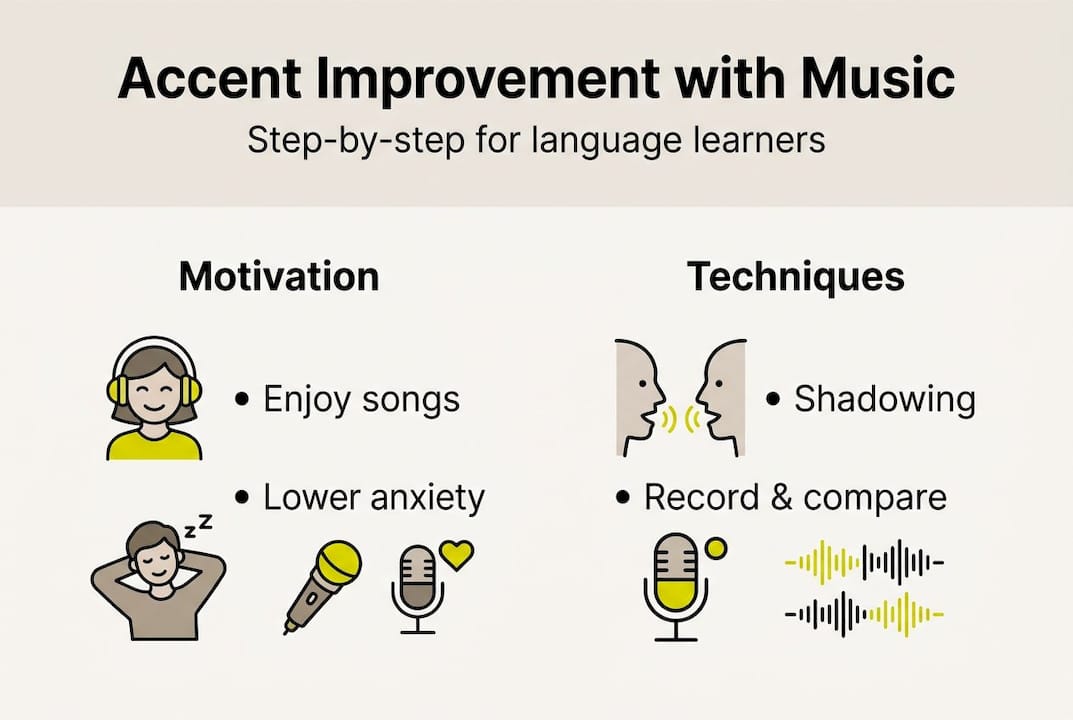
- Step-by-step: Improving your accent with songs and karaoke
- Pitfalls, progress, and the value of personal identity
- Our perspective: Why accent improvement matters and why music is your secret weapon
- Ready to improve your accent with music? Your next steps
- Frequently asked questions
Key Takeaways
| Point | Details |
|---|---|
| Music boosts learning | Using songs and karaoke makes accent improvement more enjoyable and effective for language learners. |
| Intelligibility over perfection | The goal is clear communication, not losing your identity or achieving a ‘native’ accent. |
| Progress takes practice | Consistent, interactive music-based practice with feedback leads to measurable gains in pronunciation and fluency. |
| Beware of pitfalls | Balance music with speech input and avoid copying artistic singer habits to ensure authentic accent improvement. |
What is accent improvement?
Let’s clear something up right away. Accent improvement does not mean erasing who you are. It doesn’t mean sounding like a news anchor or abandoning the rhythms of your first language. At its core, accent improvement is about intelligibility, which means being understood clearly and consistently by speakers of your target language.
Many learners approach this topic with a lot of anxiety, worried that changing how they sound means losing a piece of their identity. That fear is understandable, but it’s also a misconception. You get to decide how much you adapt. Some people want to blend in completely. Others just want to reduce misunderstandings in professional settings. Both goals are valid, and both are achievable.
Here are some of the most common myths about accent improvement:
- Myth: You need to eliminate your native accent entirely.
- Reality: Partial adaptation is not only acceptable, it’s the norm.
- Myth: Only children can significantly change their accent.
- Reality: Adults make meaningful progress with consistent, engaging practice.
- Myth: You need a speech therapist or expensive coaching.
- Reality: Music, apps, and community practice can get you surprisingly far.
The accent reduction discussion happening online reflects this shift in thinking. More learners are rejecting the idea of a “perfect” or “neutral” accent and focusing instead on clear, confident communication.
“Accent improvement prioritizes intelligibility over neutral accent; enjoyment supports consistency.” This insight from Music 101: The Key to Accent Reduction captures exactly why fun practice methods matter so much.
When you enjoy the process, you practice more. When you practice more, the patterns stick. That’s why music for language success isn’t just a nice idea. It’s a strategy backed by how humans actually learn.
Pro Tip: Don’t set “sound like a native” as your goal. Instead, aim for “be understood easily in context.” That shift alone will reduce pressure and help you practice more consistently.
How does music accelerate accent improvement?
Music does something that textbooks simply can’t: it makes you feel the language. Rhythm, stress, intonation, and connected speech are all baked into every song. When you sing along, you’re not just memorizing words. You’re physically rehearsing the sound patterns of the language.
Here’s how the main music-based techniques compare:
| Technique | What it trains | Difficulty level |
|---|---|---|
| Active listening | Ear recognition, intonation | Beginner |
| Singing along | Rhythm, stress, vowel shaping | Beginner to intermediate |
| Lyric shadowing | Connected speech, pace | Intermediate |
| Recording yourself | Self-monitoring, feedback | All levels |
| Karaoke practice | Full pronunciation flow | Intermediate |
The karaoke for language learning approach is particularly powerful because it removes performance anxiety. You’re focused on the song, not on being judged. That relaxed state is exactly when your brain absorbs new patterns most efficiently.
Research backs this up. Karaoke apps enhance EFL pronunciation, training rhythm, intonation, connected speech, vowel shaping, and pronunciation in one engaging session. A separate study found that songs improve fluency and accuracy at a statistically significant level (p<0.05), with longer practice durations producing more pronounced gains.
Here’s a simple breakdown of what music specifically trains:
- Prosody: The rise and fall of natural speech, which is embedded in every melody.
- Connected speech: How words blend together, something songs demonstrate constantly.
- Vowel shaping: Singers hold vowels longer, giving your mouth time to find the right position.
- Stress patterns: Song beats naturally emphasize the correct syllables in words.
- Repetition without boredom: You’ll happily replay a song 20 times. You won’t do the same drill 20 times.
For a deeper look at how this works across different styles, the methods for music lovers overview covers a range of approaches. And a recent study on karaoke and accent adds further evidence that structured song-based practice produces real, measurable results.
Step-by-step: Improving your accent with songs and karaoke
Theory is great, but you need a plan you can actually follow. Here’s a practical process that works for beginners and intermediate learners alike.
1. Choose the right songs. Pick artists known for clear diction in your target language. For English, Adele, Ed Sheeran, and Taylor Swift are excellent starting points. Their lyrics are articulate, their pacing is deliberate, and their vowels are clean. Avoid heavily stylized or vocally distorted tracks when you’re starting out.
2. Listen actively before you sing. Play the song through once without lyrics. Focus on where the stress falls, which syllables get stretched, and how words connect. This primes your ear before your mouth gets involved.
3. Sing slowly and deliberately. Use a tool that lets you slow playback speed without changing pitch. Many karaoke apps and YouTube lyric videos support this. Slow the track to 75% and sing line by line, focusing on matching the sounds exactly.
4. Shadow the lyrics. Shadowing means repeating a line immediately after hearing it, mimicking the exact rhythm and intonation. This is one of the fastest ways to internalize native speech patterns, as outlined in Fearless Presentations’ accent training guide.
5. Record yourself and compare. This step feels uncomfortable, but it’s essential. Record your version, then play it back alongside the original. Listen for differences in vowel sounds, stress, and connected speech. Adjust and repeat.

6. Get feedback. Share your recordings with a language partner, tutor, or community. Apps with social features let you hear how others sound and get real-time input. The karaoke case study found that feedback loops significantly improved learner outcomes.
Pro Tip: Focus on one song for at least two weeks before moving on. Deep practice with one track beats shallow exposure to ten.
For more structured guidance, check out how to practice pronunciation with music and explore musical learning methods that fit your style and level.
Here’s a quick reference for song selection:
- Clear diction: Adele, Ed Sheeran, Taylor Swift (English)
- Moderate pace: Avoid very fast rap or heavily stylized pop initially
- Lyric availability: Choose songs with accurate lyric videos or karaoke versions
- Personal connection: Songs you love keep you coming back
Pitfalls, progress, and the value of personal identity
Music makes accent work enjoyable, but it’s not a magic fix. There are real challenges worth knowing about before you dive in.
First, progress is rarely linear. Your improvement will depend on factors like your native language (L1), your age, how consistently you practice, and the quality of feedback you receive. A study on accent and L1 influence confirms that accent change is nuanced and varies significantly across learners based on all of these variables.
Here’s a quick look at how key factors affect your timeline:
| Factor | Impact on progress | What you can do |
|---|---|---|
| Native language similarity | High | Choose songs that target your specific gaps |
| Age | Moderate | Consistency matters more than age |
| Practice frequency | Very high | Daily short sessions beat weekly long ones |
| Feedback quality | High | Use recording and community input |
| Musical style of chosen songs | Moderate | Stick to clear, standard diction at first |
One underrated pitfall: copying a singer’s artistic accent rather than their natural speaking voice. Many artists deliberately bend pronunciation for stylistic effect. Singers might drop consonants, shift vowels, or blend words in ways that don’t reflect everyday speech. This is fine to notice, but don’t let it become your model for daily conversation.
Another common mistake is skipping ear training. Many learners jump straight to singing without spending enough time just listening. Your ear has to recognize a sound before your mouth can reproduce it. Spend at least as much time listening as you do singing.
Accent improvement is deeply personal. Some learners want to fully blend in; others want to stay recognizably themselves while becoming clearer. Both paths are legitimate.
The benefits of song-based language learning extend well beyond pronunciation. Songs build vocabulary, cultural knowledge, and emotional connection to the language. But for accent work specifically, set clear benchmarks. Record yourself monthly, note specific sounds you’ve improved, and celebrate small wins. Progress that isn’t measured tends to feel invisible, even when it’s real.
For a broader perspective on what learners think about this, the accent and personal identity discussion on Reddit is a genuinely interesting read.
Our perspective: Why accent improvement matters and why music is your secret weapon
Here’s an honest take: most accent improvement guides are obsessed with the wrong goal. They chase “perfect” pronunciation as if there’s a finish line, when the real target is confident, clear communication. That framing creates unnecessary pressure and, frankly, causes a lot of learners to quit.
Music flips this entirely. When you’re singing, you’re not performing for a critic. You’re connecting with a song. That emotional engagement is what makes the practice stick. You repeat phrases not because you’re drilling, but because you love the song. That’s the repetition that builds real muscle memory.
We also think the identity conversation is underrated. Your accent is part of who you are. The goal isn’t to erase it. It’s to add clarity and confidence on top of it. The benefits of song-based learning show that this approach builds both at the same time, without the anxiety that traditional methods often create.
Music doesn’t just teach you how to sound. It teaches you how to feel the language. That’s a difference worth paying attention to.
Ready to improve your accent with music? Your next steps
If everything in this guide resonates with you, the best move is to stop reading and start singing. The gap between knowing and doing is where most learners get stuck.
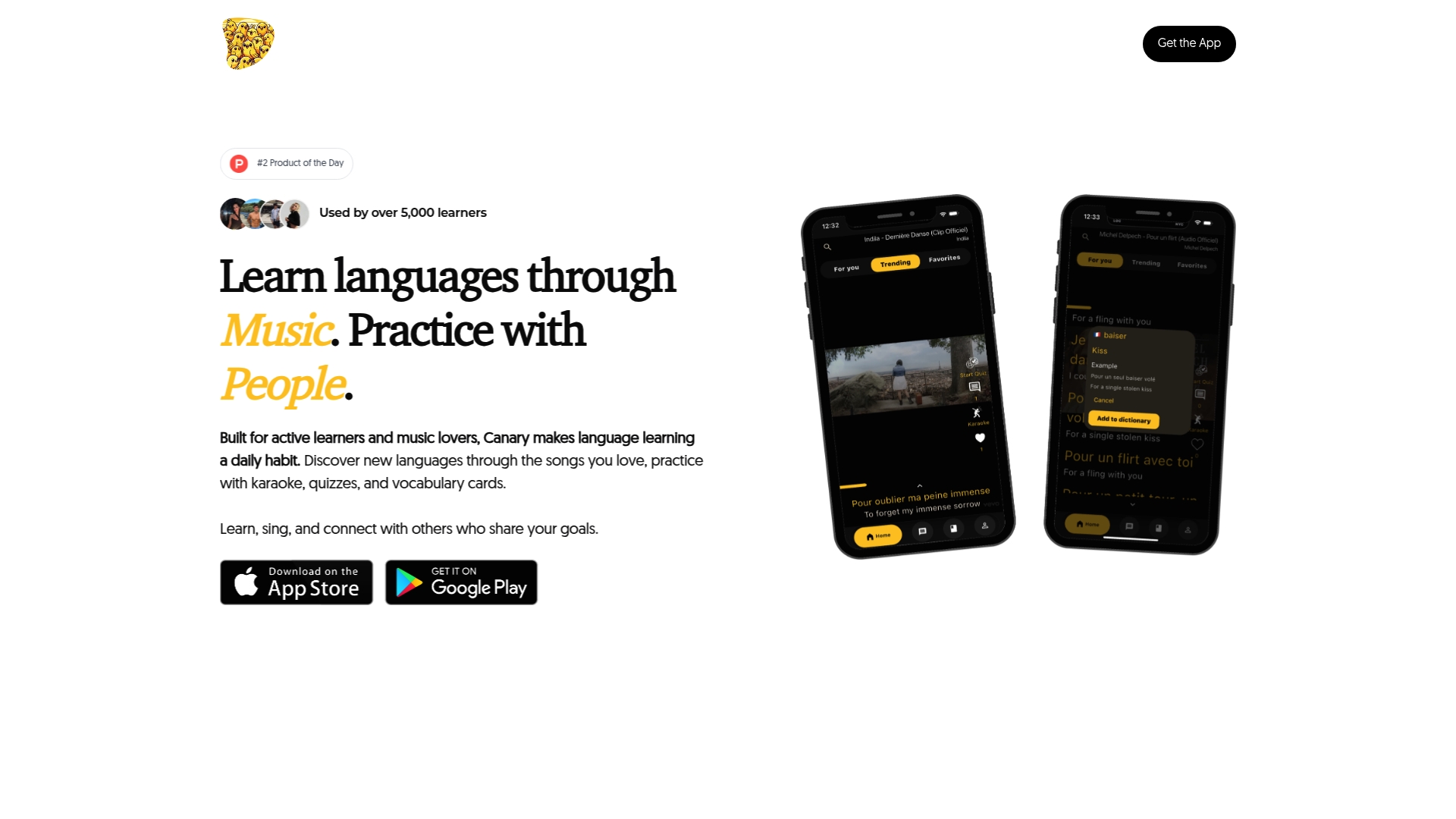
Canary is built exactly for this. It combines karaoke-style song practice, vocabulary cards, and a global community of learners who are all using music to build real language skills. You can start learning a language with music today and immediately put these techniques into action. Explore the benefits of song-based techniques to see how this approach fits your goals, or jump straight into the Song of the Week for a ready-made practice session. Your accent journey starts with one song.
Frequently asked questions
Can I really improve my accent just by singing?
Singing alone can enhance pronunciation, rhythm, and connected speech, but best results come from combining songs with feedback and varied listening. Karaoke and song practice show measurable gains in EFL pronunciation when used consistently.
Do I need to lose my native accent to speak clearly?
No. Accent improvement focuses on clarity and being understood rather than erasing your background. Prioritizing intelligibility over a “neutral” accent is the approach most learners and experts now recommend.
How fast can music-based accent improvement show results?
Most learners notice progress within a few weeks of consistent music practice, especially when they record themselves and seek feedback. Empirical data shows positive gains increase with longer practice duration.
Are there risks to learning accent through music?
The main risk is picking up a singer’s artistic accent rather than standard speech patterns. Music bends pronunciation rules, so balance song practice with real conversational input and structured feedback for the best results.