TL;DR:
- Culturally immersive learning involves active participation in authentic cultural experiences rather than passive observation. It enhances language retention and cultural understanding by integrating context, social interaction, and reflection into learning. Digital tools like virtual environments and social platforms now enable immersive experiences without the need for travel.
Culturally immersive learning is defined as an experiential approach where learners actively engage with a culture through authentic, context-rich interactions rather than passive observation. It integrates language, social norms, customs, and real-world communication into a single, unified learning experience. Unlike traditional classroom instruction, this method places the learner inside the culture, not just in front of it. Research consistently shows that immersion-based learning produces stronger language retention and deeper cultural understanding than grammar drills or textbook study alone. For educators and learners alike, understanding what culturally immersive learning means is the first step toward designing or choosing experiences that actually work.
What is culturally immersive learning, and what makes it different?
Culturally immersive learning is the industry-recognized application of experiential learning theory to cultural and linguistic contexts. The term “experiential learning,” developed by educational theorist David Kolb, describes learning through direct experience and reflection. Culturally immersive learning applies that framework specifically to culture and language, requiring learners to participate in authentic cultural situations rather than study them from a distance.
The core distinction is active versus passive engagement. A learner who reads about Japanese business customs is studying culture. A learner who practices bowing, exchanges business cards in the correct manner, and navigates a role-play negotiation in Japanese is experiencing it. That gap between knowing and doing is where culturally immersive learning lives.
Context-based language learning produces significantly stronger retention and transfer than traditional instruction. This means learners who practice language inside cultural situations remember more and use it more naturally in real conversations. The difference shows up not just in test scores but in actual communication confidence.
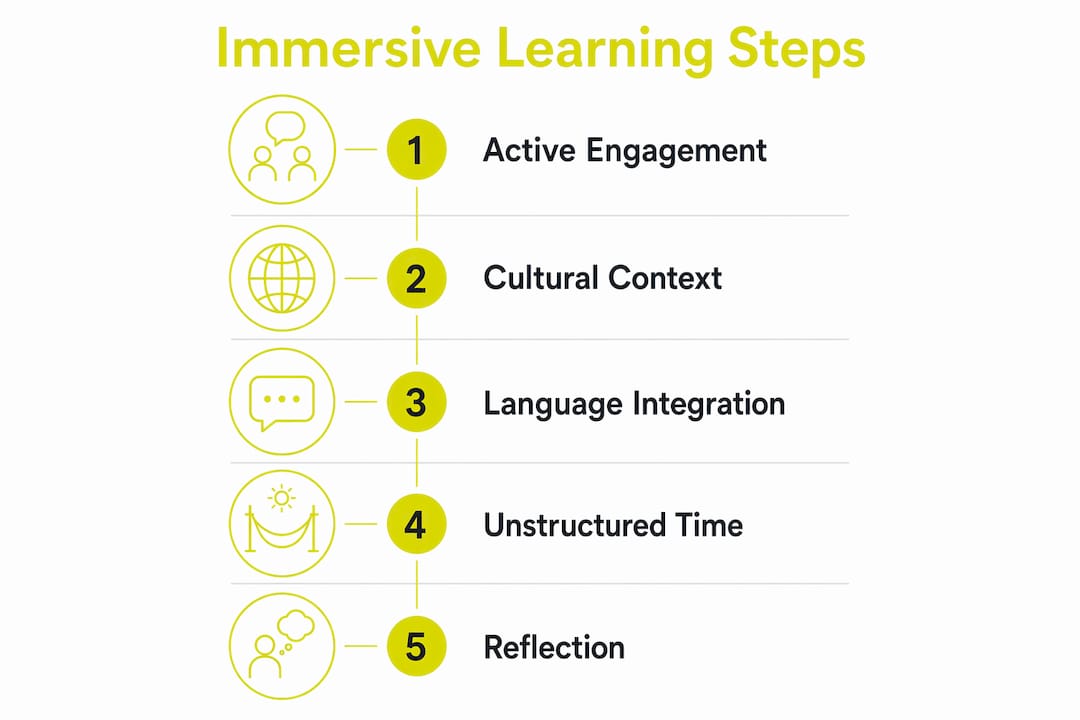
What are the essential components that define culturally immersive learning?
Culturally immersive learning is built from several interlocking elements. Remove any one of them and the experience becomes shallower.
- Active participation. Learners live within or simulate the culture rather than observe it. This means cooking traditional meals, attending cultural events, or practicing real-world transactions in the target language.
- Contextual language use. Vocabulary and grammar appear inside cultural practices, idioms, and humor. A learner picks up slang from a song lyric, not a flashcard definition.
- Social interaction. Relationship-building with native speakers or cultural insiders is non-negotiable. Meaningful cultural connections require dialog, reciprocity, and genuine exchange.
- Structured and unstructured time. Effective programs balance guided activities with open exploration and rest. Downtime is not wasted time. It is when the brain consolidates what it has absorbed.
- Reflective dialogue. Learners need space to process what they are experiencing. Structured reflection, whether journaling, group discussion, or one-on-one feedback, turns raw experience into lasting understanding.
- Productive discomfort. Learners often hit a plateau of confusion or frustration during immersion. Embracing that discomfort rather than avoiding it is what drives genuine personal and linguistic growth.
Pro Tip: When designing an immersive program, schedule at least one unstructured hour per day. Learners who have time to wander, observe, and reflect without an agenda consistently report deeper cultural insights than those in back-to-back structured sessions.
How does culturally immersive learning enhance language acquisition?
Immersive learning builds communication skills that transfer directly to real-life interactions. The mechanism is straightforward: when language appears inside a meaningful cultural moment, the brain encodes it with emotional and contextual anchors. Those anchors make recall faster and more reliable than rote memorization.
“Real immersion is not defined by physical travel but by ‘living’ the language authentically through integrated cultural routines. Creating immersive routines with music, social interaction, and real-world simulations replicates immersion without physical travel.”
The benefits extend well beyond vocabulary. Learners develop cultural fluency, which means understanding professional norms, recognizing humor, and reading tone correctly in a second language. These are the skills that separate a technically proficient speaker from one who can actually build relationships across cultures.
Researchers draw an important distinction between cultural competence and cultural humility. Cultural competence describes a fixed set of skills a learner acquires. Cultural humility, by contrast, is an ongoing self-assessment process tied to authentic immersion. True immersive learning produces the latter. It teaches learners to stay curious and open rather than assuming they have mastered a culture.
Place-based immersion programs that include relationship-building, flexibility, dialog, and rest promote lasting cultural competency. The key themes that emerge from well-designed programs include recognizing one’s own ignorance, understanding social dynamics, and questioning previously held assumptions. These outcomes go far beyond language proficiency. They represent a genuine reorientation of worldview.
Identity-driven educational frameworks, such as those described in identity-based STEAM approaches, reinforce a similar principle: learners engage more deeply when their own identity and lived experience are part of the curriculum. Culturally immersive learning works the same way. It meets learners where they are and asks them to grow from there.
What modern methods and technologies support culturally immersive learning?
Culturally immersive learning no longer requires a plane ticket. Modern delivery methods range from traditional place-based programs to fully digital platforms that replicate the critical elements of cultural context.

| Approach | Format | Key strength |
|---|---|---|
| Study abroad and fieldwork | In-person, place-based | Full sensory and social immersion |
| Community engagement programs | In-person, local | Authentic relationships without travel |
| Live native-speaker platforms | Digital, synchronous | Real-time cultural and linguistic feedback |
| Scenario-based simulations | Digital, asynchronous | Repeatable, low-stakes practice |
| VR, AR, and XR environments | Digital, immersive tech | Presence in cultural settings without travel |
Virtual immersion platforms deliver results comparable to or better than traditional classrooms by using live native-speaking interaction and cultural nuance. That finding matters because it removes the assumption that physical travel is a prerequisite for genuine immersion.
VR, AR, and extended reality (XR) technologies add another layer. These tools provide what researchers call system immersion, narrative immersion, and challenge immersion. Immersive technologies help learners experience presence in cultural environments, facilitating meaningful intercultural learning without travel. The practical implication is significant: a learner in rural Kansas can practice navigating a Moroccan market or a Tokyo subway station with a level of realism that a textbook cannot approach.
Effective digital immersion requires careful program design. System immersion means the technology itself feels natural and does not distract from learning. Narrative immersion means the cultural story or scenario is compelling enough to hold attention. Challenge immersion means the difficulty level pushes the learner without overwhelming them. Educational trends in 2026 confirm that experiential and immersive approaches are moving from experimental to mainstream across disciplines.
Pro Tip: When evaluating a digital immersion platform, check whether it includes synchronous interaction with native speakers. Asynchronous tools build vocabulary and grammar, but real-time conversation is where cultural fluency actually develops.
How can educators and learners implement culturally immersive techniques?
Practical implementation does not require a complete curriculum overhaul. Educators and learners can build immersive experiences incrementally by applying a few core principles consistently.
- Incorporate cultural routines daily. Use music, food, news, and social media from the target culture as regular learning inputs. A song lyric teaches idiom, rhythm, and cultural reference simultaneously. Music and social routines are among the most effective tools for building cultural context into daily practice.
- Use scenario-based practice. Design or choose activities that simulate real transactions: ordering food, negotiating a price, or navigating a job interview in the target language. Role-play builds the muscle memory that grammar exercises cannot.
- Create a safe space for mistakes. Programs that hold space for learners to make errors without judgment produce deeper long-term acquisition than those that prioritize accuracy over exploration. Safety and error tolerance matter more than geographic location.
- Build in reflection time. Schedule structured reflection after every major activity. Journaling, peer discussion, or a brief written summary forces learners to articulate what they experienced, which deepens encoding.
- Partner with community organizations. Local cultural centers, international student groups, and community events provide authentic interaction without requiring travel. These partnerships also build reciprocity, which is a core element of genuine cultural exchange.
- Address learner resistance directly. Many learners resist immersion because they fear embarrassment or failure. Naming that fear openly and framing discomfort as a sign of growth rather than failure shifts the learner’s mindset before the experience begins.
Immersion program design works best when it combines structured activities with genuine flexibility. Rigid schedules that leave no room for spontaneous cultural encounters undercut the very authenticity that makes immersion effective.
Key Takeaways
Culturally immersive learning works because it places language inside authentic cultural experience, producing retention, fluency, and worldview growth that no isolated drill can replicate.
| Point | Details |
|---|---|
| Definition is experiential | Culturally immersive learning requires active participation in culture, not passive observation of it. |
| Travel is not required | Digital platforms using live native speakers and VR environments replicate critical immersion elements effectively. |
| Discomfort signals growth | A plateau of confusion during immersion is a marker of genuine linguistic and personal development. |
| Safety beats geography | Creating error-tolerant learning spaces produces deeper acquisition than physical location alone. |
| Cultural humility over competence | The goal is ongoing self-assessment and curiosity, not a fixed checklist of cultural skills. |
Why educators underestimate the role of discomfort
The most common mistake I see educators make with immersive programs is designing out the discomfort. They add more structure, more scaffolding, more guided activities, all in an attempt to keep learners comfortable and engaged. The result is a program that feels safe but produces shallow learning.
Real immersion is supposed to feel disorienting. When a learner cannot follow a fast-paced native conversation, or misreads a social cue and causes an awkward moment, that friction is the learning. The brain is being forced to reorganize. The worldview is being asked to expand. That process is not pleasant, and it should not be.
What educators actually need to do is prepare learners for discomfort before it arrives, then hold space for it when it does. That means naming the experience in advance, normalizing confusion, and building in reflection time so learners can process what happened rather than simply endure it. The community-driven platform model does this well by pairing live interaction with structured feedback loops.
Digital platforms have made this easier to design at scale. A learner can now experience a culturally disorienting scenario, pause, reflect, and try again without the social stakes of a real-world mistake. That iteration cycle is where the growth happens. The best immersive programs, whether in-person or digital, are the ones that treat discomfort as a feature, not a bug.
— Ben
Singwithcanary: language learning through music and live connection
Culturally immersive learning thrives when language meets real cultural context. Singwithcanary is built on exactly that principle.
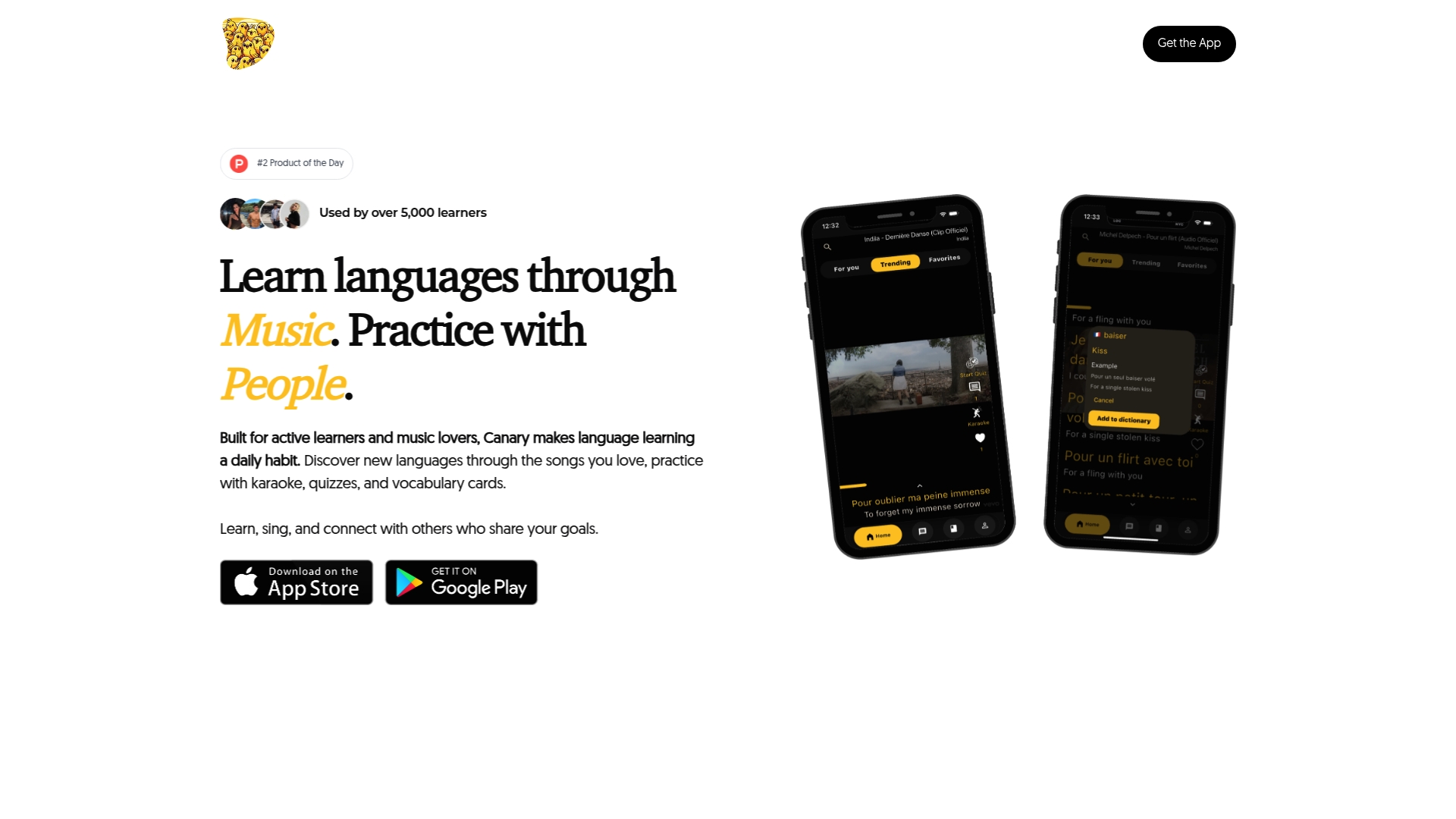
Singwithcanary combines song-based learning with karaoke, vocabulary cards, and quizzes to place language inside the cultural moments where it actually lives. Learners practice pronunciation through real song lyrics, build vocabulary in context, and connect with international speakers for live social practice. The platform replicates the core elements of immersion, authentic cultural input, real-time interaction, and meaningful repetition, without requiring travel. If you are ready to learn languages with music and practice with people from around the world, Singwithcanary offers a genuinely engaging way to make that happen every day.
FAQ
What is culturally immersive learning in simple terms?
Culturally immersive learning is active engagement with a culture through authentic experiences that integrate language, customs, and social interaction. It differs from traditional study by placing the learner inside the culture rather than outside it.
Does cultural immersion in language learning require travel abroad?
Travel is not required. Immersion is defined by living the language within cultural context, which can be replicated through digital platforms, music, social interaction, and real-world simulations at home.
What are the main benefits of culturally immersive education?
The primary benefits include stronger language retention, cultural fluency, intercultural sensitivity, and a reorientation of worldview. Programs that include reflection and social interaction produce the most lasting outcomes.
How do VR and AR support cultural immersion in language education?
VR and AR provide system, narrative, and challenge immersion that simulate cultural environments remotely, giving learners a sense of presence in another culture without geographic or financial barriers.
What is the difference between cultural competence and cultural humility?
Cultural competence refers to a fixed set of acquired skills, while cultural humility is an ongoing process of self-assessment and openness. Authentic immersive learning builds cultural humility, which is the more durable and meaningful outcome.