TL;DR:
- Pronunciation practice involves deliberate training of sounds, stress, intonation, and rhythm to improve clarity. It enhances communication and listening comprehension by targeting muscle memory and speech patterns through structured, repetitive exercises. Using tools like recordings, apps, and music accelerates progress, emphasizing consistency over intensity from the earliest stages.
You can memorize a thousand words in a new language and still leave every conversation feeling invisible. People ask you to repeat yourself. Conversations stall. The problem is rarely your vocabulary. Pronunciation practice is the missing piece, and most learners underestimate both what it actually involves and how to do it well. This article breaks down exactly what pronunciation practice is, the research-backed benefits of getting it right, and a concrete step-by-step approach you can start today regardless of your current level.
Table of Contents
- Key takeaways
- What is pronunciation practice, and why it belongs at the center of language learning
- Core components and pronunciation exercises for learners at every level
- Step by step pronunciation practice: a method that actually builds progress
- Common challenges and how to get past them
- Useful tools and resources for pronunciation practice
- My take on what most learners get wrong
- Try Singwithcanary for your pronunciation practice
- FAQ
Key takeaways
| Point | Details |
|---|---|
| Pronunciation is more than sounds | It includes stress, intonation, rhythm, and pitch, all of which affect how clearly you communicate. |
| Structured practice beats random repetition | Following a step-by-step method builds muscle memory faster than casual speaking alone. |
| Technology closes the feedback gap | Apps, speech recognition, and recording tools give you corrections when a native speaker is not available. |
| Music accelerates pronunciation gains | Singing and lyric-based learning train rhythm and intonation in a way that drills rarely match. |
| Consistency matters more than intensity | Short, daily pronunciation sessions outperform occasional long study marathons every time. |
What is pronunciation practice, and why it belongs at the center of language learning
Pronunciation practice is the deliberate training of how you produce sounds, words, and sentences in a target language. It covers four interconnected layers: articulation (how your mouth shapes individual sounds), stress (which syllables and words carry emphasis), intonation (the rise and fall of your pitch across a phrase), and rhythm (the overall flow and timing of connected speech). When any one of those layers is off, listeners struggle to follow you even when your words are technically correct.
“The goal of pronunciation practice is not a perfect accent. It is accurate communication. Meaning is lost when sounds, stress, or intonation mislead the listener about what is being said.”
The importance of pronunciation in language learning becomes obvious the moment you realize that two words pronounced with the same sounds but different stress can mean completely different things. Think of “PREsent” (noun) versus “preSENT” (verb) in English, or the dozens of tonal distinctions in Mandarin where pitch alone changes meaning entirely.
The benefits of pronunciation practice go beyond avoiding embarrassment. Good pronunciation improves your listening comprehension too, because the sounds you can produce accurately are also the sounds you can recognize more easily when others speak. That connection between production and perception is what makes pronunciation work so central to fluency, not just speaking clearly but understanding others in return.
Many learners treat pronunciation as a finishing touch, something to worry about after vocabulary and grammar are solid. Research flips that logic. Pronunciation gaps at early stages create habits that are much harder to undo later. Building accurate sound production from the beginning reduces misunderstandings and speeds up every other area of language development.
Core components and pronunciation exercises for learners at every level
Effective pronunciation practice is not one activity. It is a set of coordinated skills that work together, and understanding them separately helps you know where to focus.
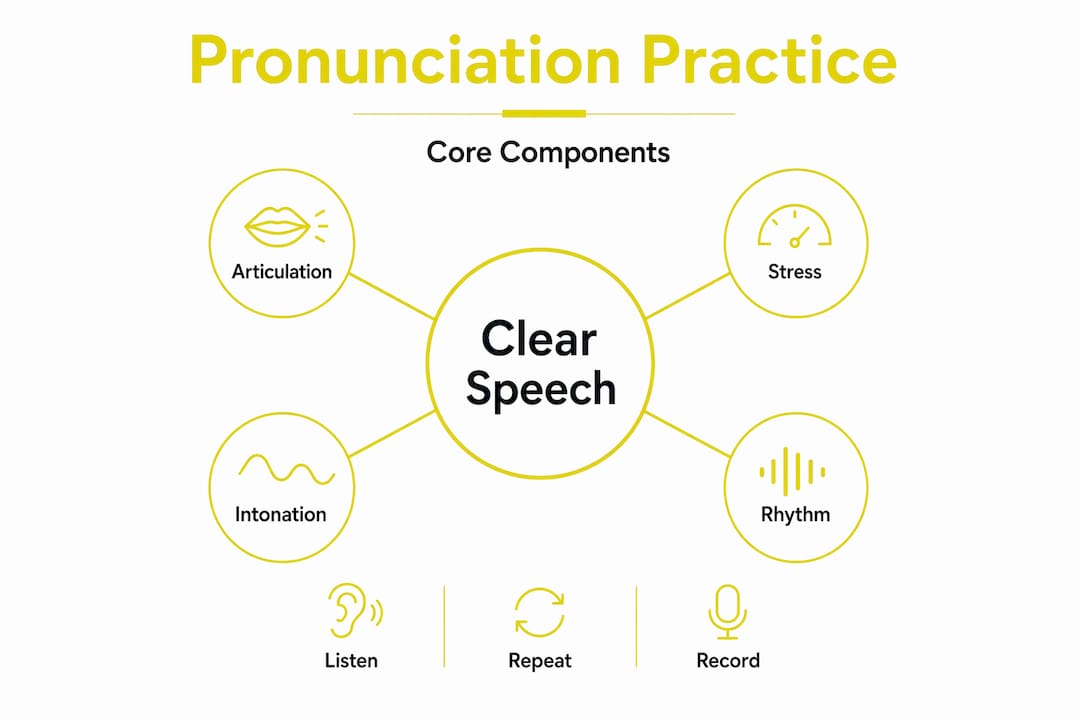
Articulation covers the physical mechanics of producing sounds. Vowels, consonants, and diphthongs (blended vowel sounds like the “oi” in “coin”) each require specific mouth, tongue, and lip positions. Many learners default to the positions their first language trained them into, which is why a Spanish speaker may struggle with the English “th” sound or a French speaker may flatten English vowels.
Stress and intonation are where most intermediate learners plateau. You might nail individual sounds but still sound robotic or confusing because your word stress is flat or your sentence melody does not match native patterns. English, for example, compresses unstressed syllables and stretches stressed ones in a way that feels extreme to speakers of syllable-timed languages like Spanish or Japanese.
Rhythm and pitch tie everything together. Native speakers do not speak word by word; they chunk speech into thought groups with natural pauses and a consistent beat. Matching that rhythm is what makes speech sound natural rather than like a textbook recording.
Here are the core pronunciation exercises for learners that cover all three layers:
- Shadowing. Listen to a native speaker and repeat what they say in real time, matching their speed, rhythm, and pitch as closely as possible. This trains your ear and mouth simultaneously.
- Tongue twisters. These force rapid articulation of similar sounds and expose exactly which phonemes give you trouble. They are not just fun. They reveal real gaps.
- Reading aloud. Pick a text, record yourself, and play it back. Compare it to a native reader’s version of the same passage. The gap between what you think you sound like and what you actually sound like is usually the most useful data you will get.
- Minimal pair drills. Practice distinguishing and producing word pairs that differ by a single sound, like “ship” and “sheep” or “bat” and “bad.” This sharpens your ear for sounds your first language does not contrast.
- IPA study. The International Phonetic Alphabet gives every sound in every language a unique symbol, so you can look up any word and know exactly how it should sound before you say it.
Pro Tip: Set your phone to record a 60-second voice memo of yourself reading the same paragraph every two weeks. Date each file and compare them side by side. Progress in pronunciation is slow enough that you will not notice it day to day, but two months of recordings will show you exactly how far you have come.
Step by step pronunciation practice: a method that actually builds progress
Most learners practice pronunciation randomly. They say a word wrong, someone corrects them, and they move on. That is not practice. That is error correction. Real step-by-step pronunciation practice is structured, deliberate, and cumulative.
Here is a method that works at any level:
- Start with focused listening. Before you speak, listen. Find a short audio clip (30 to 60 seconds) of a native speaker on a topic you find interesting. Listen three times: once for overall meaning, once for rhythm and stress, and once specifically tracking how individual sounds connect across words. Active listening first creates a target for your mouth to aim at.
- Look up unfamiliar sounds using IPA. If a word sounds different from how you expected, find its phonetic transcription. This step alone removes guesswork and tells you precisely which sound you need to practice.
- Isolate and repeat problem sounds. Do not practice the whole sentence if one sound is derailing you. Drill that sound in isolation, then in simple words, then in the full sentence. Work from small to large.
- Record yourself and compare. Say the target phrase, record it, and play it next to the original. Self-recording is one of the most underused tools in language learning. Most people hate hearing their own voice, which is precisely why this step is so effective. The discomfort means you are paying attention.
- Use apps for real-time feedback. Digital tools with speech recognition can flag mispronounced words and show you where your pitch differs from native patterns. Use them between sessions with human speakers.
- Add social practice. Speaking with real people closes the loop. The pressure of real conversation forces your pronunciation out of controlled conditions and into the messier, faster pace of actual speech. Interactive environments boost both motivation and fluency in ways that solo drills cannot replicate.
- Repeat daily in short bursts. Fifteen focused minutes every day beats two hours on the weekend. Muscle memory for speech sounds builds through repetition over time, and consistency is the only path there.
Pro Tip: Pair your pronunciation practice with content you actually enjoy. If you love cooking shows, shadow a host. If you love podcasts, transcribe 30 seconds and practice reading it back at the host’s pace. Engagement is what keeps you showing up.
Common challenges and how to get past them
Every learner hits the same walls. Knowing they are coming makes them easier to move through.
- Distinguishing similar sounds. Many learners simply cannot hear the difference between sounds that do not exist in their first language. Common sound challenges include pairs that feel identical to untrained ears. Minimal pair drills and slowed-down audio are the most direct fix.
- Fear of sounding unnatural. This one is mostly psychological but has a real effect on practice quality. Learners avoid speaking, which means they get less feedback, which means they improve more slowly. The fix is controlled exposure: record yourself instead of speaking live until your confidence builds.
- Lack of feedback. Without correction, you can practice the wrong pronunciation hundreds of times and just reinforce the error. Seek native speaker feedback wherever possible, and use technology to fill the gaps when human partners are not available.
- Progress plateaus. After initial gains, many learners feel stuck. This usually means they are practicing what they are already comfortable with. Push into harder material: faster speech, regional accents, or connected speech patterns where words blend together.
- Perfectionism. Chasing a perfect accent is a trap. Accuracy matters; flawlessness does not. The goal is to be understood, not to pass as a native speaker.
Useful tools and resources for pronunciation practice
Getting the right tools in place makes the difference between practice that drifts and practice that compounds.
| Tool type | What it does | Best for |
|---|---|---|
| IPA reference charts | Maps every sound to a symbol and audio example | Beginners building a sound inventory |
| Speech recognition apps | Gives instant feedback on accuracy and clarity | Solo learners without regular native access |
| Shadowing audio | Trains rhythm, stress, and intonation together | Intermediate learners who sound flat or robotic |
| Song-based platforms | Builds pronunciation through rhythm and melody naturally | All levels; especially useful for intonation |
| Tutoring platforms | Provides personalized feedback and correction | Learners who need targeted guidance |
Music deserves special mention here. Singing in your target language trains rhythm, intonation, and stress in context, exactly the features most drills ignore. When you learn a song, you absorb the natural melody of the language rather than reciting it word by word. That is why learners who use music often report faster gains in sounding natural, not just accurate.
For learners who want to go deeper on technique, the guide to speaking clearly today covers specific articulation techniques paired with practice drills. For understanding why music works on a deeper level, the article on pronunciation through music is worth your time.
My take on what most learners get wrong
I’ve watched countless learners spend months building vocabulary and grammar while treating pronunciation as an afterthought. Then they go to use the language and feel crushed when people struggle to understand them. The frustration is real, but the cause is predictable.
What I’ve found is that most people believe pronunciation practice means repeating words until they sound right. It does not. It means coordinating perception and production through multiple modes: listening carefully, understanding what your mouth needs to do, practicing deliberately, and getting real feedback. That multimodal approach is what actually moves the needle.
My other strong opinion: the pursuit of a perfect accent is one of the most counterproductive goals a language learner can have. I’ve seen fluent, confident speakers with heavy accents communicate beautifully because their stress and intonation were accurate. I’ve also seen learners with near-native vowels get misunderstood constantly because their rhythm was off. Clarity of communication, not accent elimination, is the real target.
Music is the tool most learners overlook entirely, and it is genuinely effective. Not because it is fun (though it is) but because songs force you to match rhythm, pitch, and connected speech in a way that isolated drills never do. If you are stuck on sounding robotic or flat, adding song-based practice will change that faster than almost anything else.
— Ben
Try Singwithcanary for your pronunciation practice
If you are ready to stop drilling in isolation and start building real pronunciation skills through music and community, Singwithcanary is built exactly for that. The platform combines song-based learning with karaoke features, vocabulary cards, and interactive quizzes so you practice stress, intonation, and rhythm in context every session.
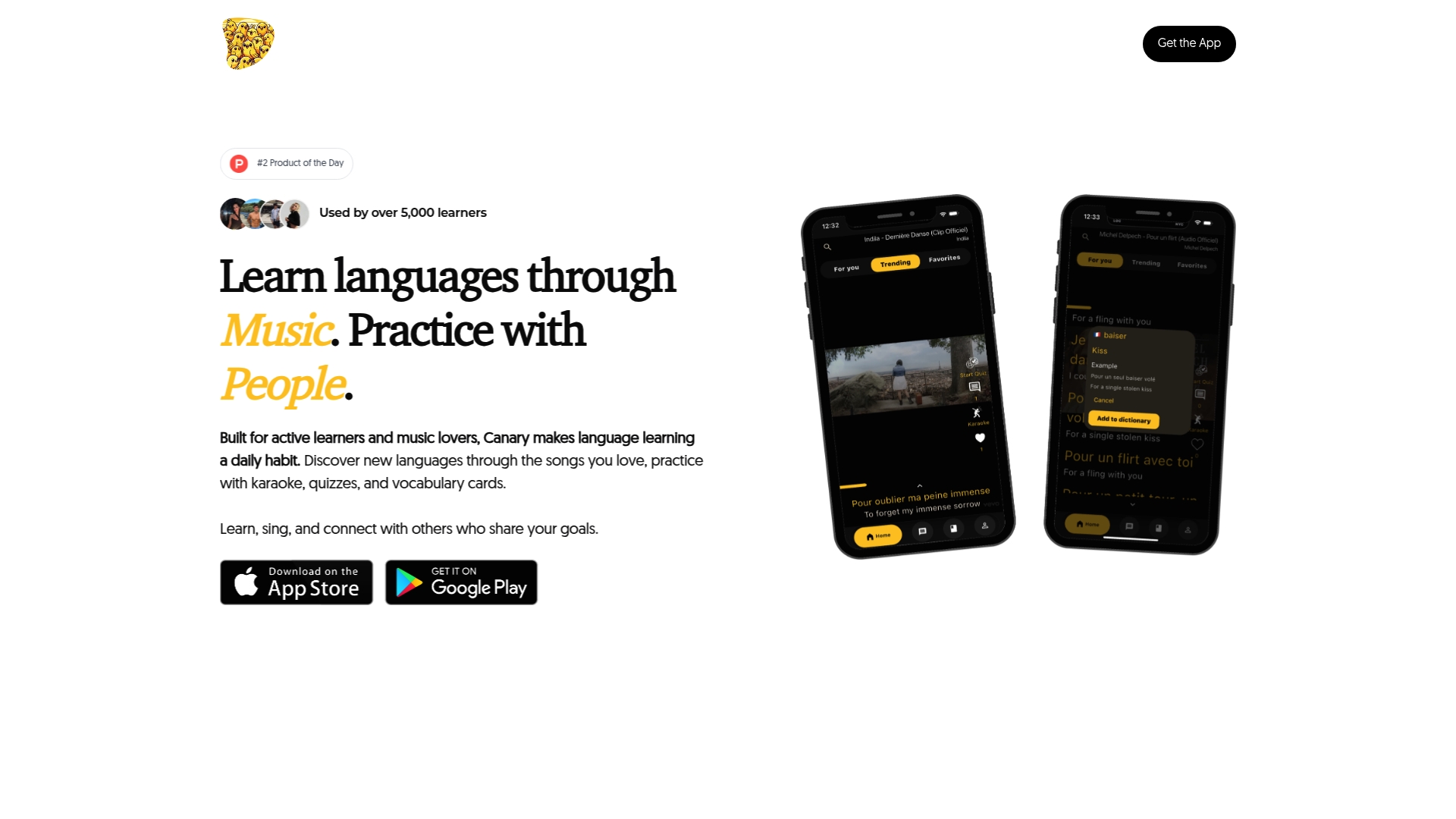
Every song you work through on Singwithcanary is a structured pronunciation exercise. You hear native delivery, match it phrase by phrase, and build the ear training that makes real conversations easier. The community element means you are also practicing with real people from around the world, not just repeating into a void. If you want a step-by-step pronunciation practice method that does not feel like homework, this is where to start.
FAQ
What does pronunciation practice actually involve?
Pronunciation practice is the deliberate training of articulation, stress, intonation, and rhythm in a target language. It combines listening, repetition, self-recording, and feedback to help learners produce sounds accurately and communicate clearly.
How long does it take to improve pronunciation noticeably?
Most learners notice real differences within four to eight weeks of daily, focused practice. Consistency matters more than session length. Fifteen minutes of deliberate practice every day produces faster gains than sporadic longer sessions.
What are the biggest benefits of pronunciation practice?
Beyond being understood more easily, pronunciation practice also sharpens your listening comprehension. When you can produce sounds accurately, you recognize them more reliably in natural speech, which speeds up overall fluency.
Can music really help with pronunciation?
Yes. Singing in your target language trains rhythm, stress, and intonation naturally because songs replicate the melody of native speech. Music-driven practice builds the same patterns that make fluent speakers sound effortless.
What should beginners focus on first in pronunciation practice?
Start with active listening to native speech and use IPA to understand how target sounds are formed. Then practice individual problem sounds in isolation before building up to full words and sentences.