TL;DR:
- Cultural context is essential for effective communication and understanding in language learning.
- Music and songs provide authentic cultural insight and enhance vocabulary retention.
- Incorporating diverse cultural materials and peer interaction accelerates intercultural competence growth.
You can memorize a thousand vocabulary words and still freeze when a native speaker cracks a joke, references a local tradition, or sings a line that hits differently depending on who’s in the room. Language without cultural context is like knowing every ingredient in a recipe but never tasting the dish. Cultural context in language learning refers to integrating cultural knowledge, norms, and practices for effective communication. For music-driven learners especially, understanding the culture behind lyrics transforms passive listening into genuine fluency.
Table of Contents
- What is cultural context in language learning?
- Key models and evidence: How experts shape cultural context
- Music as cultural context: Why songs ignite language mastery
- Edge cases and challenges: When cultural context isn’t straightforward
- Building cultural competence: Actionable strategies for learners
- Why real language learning starts with culture, not vocabulary lists
- Ready to deepen your language skills through culture and music?
- Frequently asked questions
Key Takeaways
| Point | Details |
|---|---|
| Culture shapes language | True communication comes from understanding a language’s culture, not just its words and grammar. |
| Music reveals real usage | Songs immerse learners in authentic expressions, idioms, and social norms for deeper comprehension. |
| Frameworks boost learning | Expert models like Byram’s and Kramsch’s show how to develop intercultural competence through structured activities. |
| Application matters most | Applying cultural knowledge in real-life and group discussions cements lasting language skills. |
What is cultural context in language learning?
Language is a living system. It carries history, humor, power, and emotion in ways that no grammar textbook fully captures. When we talk about cultural context, we mean the social and cultural layer that gives words their real meaning in actual conversations.
Cultural context integrates cultural knowledge, norms, and practices into language acquisition, making it possible to communicate effectively rather than just correctly. There is a big difference between those two things.
Ignoring cultural context leads to what linguists call pragmatic failure. That is when you say something grammatically perfect but socially wrong. A classic example: in French, choosing between tu (informal) and vous (formal) is not just grammar. It signals respect, familiarity, and social hierarchy. Get it wrong, and you might accidentally offend a colleague or sound oddly intimate with a stranger.
Here is why cultural context matters beyond grammar:
- Idioms and slang rarely translate word for word
- Tone and register shift depending on social setting
- Humor is almost always culturally specific
- Silence and pauses carry different meanings across cultures
- Song lyrics often rely on shared cultural references that outsiders miss entirely
That last point is huge for music learners. When you hear a Spanish pop song reference la siesta or a French chanson invoke la liberté, those words carry layers of cultural meaning that go far beyond their dictionary definitions.
“Language is not just a tool for communication. It is a reflection of the values, beliefs, and practices of the community that uses it.”
Building intercultural sensitivity means learning to read those layers. The role of context in language learning is not optional. It is the foundation. And cultural immersion strategies are the fastest way to build that foundation without moving abroad.
Key models and evidence: How experts shape cultural context
Experts have been studying this for decades, and two names come up constantly: Michael Byram and Claire Kramsch.
Byram’s ICC model and Kramsch’s inherent culture approach have shaped how language teachers think about cultural integration. Byram’s Intercultural Communicative Competence (ICC) model breaks cultural learning into five components: attitudes, knowledge, skills of interpreting, skills of discovery and interaction, and critical cultural awareness. It is not just about knowing facts about another culture. It is about developing the empathy and flexibility to navigate it.
Kramsch’s approach goes even further, arguing that culture is not an add-on subject to be taught separately. It is inherent in every act of language use. Every sentence you speak or sing is already a cultural act.
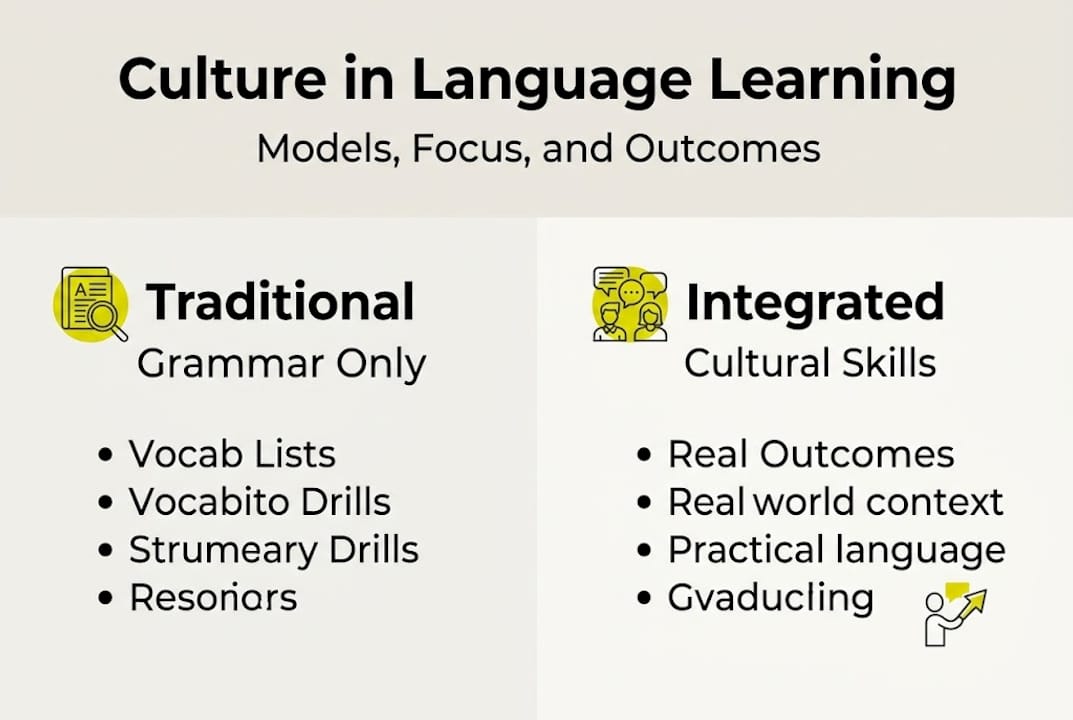
Here is a quick comparison of traditional versus modern approaches:
| Approach | Focus | Cultural role | Learner outcome |
|---|---|---|---|
| Traditional | Grammar and vocabulary | Supplementary | Accuracy |
| Byram ICC | Communication and attitudes | Central | Intercultural competence |
| Kramsch | Meaning-making | Inherent | Cultural fluency |
| Music-based | Authentic exposure | Embedded | Motivation and retention |
The evidence backs this up. Cultural education increases intercultural sensitivity by 35% in structured programs, according to a 2020 study. That is not a small number. That is the difference between a learner who gets by and one who genuinely connects.
Practical outcomes when you apply these models include:
- Recognizing when to be formal or casual in conversation
- Understanding why a joke lands in one culture but falls flat in another
- Reading emotional subtext in song lyrics and film dialogue
- Responding appropriately in culturally sensitive situations
- Building genuine relationships with native speakers
These outcomes are not abstract. They show up in real conversations, in the confidence you feel when a native speaker nods and says, “Exactly, you get it.”
Music as cultural context: Why songs ignite language mastery
Songs are not just catchy. They are cultural time capsules. Every hit carries the slang, values, and emotional temperature of the moment it was created.
Authentic songs expose learners to idioms, colloquial speech, and cultural themes that textbooks rarely include. When you learn a language through music, you are not just absorbing words. You are absorbing the world those words live in.

The memory benefits are real too. Songs boost vocabulary retention with an 85% retention rate in music-based study groups, compared to significantly lower rates in traditional study groups. Music creates emotional anchors that make vocabulary stick in ways that flashcards simply cannot replicate.
Here is a step-by-step approach to using music for cultural context:
- Select songs intentionally. Choose tracks from native-speaking artists in your target culture, not just the language. A Brazilian samba and a Portuguese fado share a language but carry very different worlds.
- Analyze the lyrics line by line. Look for idioms, references, and emotional tone. Ask yourself what cultural knowledge a native listener would bring to this song.
- Discuss with native speakers or peers. The benefits of song-based learning multiply when you talk through what you noticed with someone who grew up with the music.
- Apply what you learn in conversation. Use a phrase or reference from the song naturally in a real exchange. See how people react.
A songs and language acquisition study confirms that music-based methods outperform rote learning for motivation and cultural engagement. The role of music in language learning extends well beyond pronunciation practice. It reaches into empathy, identity, and belonging.
That said, the educational benefits of music vary by age and learning goal. Music works best when paired with reflection, not used as background noise.
Pro Tip: After listening to a song, write three sentences about what cultural values or emotions the lyrics reflect. Then compare your interpretation with a native speaker’s. The gap between your readings is where the real learning happens. You can also try weekly song challenges to build this habit consistently.
Edge cases and challenges: When cultural context isn’t straightforward
Let’s be honest. Cultural context learning is not always smooth, and music is not a magic fix for every learner.
A gap exists between ideal ICC teaching and practice, and music’s impact varies significantly by learner age. For young children, songs are powerful for rhythm and phonics but less effective for building nuanced cultural understanding. Adults and older teens tend to benefit more from the contextual and motivational dimensions of music-based learning.
Here are the key challenges learners and educators face:
- Time and resources: Deep cultural integration takes more than a single lesson or playlist
- Teacher training: Many instructors lack formal preparation for intercultural teaching
- Assessment gaps: It is hard to grade cultural competence the way you grade a grammar test
- Stereotype risk: Oversimplified cultural generalizations can do more harm than good
- Identity complexity: Learners bring their own cultural identities, which shape how they receive new cultural information
There is also the issue of power asymmetry. Not all cultural materials are created equal. Some textbooks and song selections reflect dominant cultural narratives while ignoring regional, minority, or diaspora voices. Expanding vocabulary with songs works best when you deliberately seek out diverse voices within a language, not just the most mainstream hits.
Fluent cultural navigation also means accepting that identities are fluid. A song from Mexico City carries different cultural codes than one from rural Oaxaca, even in the same language. Learning languages with songs at 40% faster vocabulary rates is achievable, but only when learners stay curious and avoid reducing cultures to stereotypes.
Pro Tip: Pair every song-based activity with a short peer discussion. Ask your language partner what the song means to them personally. That conversation builds empathy and cultural awareness faster than any worksheet.
Building cultural competence: Actionable strategies for learners
Knowing the theory is one thing. Building real cultural competence takes deliberate, repeated practice.
Here is a five-step music-first action plan:
- Curate a cultural playlist. Pick five songs from different regions where your target language is spoken. Diversity is the point.
- Dig into one song per week. Read the lyrics, look up references, and find interviews or articles about the artist’s background.
- Join a community of learners. Discuss what you find with others. Combining authentic materials, music immersion, and peer interaction builds intercultural competence faster than solo study.
- Keep a cultural journal. Write down moments when a cultural reference surprised you or changed how you understood a word.
- Test yourself in real conversations. Use what you learned in a live exchange and notice how native speakers respond.
Tools and resources that support this process:
- Annotated lyric platforms with cultural commentary
- Language exchange apps that connect you with native speakers
- Podcasts hosted by native speakers discussing their own culture
- Social media accounts run by people living in your target culture
- Community song challenges that rotate weekly themes
You will know you are making progress when you start catching cultural jokes before they are explained, when you feel the emotional weight of a lyric rather than just translating it, and when native speakers stop simplifying their speech for you. Check out success stories in music-based learning to see what that progress looks like in real learners. An intercultural competence guide can also help you benchmark your growth.
Why real language learning starts with culture, not vocabulary lists
Here is what years of watching learners thrive or stall has taught us: the ones who break through are almost never the ones with the biggest vocabulary lists. They are the ones who fell in love with the culture.
Memoizing words is a starting point, not a destination. You need to live the language, even if only through music and community at first. Songs do something that drills cannot. They create emotional connection. When a lyric moves you, your brain encodes not just the words but the feeling, the context, and the story. That is the kind of memory that lasts.
We have seen this in our own community, through tune-nights, collaborative playlists, and group karaoke sessions. When learners share why a song matters to them, something shifts. Empathy opens up. Barriers come down. The power of community in language learning is not a soft benefit. It is the engine of real fluency.
Peer learning outlasts rote drills every time. The moment you understand why a lyric is funny, heartbreaking, or politically charged in its original culture, you have crossed a threshold that no vocabulary app can take you to alone.
Ready to deepen your language skills through culture and music?
If this article has you thinking differently about how you learn, you are already ahead of most learners. The next step is putting it into practice with tools built for exactly this kind of cultural, music-driven growth.
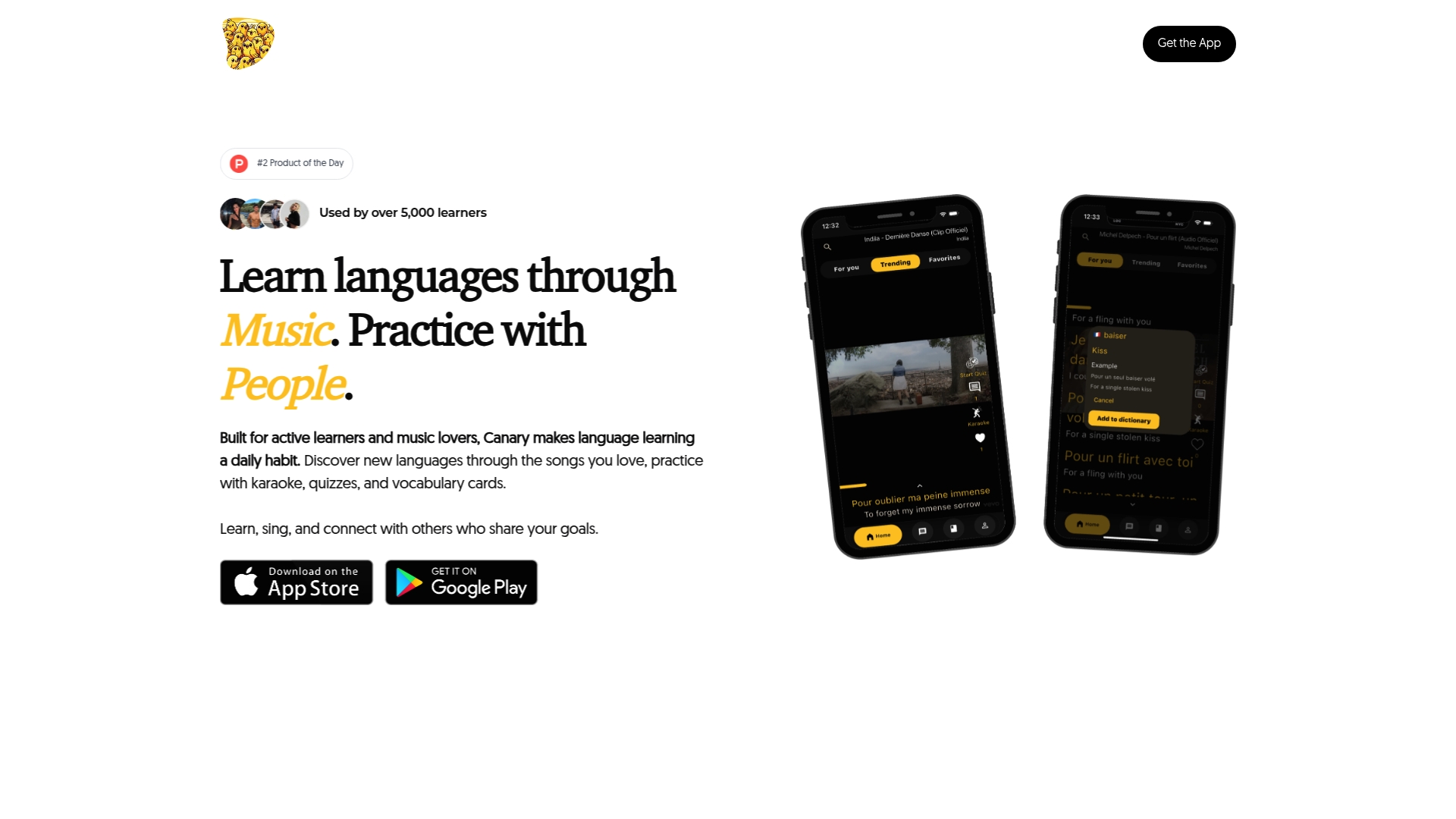
Canary is built around the idea that language lives in music and community. Every feature, from karaoke to vocabulary cards to weekly song challenges, is designed to give you cultural context at every step. You are not just learning words. You are learning the world behind them. Explore the song-based learning benefits and see more educational benefits of making music the center of your language practice. Your next breakthrough might be one song away.
Frequently asked questions
What is cultural context in language learning?
Cultural context integrates cultural knowledge, norms, and practices with language acquisition so learners can communicate naturally and avoid social misunderstandings in real-life situations.
How does music help in learning a language’s culture?
Songs provide cultural insights and improve retention by embedding idioms, traditions, and emotional nuance in a format that is memorable and motivating for learners of all levels.
Are songs effective for all ages in language learning?
Songs motivate but can be less effective for young children’s word learning specifically, while older children and adults benefit more from the cultural and contextual dimensions music provides.
What is Byram’s ICC model?
Byram’s ICC model focuses on intercultural attitudes and skills, guiding learners to develop the empathy, knowledge, and critical awareness needed to communicate across cultural boundaries effectively.
Can you learn cultural context without traveling abroad?
Authentic materials and social interaction build competence without requiring travel, making platforms that combine real songs, peer conversation, and cultural commentary a practical and powerful alternative to immersion abroad.