TL;DR:
- A Spanish vocabulary building workflow integrates comprehensible input, sentence-level spaced repetition, active production, and immediate pretesting to foster confident language use. This systematic approach, practiced for 20-30 minutes daily, can expand vocabulary from A2 to B1 levels in four to six months, surpassing traditional methods. Consistency and combining these components create a sustainable cycle that enhances long-term retention and active communication skills.
A structured Spanish vocabulary building workflow is the single most reliable method for moving from beginner guesswork to confident, fluent recall. The most effective approach combines five proven components: comprehensible input with selective noticing, sentence-level spaced repetition (SRS), active production, and choice-based pretesting with immediate feedback. Tools like Anki, Clozemaster, and Quizlet each play a specific role in this system. Research confirms that daily 20 to 30 minute sessions using this integrated method can grow your vocabulary from A2 to B1 level in four to six months, far outpacing traditional flashcard drilling.
What is a Spanish vocabulary building workflow?
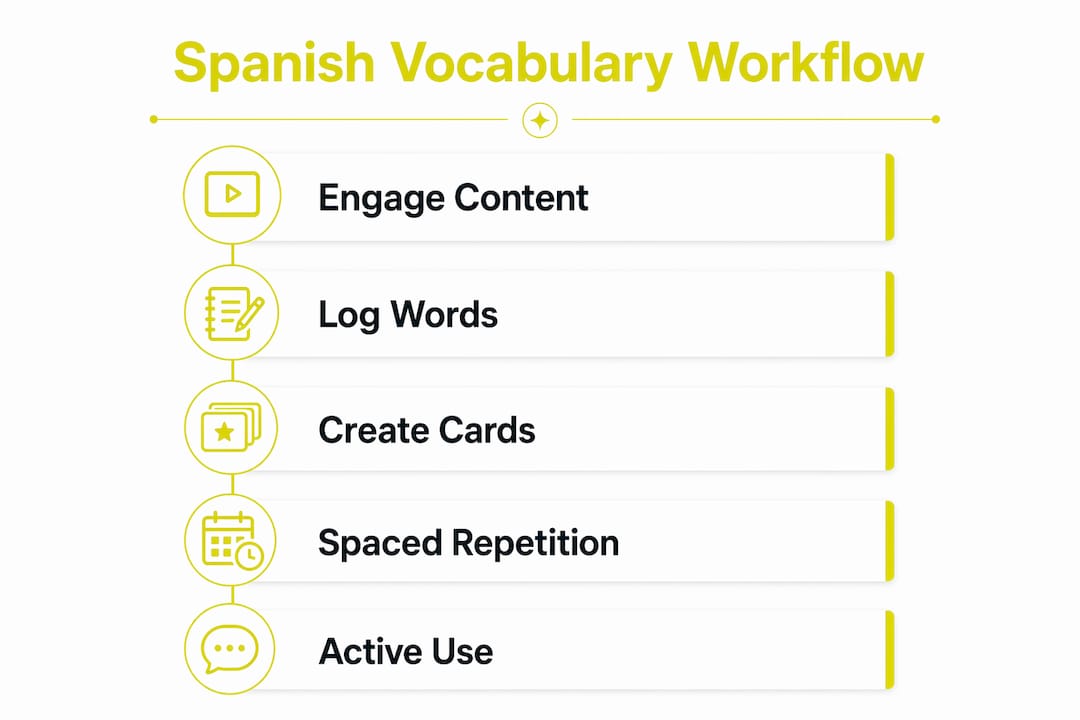
A Spanish vocabulary building workflow is a repeatable daily system that connects five learning activities into one coherent routine. The term “workflow” here replaces what language educators formally call a structured vocabulary acquisition cycle, meaning a sequence of input, noticing, encoding, retrieval, and production. Most learners treat these steps as separate hobbies. The workflow approach treats them as a single chain where each step feeds the next.
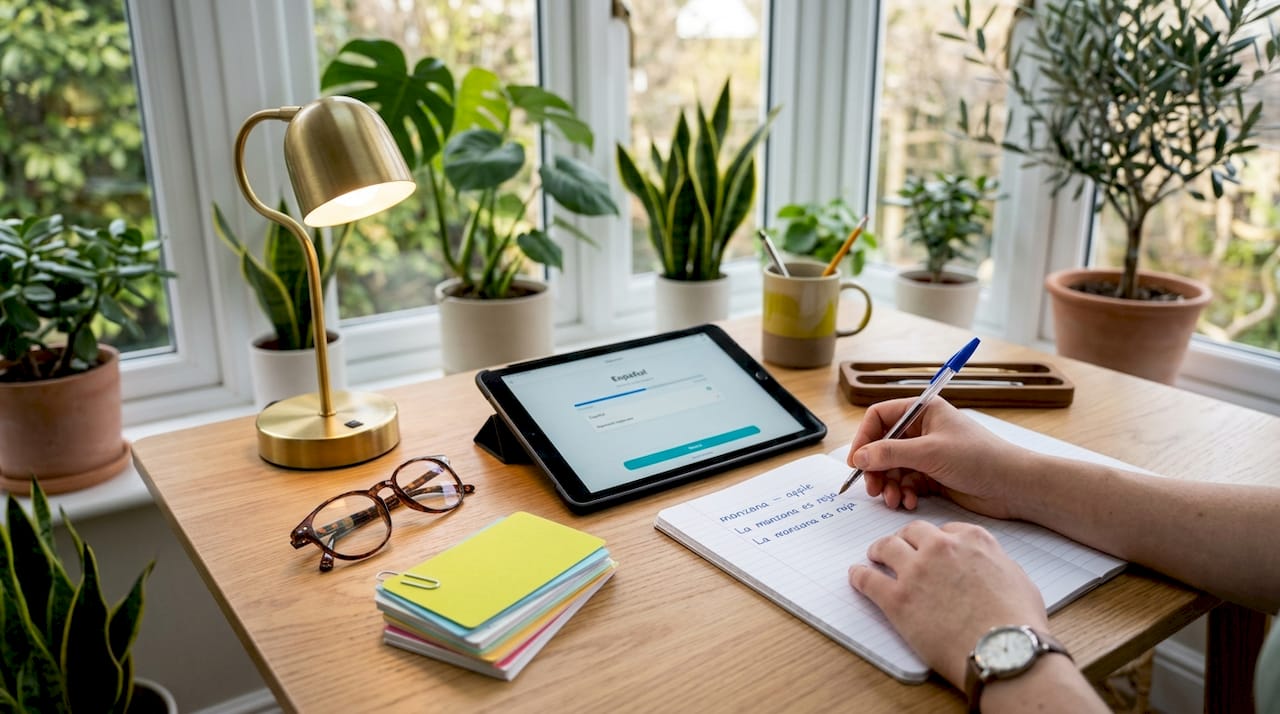
The five components are: engaging with level-appropriate Spanish content, logging new words with sentence context, creating and reviewing sentence-based SRS cards, writing or speaking to produce those words actively, and completing choice-based recall exercises with immediate feedback. Skipping any one component creates a gap. Learners who only do SRS, for example, often recognize words but freeze when trying to use them in conversation.
Why daily comprehensible input is the foundation
Comprehensible input is Spanish content you understand at roughly 80 to 95 percent of the words. At that level, your brain can infer the meaning of unfamiliar words from surrounding context. Below 85 percent comprehension, the noise overwhelms the signal and learning efficiency drops sharply.
Suitable content for beginners includes podcasts like Español con Juan, graded readers from Dreaming Spanish, and scaffolded YouTube channels with Spanish subtitles. Intermediate learners can move to telenovela clips, news summaries from BBC Mundo, or Spanish-dubbed versions of shows they already know in English.
The critical skill is selective noticing. During each session, you identify and log only five to eight new words. More than that creates cognitive overload. Fewer than five means you are not pushing your vocabulary boundary.
- Choose content where you understand the plot or topic without the new words
- Pause when you encounter an unfamiliar word and write it down with its full sentence
- Note the speaker’s tone or the scene context alongside the word
- Limit each input session to 20 minutes to maintain focus
Pro Tip: Logging vocabulary as sentence-attached units rather than isolated words anchors each new term in a real memory. When you later see “el madrugador” on a card, you remember the character who woke at 4 a.m., not just a dictionary definition.
Selective noticing during input transforms passive exposure into a manageable, reviewable target set. That distinction is what separates learners who plateau from those who keep growing.
How to implement sentence-level spaced repetition
Spaced repetition is a scheduling system that shows you a flashcard just before you are about to forget it. SRS groups retain 34 percent more material than learners who cram, and the advantage compounds over months. The key upgrade most learners miss is using sentence-level cards instead of word-translation pairs.
A sentence-level card looks like this: the front shows “Llegó al trabajo sin haber dormido, completamente ___.” The back reveals “agotado” (exhausted) plus a translation of the full sentence. This format forces you to recall meaning from context, which is exactly how memory works in real conversation.
Here is how to build your SRS deck from your logged words:
- Open your vocabulary log from that day’s input session.
- Copy the original sentence containing the new word.
- Replace the target word with a blank on the front of the card.
- Add the word, its translation, and a pronunciation note on the back.
- Import the card into Anki, Clozemaster, or a similar SRS tool.
- Review flagged cards for 10 minutes, three times per week.
Sentence-context SRS cards outperform simple word-translation flashcards significantly because they encode meaning, grammar, and usage simultaneously.
| Card type | What it tests | Retention quality |
|---|---|---|
| Word-translation pair | Recognition of isolated meaning | Surface level, fades quickly |
| Sentence-level cloze | Contextual recall in real usage | Deep encoding, transfers to speech |
Pro Tip: AI tools like ChatGPT or Claude can generate five sentence-level cloze cards from a single logged word in under 30 seconds. Paste your logged sentence and ask for four distractor sentences using the same word in different contexts. This speeds card creation dramatically.
AI-assisted vocabulary workflows show statistically significant gains in productive vocabulary outcomes compared to traditional methods, making this shortcut worth adopting early.
Active production exercises to cement vocabulary in memory
Recognition and production are two separate memory processes. You can recognize “madrugador” when you read it and still be unable to use it when speaking. Production exercises achieve 70 to 85 percent retention rates, compared to significantly lower rates for recognition-only methods. The gap is large enough to change your learning strategy entirely.
The most effective production methods for beginners and intermediates are:
- Short paragraph writing. Write 100 to 150 words in Spanish using five of your logged words from the week. The topic does not matter. Write about your morning, a film you watched, or a fictional scenario.
- Sentence substitution. Take a sentence from your SRS deck and swap out the target word for a synonym or antonym. This forces you to understand the word’s boundaries.
- Shadowing with substitutions. Play a short audio clip, repeat the sentence aloud, then replace one word with a word from your log. This combines pronunciation practice with active recall.
A 24-hour active production step after logging a new word prevents passive familiarity from becoming inaccessible during spontaneous speech. The rule is simple: use each new word in a written sentence within 24 hours of logging it.
Pro Tip: Keep a running “word of the day” note on your phone. Each morning, pick one word from your SRS deck and write three sentences using it before lunch. This takes four minutes and dramatically accelerates the shift from passive to active vocabulary.
How does pretesting improve Spanish word recall?
Pretesting is the practice of guessing a word’s meaning before you have studied it, then receiving immediate feedback on whether you were right. Effect sizes for pretesting range from d≈0.18 to d≈0.67 across cued recall and multiple-choice recognition tasks. Those numbers mean pretesting produces measurable, reliable memory gains even when your initial guess is wrong.
The mechanism is cognitive search. When you guess, your brain actively searches its existing knowledge network. That search creates a retrieval pathway. When the correct answer arrives immediately after, it slots into a pathway that is already open and active. Passive review, by contrast, never opens that pathway at all.
Practical ways to add pretesting to your workflow:
- Use Anki’s “guess before flipping” habit: say your answer aloud before revealing the back of the card
- Build Quizlet sets from your logged words and use the “Learn” mode, which forces a typed answer before showing the correct one
- Add image-based multiple-choice cards in Anki using the Image Occlusion add-on for visual learners
- Use gap-fill exercises from your input transcripts: cover the target word and choose from four options before checking
| Exercise type | Pretesting element | Feedback timing |
|---|---|---|
| Anki cloze card | Recall before reveal | Immediate on flip |
| Quizlet Learn mode | Typed guess | Immediate on submit |
| Image multiple-choice | Visual context guess | Immediate on selection |
| Gap-fill from transcript | Context-based selection | Immediate on check |
Keeping guessing time short and feedback immediate maximizes encoding effectiveness. Spending more than 10 seconds on a guess reduces the benefit. Move fast, check fast, and move on.
What does a sustainable weekly vocabulary routine look like?
A five-day weekly routine combining input, SRS review, and active production yields steady vocabulary expansion in approximately 30 minutes per day. The key is assigning each activity to a specific day rather than doing everything every day.
Here is a sample weekly schedule:
- Monday. 20 minutes of comprehensible input. Log five to eight new words with full sentences. Spend five minutes creating SRS cards from those words.
- Tuesday. 10 minutes of SRS review. 15 minutes of short paragraph writing using words logged this week.
- Wednesday. 20 minutes of new input. Log five to eight words. Five minutes of sentence substitution using Tuesday’s paragraph.
- Thursday. 10 minutes of SRS review. 15 minutes of pretesting exercises using Quizlet or Anki.
- Friday. 20 minutes of input. Log words. 10 minutes of shadowing with substitutions using this week’s audio.
| Day | Primary activity | Time |
|---|---|---|
| Monday | Input + logging + card creation | 30 min |
| Tuesday | SRS review + paragraph writing | 25 min |
| Wednesday | Input + logging + substitution | 30 min |
| Thursday | SRS review + pretesting | 25 min |
| Friday | Input + logging + shadowing | 30 min |
Beginners should log five words per session and write 75-word paragraphs. Intermediate learners can push to eight words and 150-word paragraphs. Adjust volume based on your retention rate: if you are failing more than 40 percent of SRS cards, reduce new word intake for that week.
Pro Tip: Pair your input sessions with a daily practice routine built around music to make Monday, Wednesday, and Friday feel like something you look forward to rather than a task you endure. Motivation is a retention variable, not just a mood.
Retrieval practice embedded in structured routines outperforms isolated drills because the routine itself becomes a memory cue. Your brain starts preparing to learn the moment you sit down at the same time each day.
Key takeaways
A Spanish vocabulary building workflow works because it chains five proven methods into one daily system, replacing random study with a repeatable cycle that compounds over time.
| Point | Details |
|---|---|
| Comprehensible input threshold | Aim for 80 to 95 percent understanding per session to enable reliable word inference. |
| Sentence-level SRS cards | Cards with full sentence context retain meaning, grammar, and usage simultaneously. |
| Active production within 24 hours | Write each new word in a sentence within one day to prevent passive-only familiarity. |
| Pretesting with immediate feedback | Guessing before seeing the answer opens retrieval pathways that passive review never creates. |
| Sustainable daily volume | Five days per week at 25 to 30 minutes per session is the minimum effective dose for steady growth. |
What I have learned from building vocabulary the hard way
I spent two years studying Spanish with isolated flashcards and wondering why I could read menus but not follow a conversation. The problem was not effort. It was architecture. My study sessions had no chain connecting input to output.
The shift that changed everything was logging words with their original sentences. Not definitions. Sentences. When I reviewed “imprescindible” on an Anki card, I saw the sentence from the podcast where a chef said his grandmother’s recipe was imprescindible. That memory was vivid. A dictionary definition would have been invisible.
The second shift was accepting that production feels uncomfortable before it feels useful. Writing 100-word paragraphs in broken Spanish is embarrassing. It is also the fastest path to fluency I have found. The discomfort is the learning. Learners who wait until they feel ready to produce rarely produce at all.
One practical note for visual learners: image-based multiple-choice cards in Anki work significantly better than text-only cards for concrete nouns and action verbs. For abstract vocabulary, sentence context beats images every time. Know which type of word you are encoding and choose your card format accordingly.
The role of context in retention is not a soft pedagogical preference. It is a memory architecture principle. Build your workflow around it and the results follow.
— Ben
Build your Spanish vocabulary with Singwithcanary
Singwithcanary integrates the contextual vocabulary exposure this workflow depends on directly into music-based learning. The platform’s karaoke mode, vocabulary cards, and quiz features deliver sentence-level context through song lyrics, which means every new word arrives with melody, emotion, and cultural meaning attached.
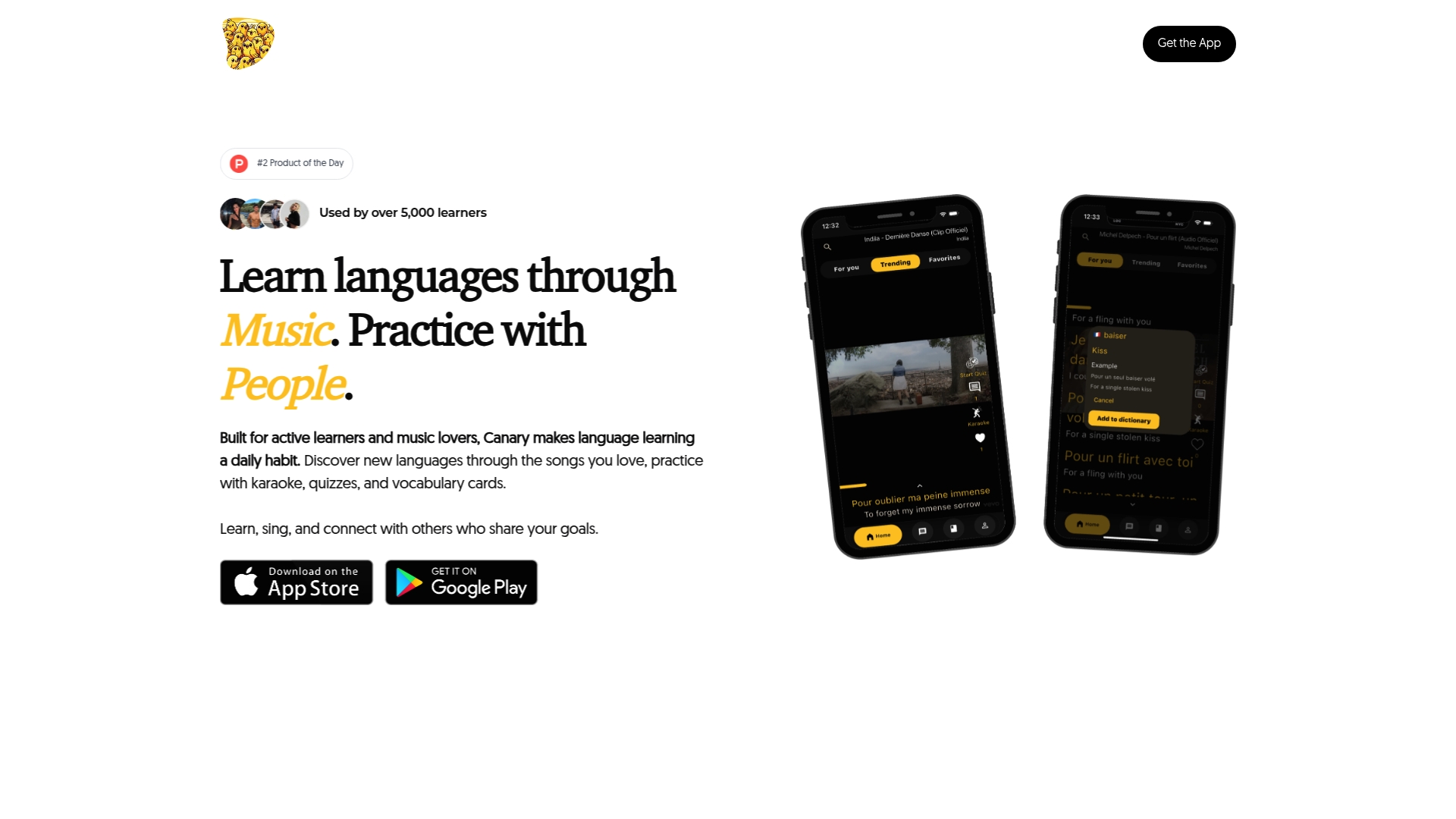
Music is one of the most powerful memory anchors in language learning, and Singwithcanary is built around that principle. If you want a daily input source that makes Monday, Wednesday, and Friday feel effortless, explore music-based Spanish practice on the platform. For a structured starting point, the vocabulary building checklist maps every step of the workflow covered in this article into a single, printable reference.
FAQ
What is the most effective Spanish vocabulary building workflow?
The most effective workflow combines daily comprehensible input with selective logging, sentence-level SRS review three times per week, active production within 24 hours, and choice-based pretesting with immediate feedback. Research shows this integrated approach can advance learners from A2 to B1 in four to six months.
How many new Spanish words should I learn per day?
Five to eight new words per session is the optimal range for beginners and intermediates. Logging more than eight words per session creates cognitive overload and reduces retention rates across your SRS deck.
Why are sentence-level flashcards better than word-translation pairs?
Sentence-level cards encode meaning, grammar, and usage context simultaneously. Context-anchored cards outperform isolated word pairs because they mirror how memory retrieval works in real conversation, where words appear inside sentences, not in isolation.
Does pretesting work even when I guess wrong?
Yes. The benefit of pretesting comes from the cognitive search process itself, not from guessing correctly. Guessing forces active retrieval that opens a memory pathway, and the immediate correction then slots the right answer into that open pathway more effectively than passive review.
How long does it take to see results from this workflow?
Consistent daily practice of 25 to 30 minutes using this workflow produces noticeable vocabulary growth within four to six weeks. Learners who add active production exercises alongside SRS review see the fastest gains in speaking confidence and spontaneous recall.