TL;DR:
- Music enhances language learning by encoding vocabulary and grammar through melody, making retention stronger. Active tasks like lyric gap-fills, shadow reading, and grammar hunts boost skills more than passive listening, with just 15 minutes daily being effective. Most learners should treat music as active practice, focusing on deep engagement rather than background noise for optimal results.
Blending music and language study is defined as the deliberate use of song lyrics, melody, and structured listening tasks to reinforce vocabulary, grammar, and pronunciation. This approach works because melody functions as a memory scaffold, encoding verbal content through dual rhythmic and linguistic memory traces. Research published in 2026 confirms that structured song-lyric exercises improved vocabulary mastery by 12.75 points with a large effect size. That result means music is not a supplement to serious study. It is a core method. The techniques below cover every skill level and fit into a daily routine without adding hours to your schedule.
1. Ways to blend music and language study with lyric-based vocabulary tasks

Song lyrics give you vocabulary in context, which is far more memorable than a word list. Pull a song in your target language, read the lyrics, and circle every word you do not know. Look each one up, write a definition in your own words, and then listen again. You will hear those words differently the second time.
The most effective version of this task goes further. Structured lyric exercises using platforms like Spotify produced a 12.75-point jump in vocabulary scores among learners in a controlled 2026 study. That gain came from active engagement, not passive listening.
Pro Tip: Copy the lyrics into a document, delete every tenth word, and fill in the blanks before checking. This gap-fill method forces recall rather than recognition, which builds stronger retention.
2. Active listening with simultaneous lyric reading
Active listening means following the printed lyrics in real time while the song plays. This trains your ear to connect spoken sounds with written words, which is one of the hardest skills in any new language. Passive listening, where you let a song play in the background, produces almost no measurable gain.
Pair this with song-based learning resources that provide synchronized lyrics. Read along, pause when you miss a word, and replay that line. Three focused repetitions of a single verse beat thirty minutes of background music every time.
3. Tense-swapping and grammar hunts inside lyrics
Lyrics are a grammar lab. Pick a song and rewrite every verb in a different tense. If the chorus uses simple past, rewrite it in present perfect. This forces you to notice grammatical structure rather than just absorb the melody.
Task-based grammar work anchored in song lyrics is one of the most reliable ways to make complex patterns stick. The Oxford Education Research Podcast identifies tense swapping and linguistic hunts as the exercises that produce the clearest gains. A linguistic hunt means scanning lyrics for all examples of one grammatical feature, such as conditional clauses or phrasal verbs, and listing them.
4. Shadow reading for pronunciation practice
Shadow reading is the practice of speaking along with a recording at the same speed, matching every sound, pause, and rhythm. Applied to songs, it is the closest method to deliberate pronunciation practice without the monotony of phonetic drills. You are training your mouth muscles to produce sounds in the exact sequence a native speaker uses.
Slow the track to 0.75x speed first. At that pace, shadow reading simulates natural connected speech and gives your articulatory muscles time to catch up. Once you can match the slowed version cleanly, return to full speed. The improvement in fluency is immediate and noticeable.
For learners who want to go deeper on the mechanics of sound production, articulatory phonetics training explains exactly how mouth position and airflow shape each sound.
5. Contrasting sung phrases with formal grammar
Song lyrics frequently use contractions, dropped syllables, and informal phrasing that textbooks never teach. That gap is actually an advantage. Contrasting sung informal contractions with formal grammar improves accent and comprehension more than rote repetition alone. When you notice that a singer says “gonna” instead of “going to,” you are learning how real speakers sound, not just how grammar books say they should sound.
Write the sung phrase in one column and the formal equivalent in another. Study both. This trains your ear for real-world speech and sharpens your ability to understand native speakers in conversation.
6. Singing along to build muscle memory
Singing along is not just fun. It is a pronunciation exercise that engages muscle memory in a way that reading or listening alone cannot. Your mouth, tongue, and breath all participate. Music training improves phonological awareness and helps learners extract speech patterns more efficiently than exposure to spontaneous speech.
Choose songs where you can already follow the melody. Sing the same verse ten times in a row. You will notice your mouth moving more naturally with each pass. This repetition is the same mechanism behind accent reduction work, just far more enjoyable.
7. Building a targeted daily playlist
A playlist built for language learning looks different from one built for entertainment. Every song should serve a specific goal: vocabulary from a topic you are studying, a grammar structure you are practicing, or a pronunciation pattern you are working on. Consistent daily listening for 15 minutes improves motivation and acquisition more than passive or irregular exposure. That 15-minute threshold is achievable for any learner, regardless of schedule.
Rotate songs in and out based on what you have mastered. When you can sing a verse from memory without looking at the lyrics, move that song to a review playlist and add a new one.
Pro Tip: Label each playlist by skill focus, such as “past tense verbs” or “vowel sounds,” so you always know exactly what you are practicing when you press play.
8. Using flashcards alongside lyric translations
Flashcards and lyrics work well together because each reinforces the other. After you translate a song line by line, pull the ten most useful new words and add them to a flashcard deck. The next time you hear the song, those words will surface automatically because you have already seen them in an emotional, musical context.
Dual coding by melody and verbal content creates stronger memory retention than verbal study alone. The melody becomes a retrieval cue. When you blank on a word during a flashcard review, humming the song line often brings it back.
How music improves pronunciation and listening skills
Music regularizes speech rhythm in a way that ordinary conversation does not. Songs repeat the same phonological patterns across verses and choruses, giving your brain structured input it can analyze. Music training elevates listening outcomes dramatically: in a 2026 controlled study, learners using task-based song-lyric lessons scored 92.50 on listening assessments versus 53.96 for the control group. That is not a marginal difference. It is a near-doubling of performance.
“Melody functions as a memory scaffold via dual-coding of verbal and rhythmic memory traces.” This means your brain stores a song lyric in two separate systems at once, making it far harder to forget than a word learned from a list.
Pronunciation practice through singing outperforms passive listening because it requires output, not just input. You cannot sing without producing sounds. Every attempt gives your brain feedback on whether your mouth is doing the right thing. That feedback loop is what builds fluency.
What daily routines support sustained music-based language learning
A daily music-based language routine works best when it is short, specific, and consistent. Vague intentions like “listen to more music in Spanish” produce vague results. A structured routine produces measurable ones. A step-by-step music language routine removes the guesswork and keeps you progressing week over week.
Here is a practical daily framework:
- Listen once through without lyrics. Note what you understood and what you missed.
- Read the lyrics while listening a second time. Mark unknown words.
- Look up marked words and write definitions in your own words.
- Shadow read at 0.75x speed, focusing on one verse.
- Sing along at full speed at least three times.
- Add new vocabulary to your flashcard deck.
- Review yesterday’s flashcards before closing the session.
This sequence takes 20–25 minutes. Done daily, it compounds. A learner who follows this routine five days a week covers more structured input in one month than most classroom students cover in a semester.
How to adapt music-based study for different ages and skill levels
The method stays the same across ages. The song selection changes. A beginner needs short songs with simple, repeated vocabulary and a slow tempo. An advanced learner benefits from complex lyrics with idiomatic expressions, fast delivery, and regional accents.
| Learner level | Song type | Primary task |
|---|---|---|
| Beginner | Children’s songs, slow pop | Gap-fill, vocabulary lookup |
| Intermediate | Standard pop, folk | Tense swapping, shadow reading |
| Advanced | Rap, spoken word, jazz | Lyric transcription, accent contrast |
Young learners respond well to games built around songs. Freeze the song mid-verse and ask them to finish the line from memory. Adults benefit more from grammar-focused tasks tied to specific learning goals. Speed adjustment matters for both groups. A beginner working with a fast song should always slow it to 0.75x before attempting shadow reading.
The benefits of song-based language learning scale with intentionality. A child singing a counting song and an adult dissecting a jazz lyric are using the same cognitive mechanism. The difference is the complexity of the input and the specificity of the task.
Key takeaways
Music-based language learning works because melody encodes vocabulary and grammar into memory through two systems at once, making retention significantly stronger than text-only study.
| Point | Details |
|---|---|
| Structured tasks outperform passive listening | Gap-fills, tense swapping, and shadow reading produce measurable gains; background music alone does not. |
| Shadow reading builds pronunciation fast | Singing along at 0.75x speed trains mouth muscles and phonological awareness simultaneously. |
| 15 minutes daily beats occasional long sessions | Consistent short sessions improve motivation and acquisition more than irregular exposure. |
| Contrast informal lyrics with formal grammar | Spotting the gap between sung contractions and textbook language sharpens real-world comprehension. |
| Adapt song choice to skill level | Beginners need slow, simple songs; advanced learners gain more from fast, idiomatic, or accented tracks. |
Why I think most learners are using music wrong
Most learners treat music as background noise and call it language study. I have seen this pattern repeatedly, and it produces almost nothing. The research is clear: music-based lessons must be task-anchored rather than passive. The shift from passive to active is the entire game.
What actually works is treating a song the way a musician treats a new piece. You slow it down, isolate the hard parts, repeat them, and only then put it all together at full speed. That process is uncomfortable at first. It feels like work. That is exactly why it works.
Pronunciation is where I see the biggest gap between what learners do and what they should do. Most people listen to native speakers and hope the accent rubs off. It does not. You have to produce the sounds yourself, repeatedly, with feedback. Singing gives you that feedback loop in a format that does not feel like a drill.
The learners who make the fastest progress are the ones who pick one song per week, go deep on it, and move on only when they can sing it cleanly from memory. That discipline, applied consistently, beats any vocabulary app or grammar workbook I have seen.
— Ben
Singwithcanary puts these methods into a daily practice
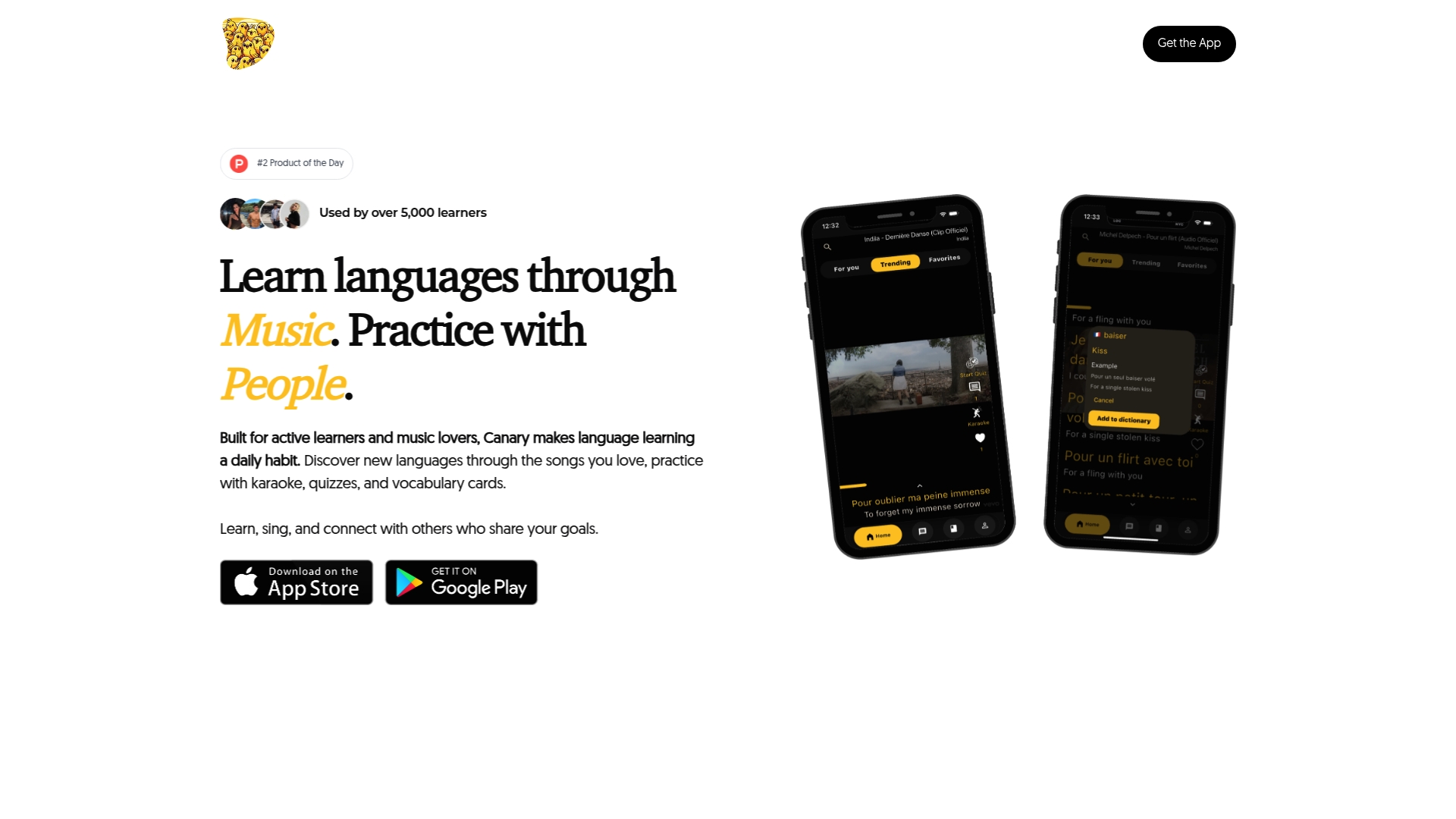
Singwithcanary is built around exactly the methods described here. The platform pairs curated songs in your target language with interactive karaoke, vocabulary cards, and pronunciation tools that let you slow tracks, read synchronized lyrics, and quiz yourself on new words. Every feature is designed to turn passive listening into active, structured practice.
Learners at every level can learn languages with music through Singwithcanary’s daily song-based routines, which guide you from first listen to confident pronunciation without requiring a classroom or a tutor. The community element means you can also practice with other learners around the world, adding real conversation to your music-based study. Check out the song of the week to see the method in action.
FAQ
Does music actually help you learn a language faster?
Yes. Task-based song-lyric lessons produced listening scores of 92.50 versus 53.96 in a control group in a 2026 study. Active engagement with lyrics, not passive listening, drives the gain.
How long should I practice with music each day?
Fifteen minutes of consistent, focused listening improves motivation and acquisition more than longer but irregular sessions. Daily short practice beats occasional long ones.
What is shadow reading and why does it improve pronunciation?
Shadow reading means speaking along with a recording in real time, matching every sound and rhythm. At 0.75x speed, it simulates natural connected speech and trains your mouth muscles to produce sounds accurately.
Which songs work best for language learning?
Beginners should use slow songs with simple, repeated vocabulary. Intermediate learners benefit from standard pop or folk. Advanced learners gain the most from fast, idiomatic tracks like rap or spoken word that expose them to real-world accent patterns.
Can children use music-based language methods?
Yes. Children respond well to games built around songs, such as finishing a verse from memory or identifying rhyming words. The cognitive mechanism is identical to adult learning; only the song complexity and task type differ.