TL;DR:
- Lyric quizzes foster active retrieval and meaningful context, leading to significant vocabulary gains beyond passive listening. They utilize structured tasks like gap-fill and recall, which enhance retention, pronunciation, and comprehension. Combining this approach with engaging songs and technology-based platforms maximizes language learning effectiveness.
Lyric quizzes are structured exercises where learners recall or fill in missing words from song lyrics, and they are one of the most effective tools for vocabulary acquisition available to language learners today. Unlike passive music listening, lyric quizzes force active retrieval, embedding new words in emotionally resonant, memorable contexts. A 2026 peer-reviewed study using Taylor Swift’s song “Opalite” with EFL students confirmed measurable motivation and vocabulary gains from gap-fill lyric activities. The method also builds listening comprehension and pronunciation awareness as natural byproducts of engaging with authentic language in song form.
Why use lyric quizzes for vocabulary instead of just listening?
Passive music listening feels productive, but the research says otherwise. When you listen to a song without a task attached, your brain processes the melody first and the words second. Retrieval never happens, so vocabulary rarely sticks. Lyric quizzes change that equation entirely by demanding active engagement with the text.
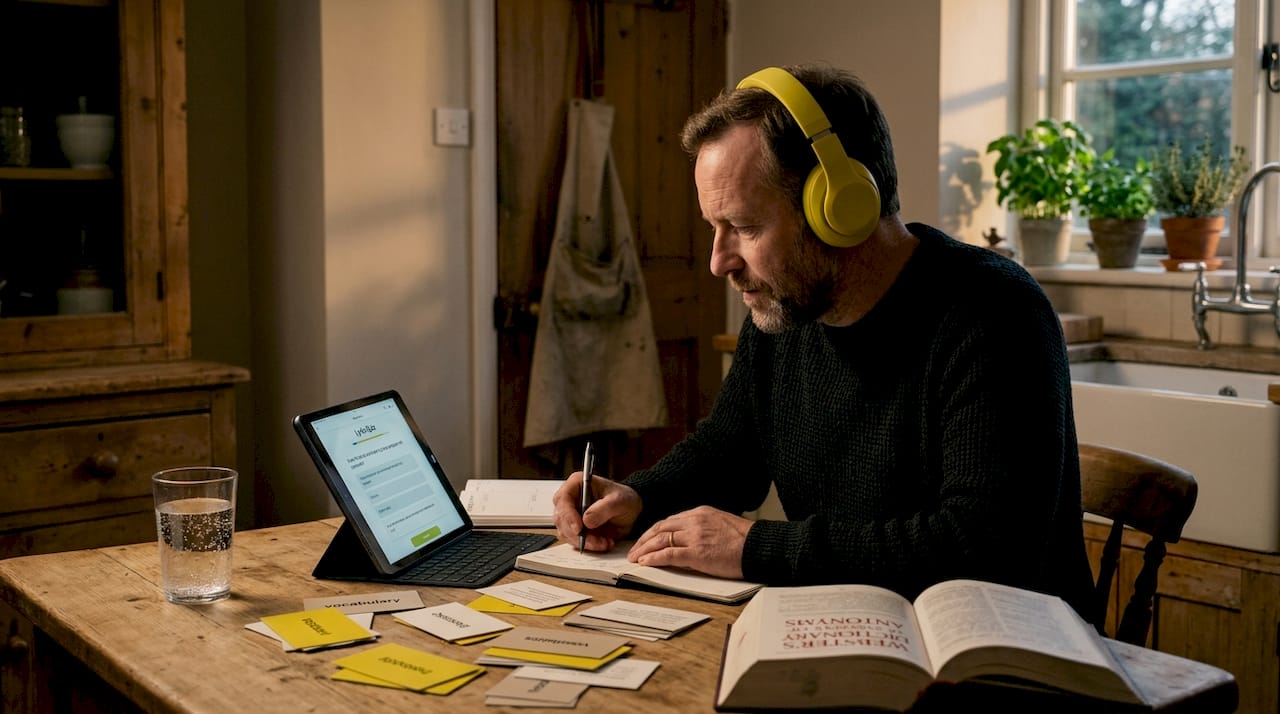
The core mechanism is active retrieval. Gap-fill and cloze tasks require you to reconstruct words from memory or context, which forces deeper cognitive processing than recognition alone. Structured retrieval tasks like lyrics gap-fill support vocabulary processing more effectively than just listening or singing along. This matters because the effort of retrieval is precisely what creates durable memory traces.
Repeated exposure in a meaningful context is the second mechanism. When a target word appears in a song you enjoy, you encounter it multiple times across verses and choruses. That repetition, combined with emotional engagement, accelerates incidental learning. Incidental vocabulary acquisition refers to learning words as a side effect of comprehending meaningful input, and music provides one of the richest environments for it.
Motivation is the third and often underestimated factor. Learners who enjoy an activity practice more frequently and for longer periods. Song-based learning consistently outperforms dry drill methods in engagement metrics, which translates directly into more vocabulary exposure over time.
- Active retrieval through gap-fill tasks drives deeper word encoding than recognition tasks
- Repeated exposure within emotionally engaging lyrics accelerates incidental acquisition
- Higher motivation leads to more practice sessions and longer study time
- Pronunciation and listening skills improve as natural byproducts of lyric work
Pro Tip: Before playing a song, give learners a list of five target words to listen for. This primes attention and turns passive listening into a focused retrieval warm-up.
What formats make lyric quizzes most effective?

Not all lyric quiz formats deliver equal results. The format you choose determines how deeply learners process vocabulary and how flexibly they can later retrieve it.
The most widely researched format is the lyrics gap-fill, also called a cloze task. Learners receive a printed or digital version of the lyrics with key words removed, then fill in the blanks while listening. This format slows input, focuses attention on target vocabulary, and requires word-level reconstruction. The Opalite study identified gap-fill as the format with the strongest impact on retention because it forces textual reconstruction rather than passive recognition.
A more demanding format is lyrics recall without audio. Learners receive the song title and perhaps a few contextual cues, then attempt to write out lines or verses from memory. This removes the tune as a retrieval cue, which is significant. Lyric recall quizzes better promote flexible vocabulary retrieval than sing-along methods precisely because they strip away the melody that learners often rely on as a crutch.
A well-designed lyric quiz sequence moves from guided to freer production:
- Pre-listening vocabulary preview. Introduce target words with definitions and example sentences before the song plays.
- Gap-fill while listening. Play the song once or twice while learners complete the cloze task.
- Comprehension check. Ask learners to explain the meaning of filled-in words in their own words.
- Recall without audio. Remove the lyrics sheet and ask learners to reconstruct key lines from memory.
- Production task. Have learners write their own sentences or a short paragraph using the target vocabulary.
This progression mirrors the input-to-output arc that second language acquisition research consistently recommends. Each step increases the retrieval demand, which deepens encoding.
Pro Tip: For self-study learners, cover the lyrics after the first listen and try to write out the chorus from memory. The struggle to recall is where the vocabulary learning actually happens.
What does research say about lyric quiz outcomes?
The 2026 research base on lyric quizzes is specific and encouraging. Studies do not just report that learners “enjoyed” the experience. They report measurable vocabulary score gains and detailed learner perceptions that educators can act on.
One of the clearest outcome measures comes from a case study using WhatsApp audio delivery. Vocabulary test scores improved from an average of 44.84 to 65.15 after a structured song-based intervention. That is a 20-point gain, which represents a meaningful shift from below-average to above-average performance on a standardized vocabulary measure. The study combined digital audio delivery with pre-test and post-test assessment, demonstrating that technology access does not need to be sophisticated to produce results.
Learner perception data adds another layer. English students confirmed through questionnaires that Taylor Swift songs were both enjoyable and effective for vocabulary development. Enjoyment matters because it predicts sustained engagement, which is the real driver of long-term vocabulary growth.
Not every finding is uniformly positive. Fast tempo, unclear pronunciation, and learner distraction toward the music rather than the words are documented barriers. These findings underscore that lyric quizzes require deliberate facilitation, not just song selection and playback.
| Research finding | Implication for practice |
|---|---|
| 20-point vocabulary score gain via WhatsApp audio | Digital delivery with structured tasks produces measurable results |
| Taylor Swift songs rated effective by learners | Familiar, popular artists increase motivation and perceived value |
| Fast tempo identified as a learning barrier | Select songs with clear diction and moderate pace for beginners |
| Recall without tune cues improves transfer | Design quizzes that remove audio after initial exposure |
“Lyric quizzes approximate the conditions for vocabulary transfer by reducing reliance on stimulus-specific cues like melody, training learners to access words in varied contexts.” — Reflective teaching commentary, Educating MrMattock, 2026
How to apply lyric quizzes in classrooms and self-study
Effective implementation depends on decisions made before the quiz begins. Song selection is the single most consequential choice. Songs with clear pronunciation, moderate tempo, and vocabulary appropriate to learner level produce the best outcomes. Ballads and mid-tempo pop tracks work better than fast rap or heavily accented regional music for beginners.
For classroom educators, the following practices consistently improve results:
- Match vocabulary to curriculum goals. Choose songs that contain words learners are already studying, so the quiz reinforces rather than introduces entirely new vocabulary in isolation.
- Use pre-tests and post-tests. Pre and post assessments with digital delivery give both teachers and learners concrete evidence of progress, which sustains motivation across multiple sessions.
- Deliver audio through accessible channels. WhatsApp audio, Google Classroom, or Singwithcanary’s platform all reduce friction and increase the likelihood that learners engage outside class hours.
- Guide focus explicitly. Tell learners which words to pay attention to before playing the song. Without this direction, attention drifts to melody and rhythm rather than lexical content.
- Rotate quiz formats across sessions. Alternate between gap-fill, recall, and production tasks to prevent habituation and maintain retrieval challenge.
For independent learners, the step-by-step song-based approach works best when paired with a vocabulary tracking system. Keep a running list of words encountered in lyrics, review them the following day without the song, and then attempt to use them in writing or conversation. This spaced retrieval cycle is what converts incidental exposure into durable vocabulary knowledge.
Expanding vocabulary through songs also benefits from cultural context. Understanding what a lyric means in its cultural setting deepens word knowledge beyond simple definition recall, which is the difference between recognizing a word and actually owning it.
How do lyric quizzes compare with other vocabulary methods?
Lyric quizzes occupy a specific and valuable niche among vocabulary learning methods. They are not a replacement for every other technique, but they outperform several common approaches on key dimensions.
Rote memorization, the practice of repeating word-definition pairs until they stick, produces recognition but rarely flexible production. Words learned through rote methods are often inaccessible in real conversation because they lack contextual anchoring. Lyric quizzes embed words in narrative and emotional context, which makes retrieval more robust across different situations.
Flashcard systems like spaced repetition software are excellent for high-volume vocabulary review, but they present words in isolation. A learner who knows a word’s definition may still struggle to use it naturally. Lyric quizzes provide the contextual scaffolding that flashcards lack, making the two methods genuinely complementary rather than competing. Using vocabulary cards alongside music is a combination that addresses both breadth and depth of word knowledge.
Passive multimedia approaches, such as watching foreign language films without subtitles or listening to podcasts, expose learners to authentic language but make no retrieval demands. The result is improved listening comprehension over time but slower vocabulary acquisition compared to task-based methods.
| Method | Strengths | Limitations |
|---|---|---|
| Lyric quizzes | Contextual, motivating, retrieval-focused | Requires careful song selection and facilitation |
| Rote memorization | Fast for high-frequency words | Weak contextual anchoring, poor transfer |
| Flashcard systems | Scalable, spaced repetition | Words presented in isolation, low engagement |
| Passive listening | Authentic input, natural exposure | No retrieval demand, slower vocabulary gains |
The educational benefits of music in language learning extend beyond vocabulary to pronunciation modeling and cultural literacy, which gives lyric quizzes an advantage no purely text-based method can match.
Key takeaways
Lyric quizzes outperform passive music listening for vocabulary acquisition because they combine active retrieval, meaningful context, and learner motivation into a single, measurable practice.
| Point | Details |
|---|---|
| Active retrieval drives retention | Gap-fill and recall tasks encode vocabulary more deeply than recognition or passive listening. |
| Research confirms measurable gains | Vocabulary scores improved by roughly 20 points in structured song-based interventions. |
| Format sequence matters | Progress from gap-fill to recall to production for maximum vocabulary depth. |
| Song selection is critical | Choose tracks with clear diction and moderate tempo to avoid tempo and accent barriers. |
| Combine with other methods | Pair lyric quizzes with flashcard review for both contextual depth and vocabulary breadth. |
What I’ve learned from watching lyric quizzes actually work
I’ve seen a lot of vocabulary methods come and go, and the ones that survive in real classrooms and real self-study routines share one quality: they make the learner do something with the language, not just receive it. Lyric quizzes have that quality built in.
What surprises most educators when they first use lyric quizzes seriously is how much the format matters compared to the song choice. Teachers spend enormous energy finding the perfect track, then design a quiz that amounts to a simple listen-and-fill exercise with no follow-up. The song does not do the work. The retrieval task does. A mediocre song with a well-designed recall sequence will outperform a brilliant song with a passive listen-along every time.
The other thing I’d push back on is the assumption that lyric quizzes are only for younger or lower-level learners. Advanced learners benefit enormously from working with complex lyrics, idiomatic expressions, and culturally dense references in songs. The challenge simply shifts from basic word recognition to nuanced meaning and register. Adapting the quiz format to the learner’s level, rather than always reaching for beginner-friendly pop, is where the real instructional creativity lives.
Technology is making this easier. Platforms that integrate music-based vocabulary practice with structured quiz formats and progress tracking remove the logistical burden from educators and learners alike. The future of lyric-based learning is not a teacher printing out lyrics and hitting play. It is a system that selects, sequences, and assesses automatically while keeping the human joy of music at the center.
— Ben
Learn languages through music with Singwithcanary
Singwithcanary is built on exactly the principles this article describes: active engagement with song lyrics, structured vocabulary quizzes, and the motivational power of music you actually want to listen to.
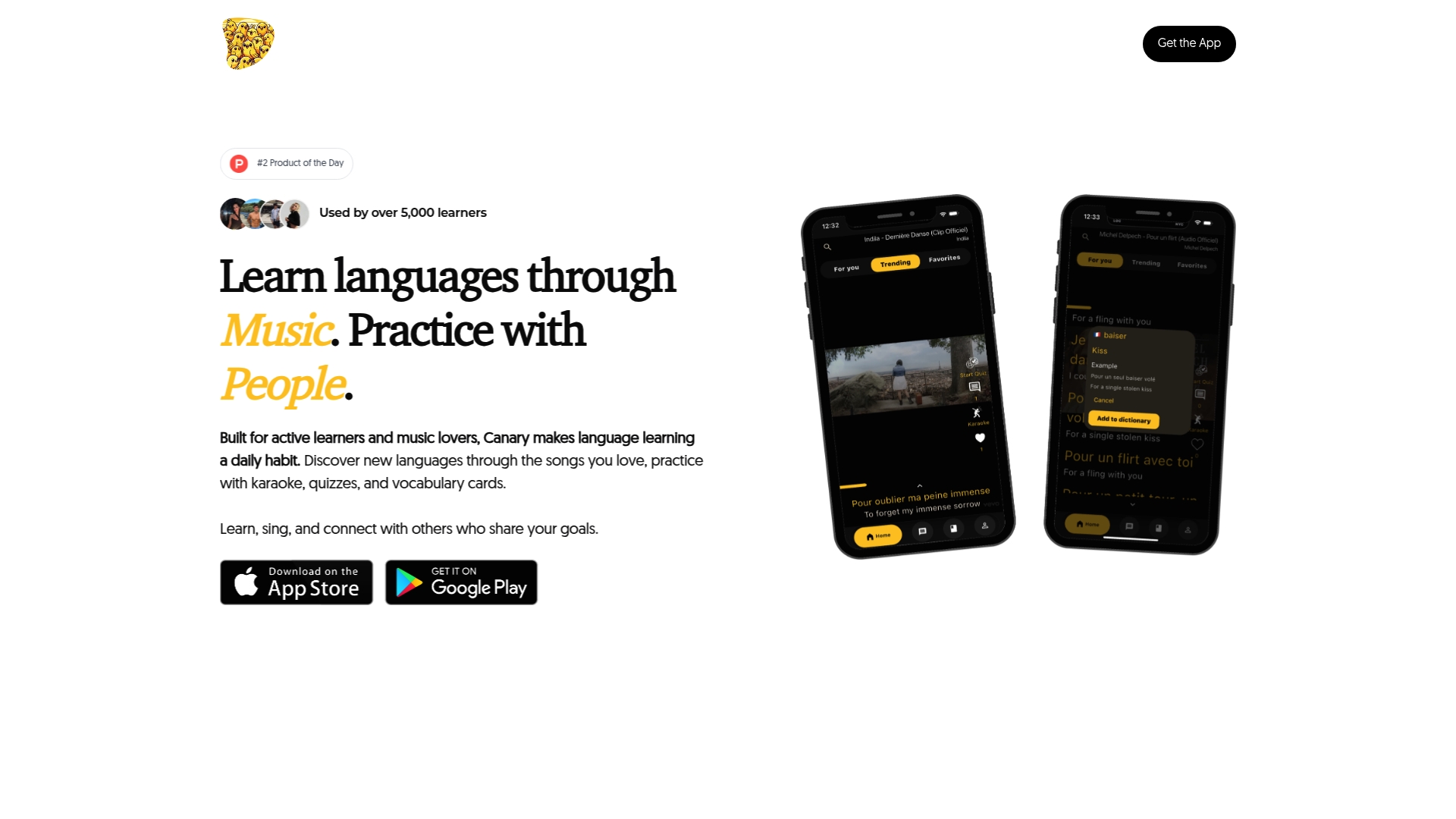
The platform combines karaoke, lyric quizzes, and vocabulary cards into a single learning environment designed for daily practice. Songs are curated for pronunciation clarity and vocabulary richness, so you skip the song-selection guesswork entirely. Pre-built quiz formats move you from gap-fill to recall to production, following the research-backed sequence that produces real vocabulary gains. Whether you are an educator building a music-based curriculum or a self-study learner who wants to learn languages with music, Singwithcanary gives you the structure and the songs to make it work. Start your free account and put your first lyric quiz to work today.
FAQ
What are lyric quizzes in language learning?
Lyric quizzes are structured vocabulary exercises where learners fill in missing words or recall lines from song lyrics. They combine active retrieval with meaningful context, making them more effective than passive listening for vocabulary acquisition.
Are lyric quizzes effective for building vocabulary?
Yes. A 2026 case study found that structured song-based tasks raised average vocabulary test scores from 44.84 to 65.15, a gain of roughly 20 points. The key is pairing audio exposure with retrieval tasks, not just listening.
What songs work best for lyric quizzes?
Songs with clear pronunciation, moderate tempo, and vocabulary aligned to learner level work best. Research on pop songs for vocabulary identifies fast tempo and unclear diction as the primary barriers to effective lyric-based learning.
How do lyric quizzes differ from sing-alongs?
Sing-alongs rely on the melody as a memory cue, which limits vocabulary transfer to other contexts. Lyric recall without audio removes that cue, training learners to access words independently of the tune.
Can self-study learners use lyric quizzes effectively?
Absolutely. Self-study learners can follow a gap-fill, recall, and production sequence using any song. Platforms like Singwithcanary automate this sequence, removing the need to design quizzes from scratch while keeping the music-based motivation intact.