TL;DR:
- Music with lyrics activates memory systems beyond traditional study methods.
- Repeated listening and active engagement with songs improve long-term vocabulary retention.
- Choosing accessible songs and integrating structured listening enhances language learning outcomes.
Flashcards, grammar drills, and repetitive word lists have dominated language learning for decades, but neuroscience and classroom research are quietly pointing to something far more enjoyable. Music, specifically song lyrics, activates memory systems that traditional study methods simply can’t reach. The combination of melody, rhythm, and emotional resonance creates a neurological shortcut for storing and recalling new words. This article walks you through the science, the research, and the practical steps that turn your music playlist into one of the most effective vocabulary tools available.
Table of Contents
- Why lyrics work: The science behind music-powered memory
- Proven results: Studies on lyrics and vocabulary retention
- How lyrics boost memory: From repetition to real context
- Practical strategies: Using lyrics to lock in vocabulary
- The overlooked truth: Making lyric learning work for you
- Ready to learn more? Harness music for your language journey
- Frequently asked questions
Key Takeaways
| Point | Details |
|---|---|
| Lyrics enhance memory | Song lyrics use rhythm, repetition, and emotion to anchor new words more deeply in long-term memory. |
| Active listening works best | Deliberately listening, repeating, and singing along produces significantly greater vocabulary gains than passive listening. |
| Pick simple, clear songs | Repetitive and slower songs are most helpful for beginners, while complex lyrics may overwhelm. |
| Consistency is key | Frequent and spaced exposure to the same lyrics leads to stronger retention compared to cramming. |
| Combine methods for results | Lyrics are a powerful tool but should be used together with other language learning approaches for best results. |
Why lyrics work: The science behind music-powered memory
Most people think of music as entertainment. But the moment lyrics enter the equation, something genuinely interesting happens in the brain. Repetition, rhythm, melody, and emotional connection all work together to reinforce new vocabulary in ways that standard study sessions rarely achieve.
When you hear a word embedded in a song, it doesn’t arrive alone. It comes packaged with a melody, a rhyme, a beat, and usually a story or feeling. That packaging gives your brain multiple hooks to hang the word on. Music’s educational benefits go far beyond making study sessions feel lighter. They tap into deep cognitive architecture that humans developed long before written language existed.
Research confirms that song lyrics aid vocabulary retention through repetition, rhythm, melody, context, and emotional engagement, directly enhancing cognitive processing and long-term memory for language learners. Three major theories explain this advantage:
- Dual Coding Theory: Words paired with musical cues are stored in two separate mental formats, verbal and non-verbal, doubling the chances of successful recall.
- The Affective Filter Hypothesis: A lower anxiety state, which music naturally produces, allows new language input to reach deeper memory systems.
- Shared Neural Resources: Language and music processing overlap significantly in the brain, meaning musical exposure actively strengthens language pathways.
Beyond theory, the practical mechanics matter too. Melody acts as a mnemonic cue, so when you later try to recall a word, humming even a fragment of the song can trigger it. Rhythm reinforces stress patterns, which is critical for pronunciation. And as research shows, melody provides a mnemonic cue for foreign words while the emotional response to music aids memory consolidation in ways that emotionally flat study material never can.
“Language acquisition that engages the emotional brain creates memories that last weeks, months, and sometimes years. Music is one of the most reliable triggers for that kind of deep encoding.”
Context is another major factor. When you learn the word “wander” from a flashcard, it exists in a vacuum. When you hear it in a lyric like “I found myself wandering through an empty town,” you understand it instantly through imagery and feeling. That context makes the word less abstract and dramatically easier to retain. The music boosts vocabulary argument isn’t just theoretical. It’s grounded in how real human memory works.
Proven results: Studies on lyrics and vocabulary retention
Understanding the science is one thing, but what do actual studies show when learners use lyrics versus traditional materials?
The evidence is compelling. Several well-designed studies have tested whether lyric-based learning actually produces better vocabulary outcomes, and the results consistently favor music over conventional methods.
| Study | Participants | Method | Result |
|---|---|---|---|
| Nie et al. (2022) | 114 Chinese college students | Listening to English songs vs. standard materials | Significant vocabulary gains retained after 4 weeks |
| Ludke et al. (2013) | Adult L2 learners | Singing vs. speaking Hungarian phrases | Singing group recalled twice as many phrases in key tests |
| Murphey (1992) | Various learner groups | Lyric-based incidental exposure | Strong incidental acquisition of contextual vocabulary |
The Nie et al. (2022) study found that students who listened to English songs showed significant vocabulary improvements, and those gains held up after four full weeks, especially among students who had multiple exposures to the same tracks. This isn’t a minor result. Vocabulary that sticks for a month is vocabulary that has genuinely moved into long-term memory.

The Ludke et al. (2013) findings are even more striking. Students who sang Hungarian phrases outperformed those who simply spoke them, in some tests performing twice as well. If you’ve ever wondered why you can still sing every word of a song you haven’t heard in ten years but can’t remember what you studied last Tuesday, that study explains it beautifully.
These findings have direct implications for how you approach your own learning. Songs you can expand vocabulary with aren’t a shortcut or a lazy alternative. They’re a scientifically supported method with real, measurable outcomes.
Pro Tip: Don’t just play a song once and move on. The Nie et al. data specifically highlights multiple exposures as the key driver of long-term retention. Create a weekly playlist of three to five songs and cycle through them daily. Think of each listen as a spaced repetition review session in disguise. This is exactly what makes song-based learning so powerful when used intentionally rather than casually.
How lyrics boost memory: From repetition to real context
You’ve seen the proof. Now let’s understand why lyrics work so well for memory, and when they might fall short.
One of the most underappreciated aspects of lyric learning is the sheer density of repetition. Songs repeat choruses. They repeat phrases. They repeat key emotional beats. That structure is almost perfectly aligned with what memory science calls “spaced repetition,” the idea that reviewing material at intervals significantly boosts retention. A chorus you hear four times in one song is a vocabulary exercise you’ve done four times without even noticing.
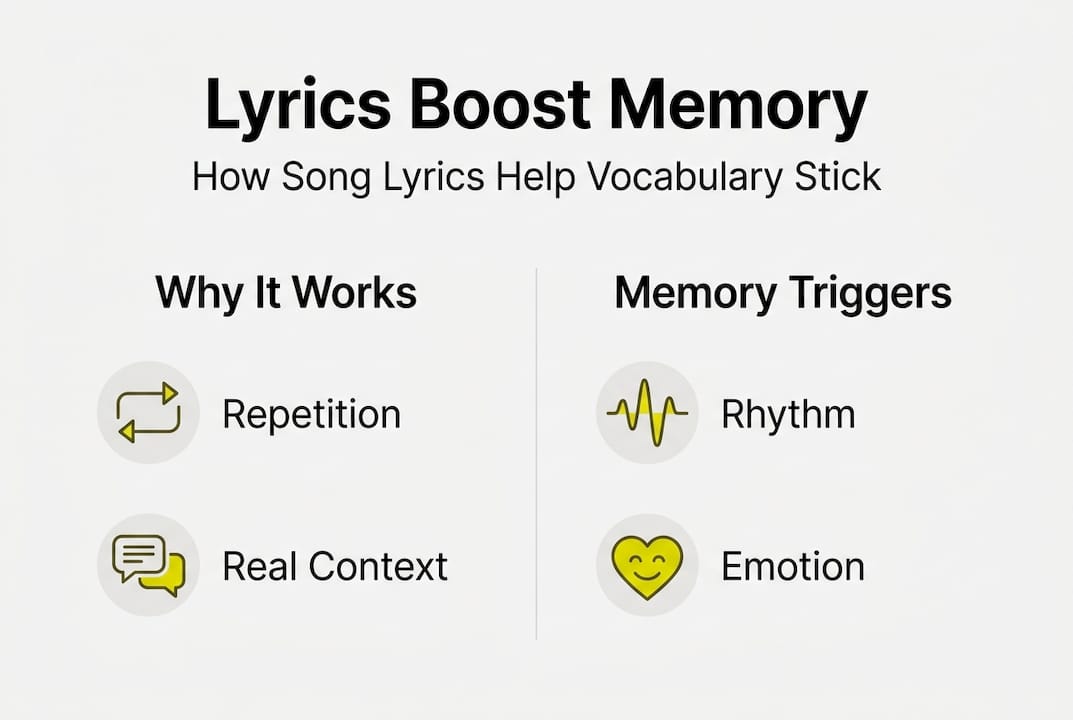
The repetitive nature of songs, combined with contextualized language in lyrics, supports incidental vocabulary acquisition. “Incidental” here means you absorb words without explicitly trying to memorize them. This aligns with Krashen’s Input Hypothesis, which argues that language is best acquired when it’s slightly beyond your current level but delivered in a context you can mostly understand. A well-chosen song hits that target naturally.
What else makes lyrics so sticky in memory?
- Narrative context: Songs tell stories. Your brain encodes story-based information more reliably than isolated facts, so words you meet in narrative lyrics stay sharper.
- Phonological rhythm: The beat of a song reinforces the sound pattern of words, helping you internalize how they’re pronounced and where stress falls, not just what they mean.
- Emotional tagging: Songs make you feel something. Words connected to emotions are consistently recalled better than emotionally neutral words in memory research.
- Chunking: Phrases in lyrics are delivered as natural language chunks, so you learn expressions and collocations (words that naturally appear together), not just individual vocabulary items.
Learning lyrics in context builds a richer mental vocabulary because words arrive with their surrounding ecosystem intact.
That said, lyric learning isn’t perfect for every situation. The Ludke et al. research also notes edge cases where the approach is less effective. If lyrics are too fast, too complex, or too abstract for your current level, the song stops being a helpful input and becomes noise. Very fast rap, dense literary poetry, or heavily accented content can overwhelm a beginner’s processing capacity and reduce retention rather than boosting it.
Pro Tip: If you’re early in your language journey, start with songs that are slow, melodically clear, and lyrically repetitive. Pop ballads, folk songs, and children’s music in your target language are surprisingly powerful learning tools. Build up gradually. As your ear and vocabulary strengthen, you can tackle faster and more complex material. Think of song-based language learning as a spectrum, not a single level.
Practical strategies: Using lyrics to lock in vocabulary
You know why lyrics work. Now here’s how to make the most out of them, step by step.
Having the right strategy transforms casual music listening into a serious vocabulary-building practice. The difference between a learner who “just listens to songs” and one who actually retains dozens of new words every month comes down to a few specific habits.
The listen-repeat-sing method is the most research-backed workflow for step-by-step lyric-based learning:
- First listen with full lyrics: Read the lyrics in your target language as you listen. Don’t try to understand everything. Just let the melody and words land together without forcing translation.
- Second listen with translations side by side: Mark any words you didn’t understand. Look them up and write a brief note about the context in which they appeared in the song.
- Third listen with active focus: Pay attention specifically to the words you marked. Notice how they’re pronounced within the musical phrase. Say them out loud between listens.
- Sing along: This is where retention accelerates. Singing facilitates pronunciation and vocabulary learning in ways that reading or passive listening alone cannot match, according to research by Zhang, Baills, and Prieto in 2023.
- Repeat across multiple days: Return to the same song for at least a week. Each pass reinforces what you learned and surfaces details you missed.
Tracking your progress is also essential. It’s easy to feel like you’re learning when you’re enjoying yourself, but that feeling doesn’t always reflect actual vocabulary gains. Use pre and post vocabulary tests, as supported by methodologies outlined in current research, to measure real improvement. Write down the words from a song before you study it, then test yourself a week later.
Matching song difficulty to your level is the third critical variable. Genre matters more than most learners realize. Reggae, classic pop, and acoustic folk tend to have clear enunciation and deliberate pacing. Hip-hop and electronic music can be incredible for advanced learners but are often too dense for beginners. Choosing the right track is as strategic as choosing the right textbook chapter.
Pro Tip: Record yourself singing the song and compare it to the original. This one habit gives you feedback on both vocabulary pronunciation and overall language fluency. You’ll notice patterns in the sounds you consistently miss, which makes targeted practice far more efficient. It also gives you a motivating before-and-after record of your progress. Using a platform that supports mastering language with lyrics can make this kind of structured practice much easier to sustain.
The overlooked truth: Making lyric learning work for you
Here’s something most content about music-based learning won’t tell you directly: casual listening doesn’t move the needle. Putting on a French playlist while cooking dinner is enjoyable. It might help your ear get used to the sounds of the language. But it won’t reliably expand your active vocabulary or sharpen your pronunciation. There’s a huge gap between passive exposure and the kind of active engagement that actually produces retention.
This distinction is the single biggest reason lyric learning fails for some people. They hear that music helps language acquisition, they start playing songs in the background, and then they wonder why nothing seems to stick after three months. The answer isn’t that the method is wrong. It’s that passive exposure is not the same as active processing.
Song choice is also dramatically underestimated. Most learners pick songs they love in the target language, which is a great starting point for motivation. But if those songs are too fast, too slang-heavy, or too far beyond your current comprehension level, they’re not giving your brain the right input. You need songs that feel slightly challenging but mostly accessible. That’s the sweet spot where real acquisition happens.
You can take a deep dive on song choices to build a curated learning playlist rather than relying on whatever your streaming algorithm serves up. The difference in outcomes is real.
Consistency and review are the true drivers of retention, not novelty. A learner who works deeply with five songs over a month will outperform someone who passively samples fifty songs in the same period. Your brain doesn’t reward variety for its own sake. It rewards repeated, meaningful contact with material. The most common mistake is chasing the new and exciting rather than committing to the review cycles that actually cement vocabulary into long-term memory.
Ready to learn more? Harness music for your language journey
After reading this, you’re already thinking about music differently. The strategies in this article work because they align with how human memory actually functions, not just how we wish it did.
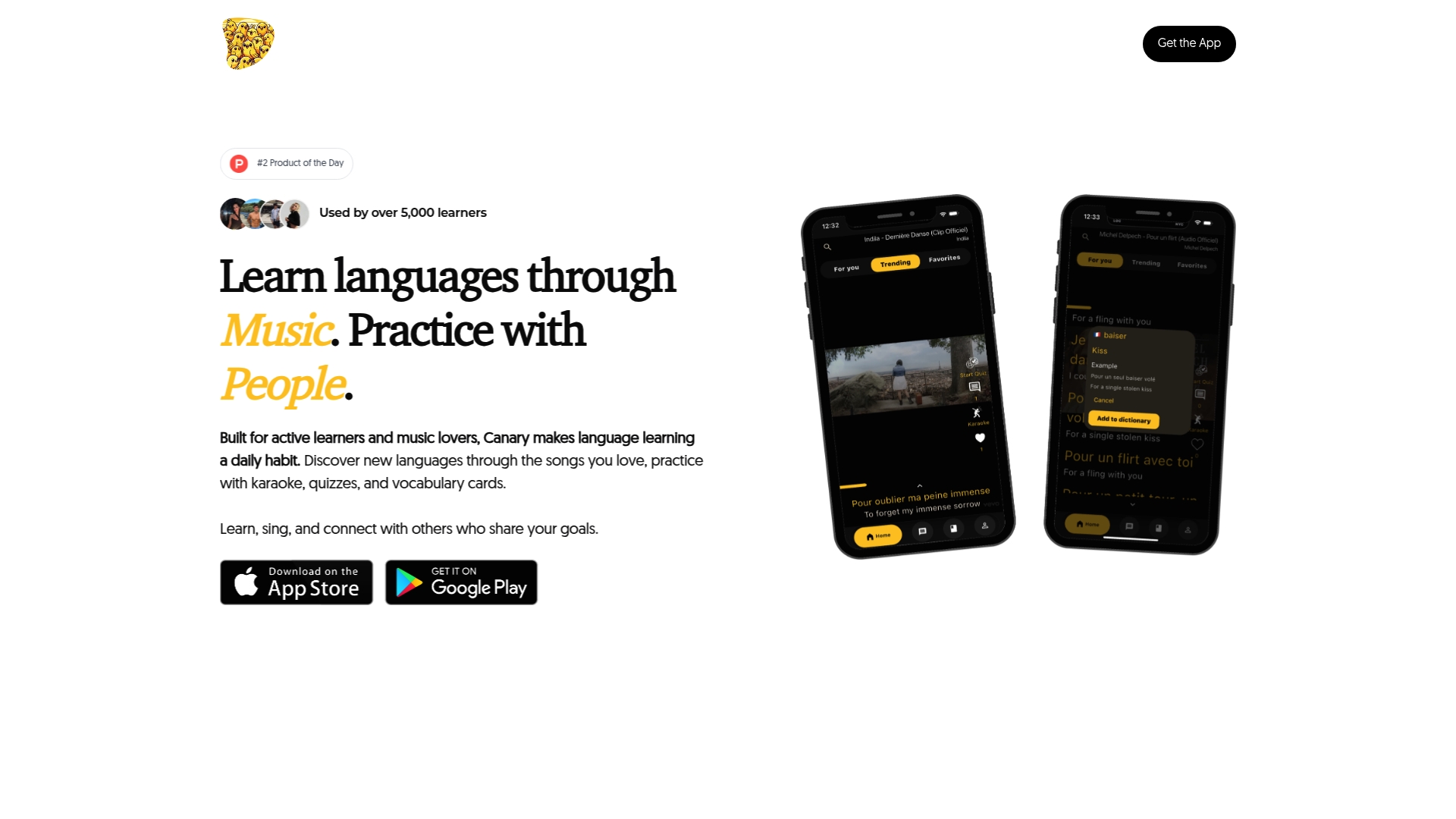
At Canary, we built an entire platform around exactly this approach. When you learn languages with music, you get structured karaoke sessions, vocabulary cards drawn directly from song lyrics, and pronunciation feedback built into the experience. Our weekly Song of the Week challenges give you a fresh track to work with every week, complete with community practice and guided activities designed to make every listen count. You’re not just playing music in the background. You’re learning with intention, surrounded by a global community of learners doing the same thing. Ready to make your playlist your most powerful study tool? Join now and put these strategies to work today.
Frequently asked questions
Does singing lyrics help with pronunciation or just vocabulary?
Singing has been shown to boost both vocabulary retention and pronunciation accuracy compared to speaking alone, with research confirming that singing facilitates pronunciation and L2 vocabulary learning more effectively than rhythmic speech.
Is there a best genre or type of song for vocabulary retention?
Songs with clear, slow, and repetitive lyrics are most effective for learners, while very fast or lyrically complex songs can be challenging. Research shows the approach works best with repetition-rich material where every word is audible.
How often should I listen to a song to remember new words?
Multiple exposures over several weeks deliver the best long-term results. The Nie et al. findings found vocabulary gains were retained after four weeks specifically among students who had repeated listens to the same songs.
Can listening to lyrics alone replace traditional vocabulary study?
Lyrics are a powerful supplement but work best alongside other methods like speaking, writing, and direct study. Songs supplement rote learning most effectively when combined with active engagement strategies rather than used as a standalone approach.