TL;DR:
- Interactive and music-based practice leads to faster fluency, better retention, and higher motivation.
- Singing and music anchor words in memory by engaging emotion, rhythm, and pronunciation.
- Adults benefit more from social, joyful, music-rich activities that promote real conversation and confidence.
Sitting alone with flashcards and grammar drills might feel productive, but it rarely gets you speaking with confidence. A 15-week song intervention with 28 adult EFL learners showed significant gains in speaking accuracy, fluency, and word output — proof that music and interaction do what memorization simply cannot. Interactive language practice flips the script entirely. Instead of studying a language in isolation, you use it, sing it, and share it with others. This article walks you through what interactive practice really means, why music makes it so powerful, and which hands-on methods get adults speaking faster and with more joy.
Table of Contents
- What is interactive language practice?
- Why music and singing supercharge your practice
- Active methods: Turning practice into real conversations
- Evidence table: How interactive practice compares to traditional learning
- What most people miss about interactive practice for adults
- Ready to upgrade your language learning journey?
- Frequently asked questions
Key Takeaways
| Point | Details |
|---|---|
| Active engagement matters | Participating in song-based, interactive activities builds lasting fluency, not just knowledge. |
| Science supports singing | Research shows music and singing improve vocabulary retention, pronunciation, and motivation for adult learners. |
| Mix methods for best results | A blend of interactive and traditional practice maximizes language growth and enjoyment. |
| Community powers progress | Learning with others through music fosters accountability and keeps you inspired to practice. |
What is interactive language practice?
Most people picture language learning as a solo activity: textbooks, vocabulary lists, and grammar exercises done quietly at a desk. That image is outdated. Interactive language practice refers to active, collaborative methods that emphasize communication, participation, and real-life application over passive memorization, including role-playing, discussions, gamification, and task-based learning to enhance fluency, motivation, and comprehension.
The key difference is that you are always producing language, not just absorbing it. You respond, adapt, and communicate in real time. That process builds neural pathways that passive study simply does not reach.
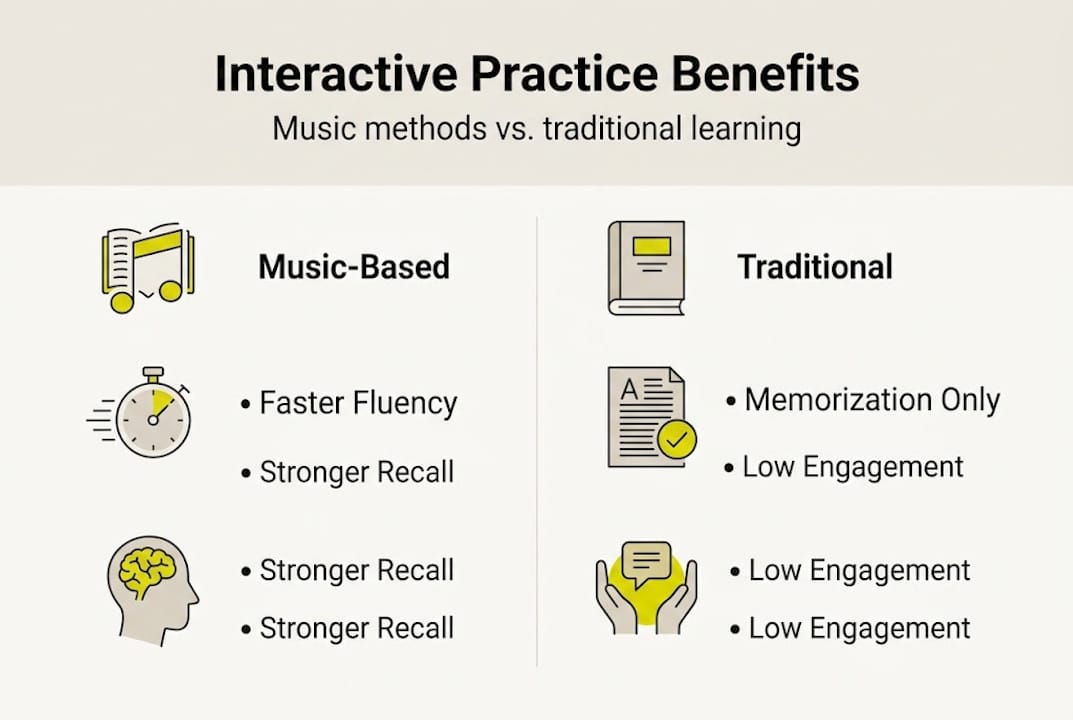
Think of it this way: reading a recipe is very different from actually cooking the meal. You can memorize every step, but until you chop, stir, and taste, you have not really learned to cook. Language works the same way. You need to use it in context, with feedback, and ideally with other people.
Here is a quick look at how interactive methods compare to traditional approaches when applied to interactive language learning:
| Feature | Interactive methods | Traditional methods |
|---|---|---|
| Learning style | Active, collaborative | Passive, individual |
| Primary focus | Communication and use | Grammar and memorization |
| Feedback source | Peers, native speakers | Teacher or textbook |
| Motivation level | High, social-driven | Often lower over time |
| Real-world transfer | Strong | Moderate |
The core benefits of interactive practice include:
- Faster fluency gains because you practice speaking from day one
- Higher motivation since social interaction keeps things engaging
- Better retention through emotional and contextual memory triggers
- Deeper comprehension because you process meaning in real situations
- Stronger pronunciation shaped by live feedback and listening
Interactive practice is not about abandoning structure. It is about making structure serve real communication instead of the other way around.
Why music and singing supercharge your practice
With interactive principles defined, let’s uncover why music makes such a powerful impact on language learning for adults.
Songs are not just entertaining. They are one of the most efficient delivery systems for language that humans have ever created. Melody, rhythm, and repetition work together to anchor words in long-term memory far more effectively than reading a word list ever could. When you sing a phrase, you encode it emotionally, rhythmically, and linguistically all at once.
Research backs this up strongly. A 15-week song intervention with adult EFL learners showed significant improvements in speaking performance, accuracy, and fluency, including longer spoken runs and higher word counts. These are not minor gains. They reflect genuine communicative ability.
“Music activates multiple brain regions simultaneously, including those responsible for language, emotion, and memory, making it one of the most neurologically rich tools for learning.”
Beyond memory, songs teach you how a language sounds. Intonation, stress patterns, and natural rhythm are baked into every lyric. When you sing along, you are training your mouth and ear at the same time. That is something grammar drills cannot replicate. AI-generated songs have also shown improved vocabulary retention, with music aiding memory and prosody in ways supported by research from institutions including Stanford, MIT, and Cambridge.

The song-based language learning benefits extend to cultural fluency too. Songs carry idioms, slang, and emotional tone that textbooks rarely capture. Learning a language through its music means learning how its speakers actually think and feel.
For vocabulary specifically, the gains are striking. Learners using music-based methods can achieve 40% faster vocabulary growth compared to traditional study alone.
Pro Tip: Pick songs that match your current level but stretch you slightly. A track with one or two unfamiliar words per verse is ideal. Too easy and you coast; too hard and you lose the thread. Slow ballads with clear pronunciation are great for beginners, while faster rap or spoken-word tracks challenge intermediate learners.
Active methods: Turning practice into real conversations
Now that we appreciate the power of music in learning, let’s get hands-on with techniques you can try right away.
Knowing that interactive methods work is one thing. Knowing exactly what to do on a Tuesday evening when you have 30 minutes is another. Here is a practical sequence that combines music, interaction, and real conversation for adult learners.
- Lyric gap-fills — Listen to a song and fill in missing words from the lyrics. This trains focused listening and vocabulary recognition without feeling like a test.
- Sing-alongs with self-recording — Record yourself singing a verse, then compare your pronunciation to the original. The gap between what you think you sound like and what you actually sound like is where real growth happens.
- Song translation chats — Translate a verse with a language partner, then discuss the choices you each made. This sparks genuine conversation about meaning, culture, and nuance.
- Role-play inspired by lyrics — Take a scenario from a song (a breakup, a journey, a celebration) and role-play it with a partner in the target language. Music gives you emotional context that makes the role-play feel real.
- Digital duets — Sing a song with an online partner or in a community group. The social pressure (in a good way) sharpens your performance and builds confidence fast.
Interactive music methods show consistent benefits for adult motivation and fluency, though the research also notes that retrieval practice and spaced repetition matter. Pairing songs with regular review sessions closes that gap.
Adding language practice gamification to your routine, like earning points for completing lyric challenges or competing in vocabulary quizzes, keeps motivation high between sessions. Explore music-based language tips to build a routine that sticks.
Pro Tip: Sequence your week intentionally. Start Monday with a new song and gap-fill. Wednesday, do a sing-along and record yourself. Friday, chat with a native speaker using the song as a conversation starter. That three-day rhythm builds habit without burnout.
Evidence table: How interactive practice compares to traditional learning
But does all the research live up to the hype? Let’s see how interactive and traditional methods actually compare across the outcomes that matter most to adult learners.
| Outcome | Interactive and music-based | Traditional methods |
|---|---|---|
| Fluency | Strong gains, especially with song-based tasks | Slower development without real conversation |
| Motivation | High, sustained through social and musical engagement | Often declines with repetitive drills |
| Vocabulary retention | Significantly improved with rhythm and melody | Moderate; depends on frequency of review |
| Pronunciation accuracy | Enhanced through singing and auditory feedback | Limited without native speaker input |
| Cultural understanding | Deep, embedded in song meaning and context | Surface-level, often textbook-driven |
A 15-week song study with adult EFL learners confirmed significant fluency and accuracy gains. AI-generated music tools also show measurable vocabulary retention improvements, adding a modern layer to the evidence. Still, some studies note that interactive methods only outperform traditional ones when paired with retrieval practice and consistent spacing.
Traditional methods still have value in specific situations. Grammar rules, verb conjugations, and formal writing conventions are often learned more efficiently through structured study. The real win comes from blending both.
Here is how to build a balanced program that uses the educational benefits of music alongside solid structure:
- Use grammar study to understand rules, then practice them through songs and conversation
- Apply spaced repetition to vocabulary you first encounter in song lyrics
- Alternate between structured lessons and free, music-driven interaction each week
- Track your progress with recordings so you can hear real improvement over time
- Join a community group for accountability and regular native speaker contact
What most people miss about interactive practice for adults
Here is something the research rarely says out loud: adults do not just benefit from interactive, music-based practice. They often need it more than children do.
Children acquire language through constant, joyful, low-stakes exposure. Adults lose that environment the moment formal study begins. The pressure to be correct, the fear of sounding silly, and the habit of translating in your head all work against natural acquisition. Music and social interaction break those patterns because they shift the focus from being right to being present.
The biggest mistakes we see adults make are skipping feedback (singing alone forever without checking your pronunciation), over-relying on solo apps, and ignoring the motivational fuel that comes from community. A community-driven learning environment gives you accountability, encouragement, and the kind of real interaction that no app can fully replicate on its own.
Joy is not a bonus feature of language learning. It is a core mechanism. When you enjoy what you are doing, you practice more, you retain more, and you take more risks with the language. Music delivers that joy reliably, session after session.
Ready to upgrade your language learning journey?
If you are ready to put these insights into action, here is how to take the next step.
Canary is built for exactly this kind of learning. It combines music-based language learning with social interaction, karaoke, vocabulary cards, and quizzes so every session feels like practice and play. You are not just studying a language. You are living it through song, with real people from around the world.
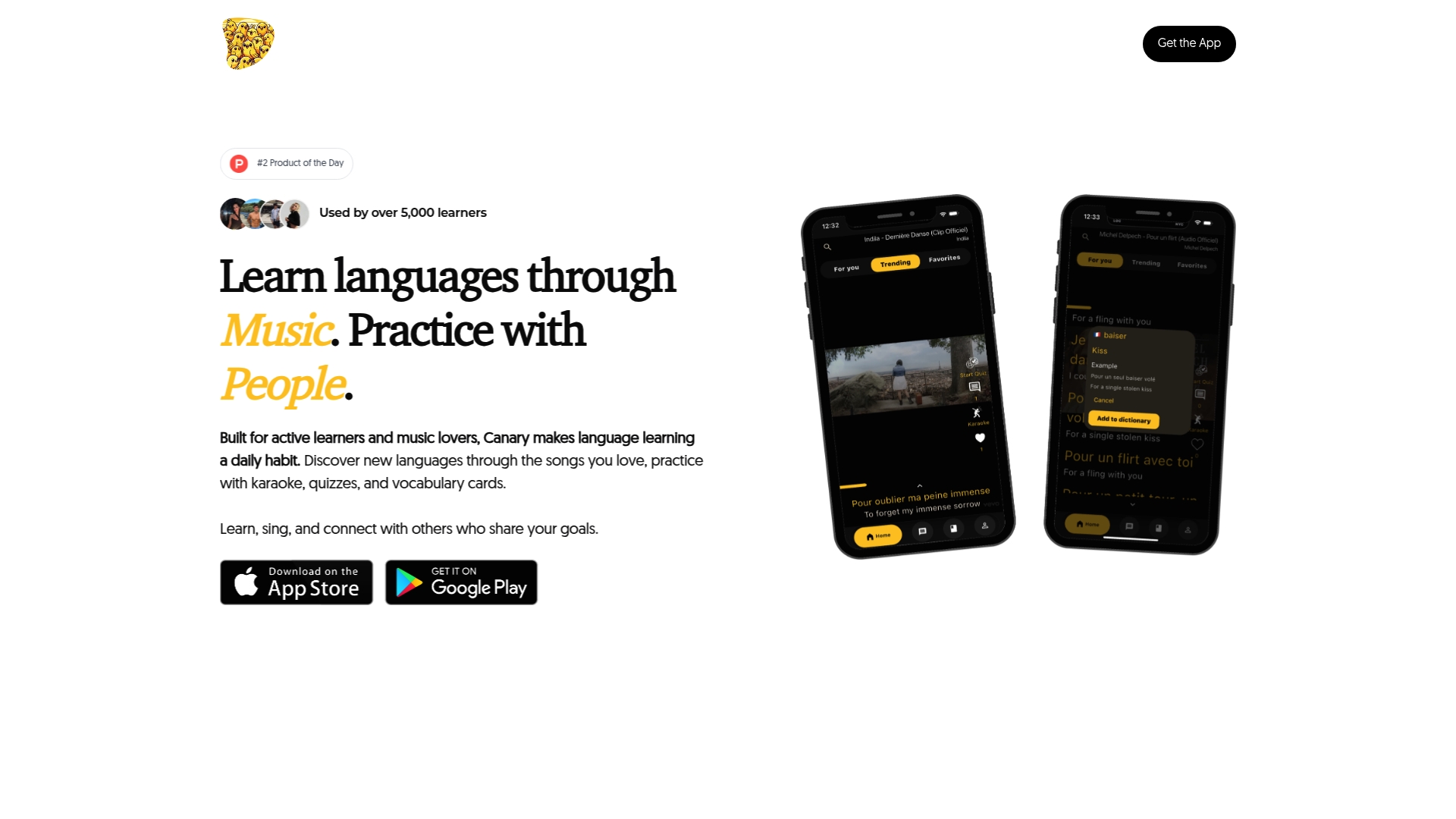
Whether you want to sharpen your pronunciation, grow your vocabulary faster, or finally feel confident speaking, the benefits of song-based practice are waiting for you. Thousands of learners are already using Canary to make daily practice something they actually look forward to. Start practicing today and find out what learning through music really feels like.
Frequently asked questions
What are examples of interactive language practice activities with music?
Interactive activities include singing along with lyrics, role-play conversations set to songs, lyric gap-fills, digital duets, and exchanging song translations with native speakers. Song-based activities like these combine communication and play for stronger results.
Is interactive language practice with songs more effective than traditional memorization?
For adult learners, music-based interactive practice leads to greater fluency, vocabulary retention, and motivation compared to rote memorization. A 15-week song study with adults confirmed significant speaking gains across multiple measures.
Can I use these methods if I’m not musically talented?
Absolutely. The benefits come from participation and engagement, not singing ability. Even speaking lyrics aloud or clapping to a rhythm activates the memory and pronunciation benefits that music provides.
How often should I practice with interactive, musical activities?
Aim for at least three sessions a week, combining song-based tasks with native speaker interaction. Consistent, spaced practice leads to stronger language retention than longer but infrequent study sessions.