TL;DR:
- Song-based learning utilizes rhythm and melody to enhance memory and reduce anxiety.
- Combining focused listening, active singing, and explicit instruction yields the best language outcomes.
- AI tools enable personalized songs, improving engagement and addressing specific vocabulary or grammar goals.
Finding a language learning method that actually sticks is harder than it sounds. Most apps rely on repetition drills that quickly feel like homework. Songs offer something different. They use rhythm, melody, and repetition to encode language in memory more naturally, while also lowering anxiety and keeping motivation high. Research backs this up, and the practical methods are more varied than most people realize. Whether you prefer listening, singing, moving, or creating, there is a song-based approach built for your learning style. This guide walks you through seven methods, how to choose among them, and what really makes the difference.
Table of Contents
- Criteria for selecting a song-based learning method
- Lyrics reading and focused listening
- Performing, singing, and rhythm practice
- Integrating movement, drama, and interactive activities
- AI-generated custom songs and edge cases
- What most song-based learning guides miss
- Explore music-powered language learning with Canary
- Frequently asked questions
Key Takeaways
| Point | Details |
|---|---|
| Active singing boosts retention | Singing and performance increase vocabulary recall and pronunciation accuracy more than passive methods. |
| Combine methods for impact | Mix lyric reading, focused listening, movement, and drama for the best results in language learning. |
| Tailor activities to age | Preschoolers may benefit more from speech, while older learners thrive on song-based and interactive tasks. |
| AI opens new possibilities | AI-generated songs offer customizable vocabulary and grammar practice for any language. |
| Culture comes alive through music | Authentic lyrics and song-based activities immerse learners in real-life social and cultural contexts. |
Criteria for selecting a song-based learning method
Not every song-based approach works the same way for every learner. Before jumping in, it helps to think through a few key factors that shape which method will serve you best.
Learning goals matter first. Are you trying to expand vocabulary, sharpen pronunciation, or understand cultural context? Each goal points toward a different technique. Vocabulary-focused learners benefit most from reading lyrics and doing gap-fill exercises. Pronunciation-focused learners gain more from singing and rhythm training. Cultural learners thrive on authentic song exposure with discussion activities.
Engagement style is equally important. Some learners love passive listening, while others need to sing out loud or move their bodies to absorb new language. Knowing your preferred mode helps you build a routine that you will actually maintain.
Structure determines results. Combining listening, singing, and interactive tasks with organized pre-listening, during-listening, and post-listening phases produces the strongest vocabulary, pronunciation, and cultural gains. Without structure, even great songs become background noise.
Here are the key factors to evaluate before choosing your method:
- Learning goal: vocabulary, pronunciation, fluency, or cultural understanding
- Preferred engagement: passive listening, active singing, or multisensory participation
- Learner type: adult self-study, classroom student, or young learner
- Available tools: apps, lyrics websites, karaoke platforms, or AI tools
- Time commitment: quick daily sessions vs. deeper weekly practice
Pro Tip: Pair any song-based activity with explicit instruction, meaning deliberate focus on grammar or vocabulary rules. This combination, covered in these music-based vocabulary tips, consistently outperforms passive listening alone.
Lyrics reading and focused listening
The most accessible starting point for most learners is reading lyrics while listening to a song. This pairing strengthens vocabulary and phonics at the same time. When you see a word written and hear it pronounced simultaneously, the connection between spelling and sound gets reinforced fast.
Focused listening takes this further through structured activities. The three most effective formats are:
- Gap-fill exercises: Listen and fill in missing words from a printed or digital lyric sheet. This trains your ear to catch specific sounds and vocabulary.
- Dictation: Write down what you hear without seeing the lyrics first. Then compare your version to the original. The gap between what you heard and what was actually said reveals your weak spots.
- Draw-the-scene: Visualize or sketch what the song describes while listening. This activates imagery-based memory, which strengthens comprehension.
These song learning advantages are well documented, and a music-driven EFL study confirmed that structured lyric activities significantly outperform unstructured listening for vocabulary growth. The reason is simple: active processing beats passive exposure every time.
One striking finding from research on music boosting vocabulary shows that learners demonstrate better recall in song format compared to standard speech delivery. As the research puts it:
“Up to 40% better recall when singing vs speaking.”
That kind of advantage is hard to ignore when you are deciding how to spend your study time.
Performing, singing, and rhythm practice
Beyond listening, performing and singing unlock new levels of engagement and linguistic accuracy. When you sing in a foreign language, your mouth, breath, and timing all work together in ways that simply reading or speaking never require. That physical engagement leaves a deeper imprint.
Here are the core performing and rhythm methods ranked by impact:
- Singing along: Match the original recording word for word. Focus on sounds you struggle with and slow the track down if needed.
- Chant practice: Use song excerpts as spoken chants, emphasizing stress and intonation patterns. This is especially useful for tonal languages and languages with complex rhythm.
- Prosody drilling: Repeat phrases from songs with deliberate attention to word stress, sentence rhythm, and pitch. Prosody refers to the musical quality of speech.
- Call and response: Sing one line, pause, and repeat it from memory. This combines performance with active recall.
Empirical evidence supports this approach. A singing group outperformed a speaking-only group across pronunciation, fluency, and motivation metrics. Music’s role in learning goes beyond enjoyment since the rhythm and melody physically shape how your brain encodes speech patterns.

Studies also show a 14% gain in listening comprehension among learners who practiced singing regularly compared to those who only listened.
Pro Tip: Use a karaoke app to practice pronunciation in real time. Seeing lyrics scroll while you sing keeps you accountable and makes it easy to spot where your timing breaks down. Building music learning habits around daily karaoke sessions pays off faster than most learners expect.
Integrating movement, drama, and interactive activities
Some learners thrive with multisensory experiences. Movement and drama-powered activities elevate the impact of songs far beyond what sitting and listening can achieve.
Songs leverage multimodal engagement across auditory, visual, and kinesthetic channels. Adding physical movement or dramatic performance activates all three at once, which is powerful for retention.
| Method | Core benefit | Best for |
|---|---|---|
| Traditional listening | Audio processing, vocabulary input | Beginners, passive learners |
| Movement with songs | Kinesthetic memory, energy, engagement | Young learners, active adults |
| Drama and skits | Authentic speech, slang, social context | Intermediate to advanced learners |
| Group dance activities | Cultural immersion, peer collaboration | Community-based learners |
Key interactive song-based activities worth building into your practice:
- Action songs: Perform physical gestures that match the lyrics. This is used widely in early language education because it anchors meaning to movement.
- Role play skits: Rewrite a song’s story as a short drama and perform it. This forces active use of vocabulary in context.
- Group choreography: Create simple movements as a team to a target language song. It builds community and language learning and culture awareness simultaneously.
- Song-based debates: Discuss what a song means, argue interpretations, and explore slang. This pushes critical thinking in the target language.
Exploring weekly language songs with these activities gives you fresh material to work with regularly without burning through your motivation.
AI-generated custom songs and edge cases
As technology advances, new song-based opportunities arise, and so do important nuances to consider.
AI tools can now generate custom songs built around specific vocabulary lists, grammar targets, or cultural topics. This means you can create a song featuring exactly the 20 words you are trying to memorize this week, set to a melody that matches your taste. The personalization potential is significant.
| Learner type | Song-based effectiveness | Notes |
|---|---|---|
| Adult learners | High | Best results with structured activities |
| Teen learners | High | Motivation boost from authentic pop songs |
| School-age children | Moderate to high | Rhythm and chant methods work well |
| Preschoolers | Mixed | Speech may outperform song for word mapping |
Practical uses for AI-generated songs in language learning:
- Build vocabulary songs around your personal word list
- Create grammar-focused songs that drill specific verb tenses
- Generate culturally themed songs to explore cultural understanding through songs
- Produce songs in a preferred music genre to boost engagement
One important edge case: preschoolers may actually learn words more effectively through direct speech rather than song, because melody can compete with the semantic processing needed for early word mapping. The educational benefits of music are real, but age and developmental stage shape which format works best. For older learners, structured song activities with AI customization represent one of the most promising directions in language learning today.
What most song-based learning guides miss
After mapping out all the options, it is worth stepping back to look at what really drives results versus what just sounds appealing on paper.
Most guides present song-based learning as a single method, when the real power comes from blending approaches. Listening alone is passive. Singing without vocabulary focus is entertaining but shallow. The combination of focused listening, active performance, and explicit vocabulary instruction is what produces lasting change. Research on language learning habits built through music consistently shows that variety within a structured routine beats any single technique.
Another overlooked factor is motivation calibration. Younger learners and adult beginners respond to different song styles, different energy levels, and different types of participation. A method that electrifies a 25-year-old pop fan may bore a 40-year-old classical music lover. Most guides ignore this and offer one-size-fits-all advice.
It is also worth noting that most studies show facilitative effects, but some research finds null or conflicting results, particularly for word-level learning in isolation. The honest takeaway is this:
“Long-term retention is achieved when learners actively engage, not just passively listen.”
If you treat songs as entertainment rather than structured practice, you will get entertained. If you treat them as a learning system, you will actually improve.
Explore music-powered language learning with Canary
Ready to try song-based methods firsthand? Canary brings all of these approaches together in one platform designed for people who want to learn a language and actually enjoy the process.
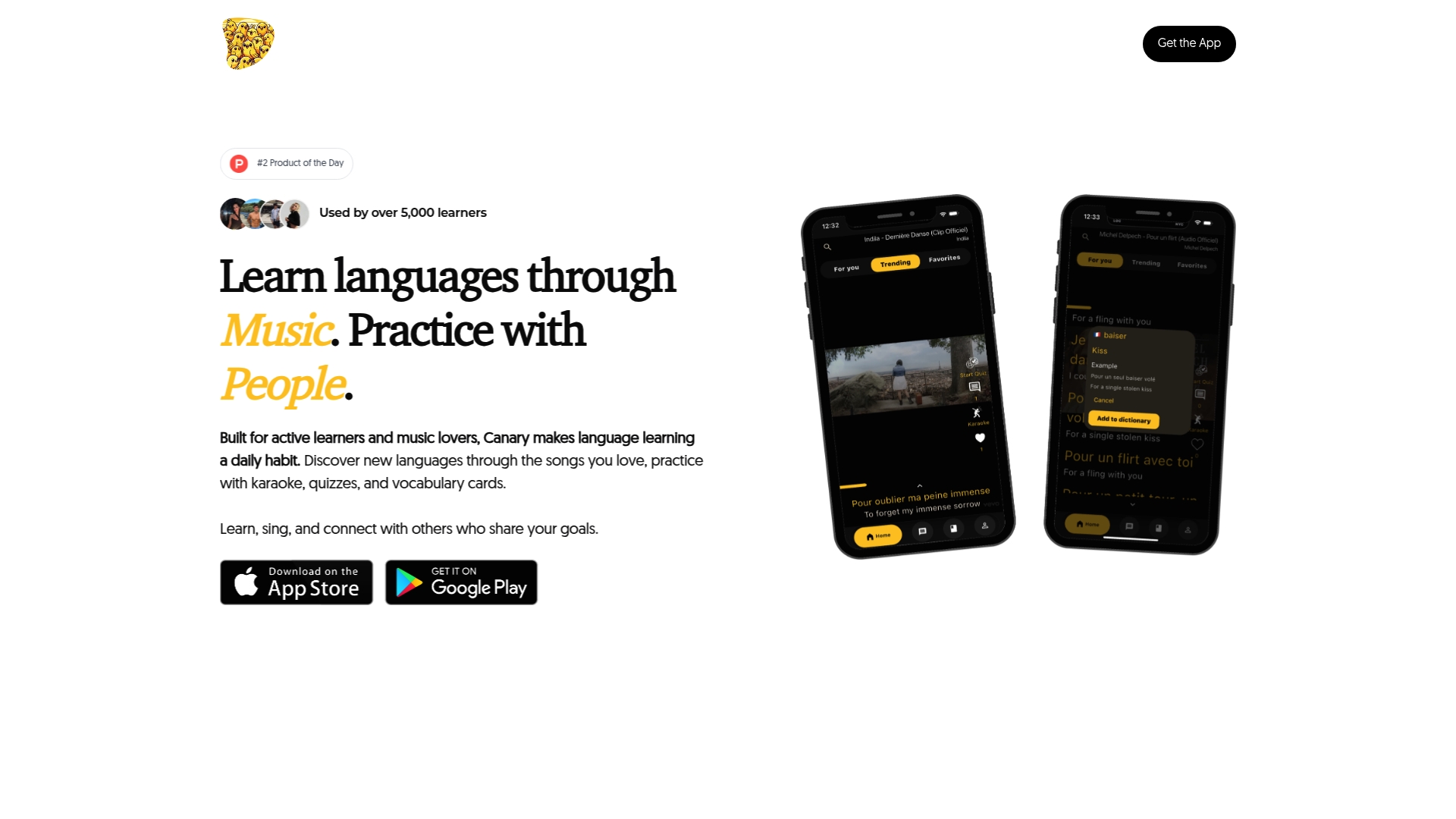
Whether you want to explore Spanish music learning tools, dive into interactive language learning with a global community, or sharpen your fluency through karaoke-style practice, Canary gives you the tools to make it happen. The platform combines vocabulary cards, quizzes, karaoke, and social features so you can practice with real people from around the world while the music keeps you coming back every day.
Frequently asked questions
Which song-based learning method is best for vocabulary?
Lyrics reading with gap-fill exercises yields the strongest vocabulary gains, especially when combined with explicit instruction that draws attention to meaning and usage.
Can song-based learning improve pronunciation?
Yes. Singing and rhythm practice show significant fluency and accuracy improvements, because they force your mouth and breath to follow the precise timing of native speech patterns.
Is song-based learning suitable for all ages?
It works well for most ages, but preschoolers may map words more efficiently through direct speech rather than song, since melody can interfere with early semantic processing.
How can I use AI-generated songs for language learning?
AI tools let you build custom vocabulary songs around your personal word list or grammar targets, making repetition feel fresh and personally relevant rather than generic.
Does music-based learning help with cultural understanding?
Absolutely. Authentic lyrics and slang immerse you in the real social context of a language, exposing you to expressions and cultural references that textbooks rarely include.